 |
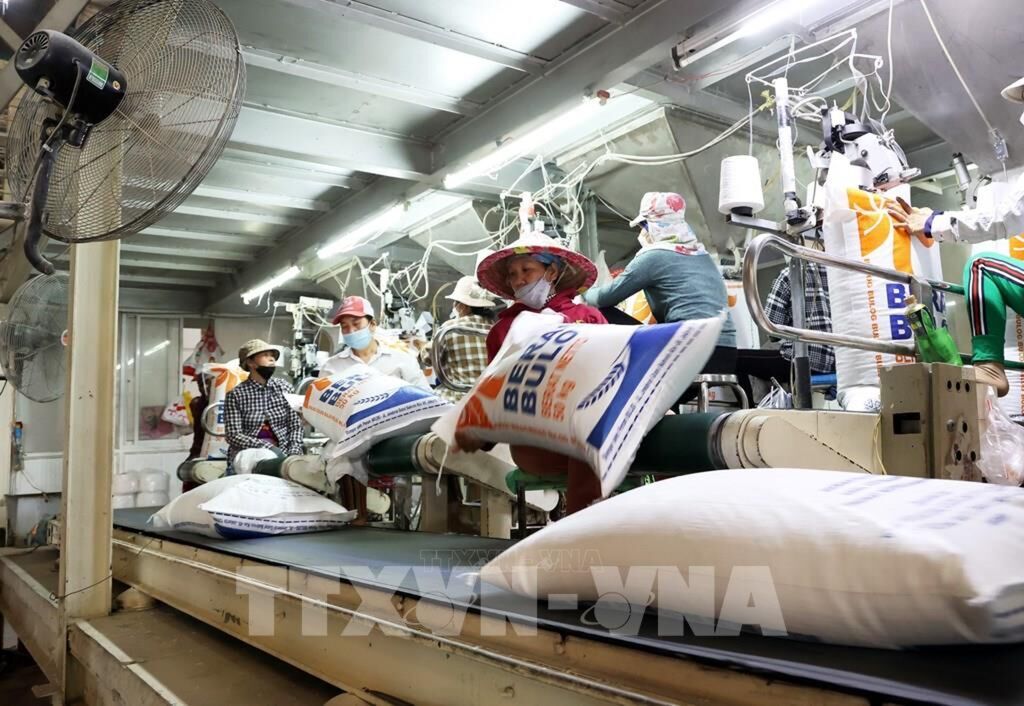
| An export rice packaging line in An Giang province __Photo: Hong Dat/VNA |
The Government has recently submitted the draft Law on Commodity Derivatives Trading to the 16th National Assembly for debate at its second session, seeking to strengthen the legal framework governing commodity derivatives trading, address shortcomings in existing legislation and facilitate the development of a modern, transparent and secure market.
Comprising 54 articles, the draft proposes a unified legal framework covering both exchange-traded and over-the-counter (OTC) markets, trading mechanisms, clearing and settlement infrastructure, and measures to safeguard market stability.
Strengthening market organisation and risk management
Under the draft, the exchange-traded market would operate through commodity exchanges, while the OTC market would operate through intermediaries. Particularly, commodity derivatives transactions concluded directly between parties without the involvement of an intermediary would be regulated by the civil law.
The draft also allows commodity exchanges to operate both centralised spot markets and derivatives markets, provided that clear distinctions are maintained between products, members, accounts, trading activities, settlement arrangements and risk management mechanisms.
To strengthen market infrastructure, the draft sets out provisions governing the organisation and operation of commodity exchanges and clearing houses.
Accordingly, clearing houses would independently operate the exchanges and be responsible for clearing and settlement, managing margin collateral, overseeing risk management and implementing measures to ensure the fulfilment of obligations arising from commodity derivatives transactions.
For OTC trading, the draft provides a framework under which parties may agree on the underlying commodities, types of contract, trading volumes, transaction prices, contract terms, payment methods, measures to secure obligation performance, the choice of governing law, dispute resolution mechanisms and close-out netting arrangements.
Intermediaries, including commodity exchanges, clearing houses, members of these institutions, credit institutions and other legally established organisations, would be responsible for organising and facilitating transactions and providing clearing and settlement services.
Alongside improving trading mechanisms, the draft introduces requirements for margin management, control of trading positions, counterparty and liquidity risk management, and protection of investor assets.
Notably, it proposes a market surveillance mechanism involving the collection and analysis of trading data, monitoring of risk indicators, detection of unusual trading activities and implementation of early warning measures.
In the event of serious market volatility, causing threats to market stability or risks to economic and financial security or public order and safety, or when detecting signs of serious violations of law, competent state management agencies, commodity exchanges and clearing houses would be authorised to take emergency intervention measures to safeguard the system.
These provisions are expected to help curb price manipulation, fraudulent trading, payment defaults and other risks that could threaten overall market stability.
Developing price-risk hedging instruments linked to Vietnamese commodities
Beyond strengthening market organisation, the draft law seeks to enhance the role of commodity derivatives trading in production, processing, distribution and export activities.
Accordingly, market development policies would prioritise derivatives based on commodities in which Vietnam has competitive strengths in production, gradually promote the development of domestic contracts and reference price indices, and reduce reliance on foreign reference prices and market infrastructure.
The draft defines the underlying commodity in a commodity derivatives transaction as a commodity or commodity price index used as a reference for determining the price, rights and obligations arising from the transaction.
The commodity derivatives contracts covered by the draft include forward contracts, futures contracts, options, swaps and other derivatives contracts.
Through these instruments, businesses can hedge against adverse commodity price movements. For example, agricultural product exporters can use appropriate derivatives contracts to mitigate the impact of falling selling prices, while processing companies can hedge against rising raw material costs.
The draft also sets out provisions governing the participation of state enterprises, credit institutions and foreign bank branches in commodity derivatives trading, within the limits permitted by law and subject to risk management and investor protection requirements.- (VLLF)