 |
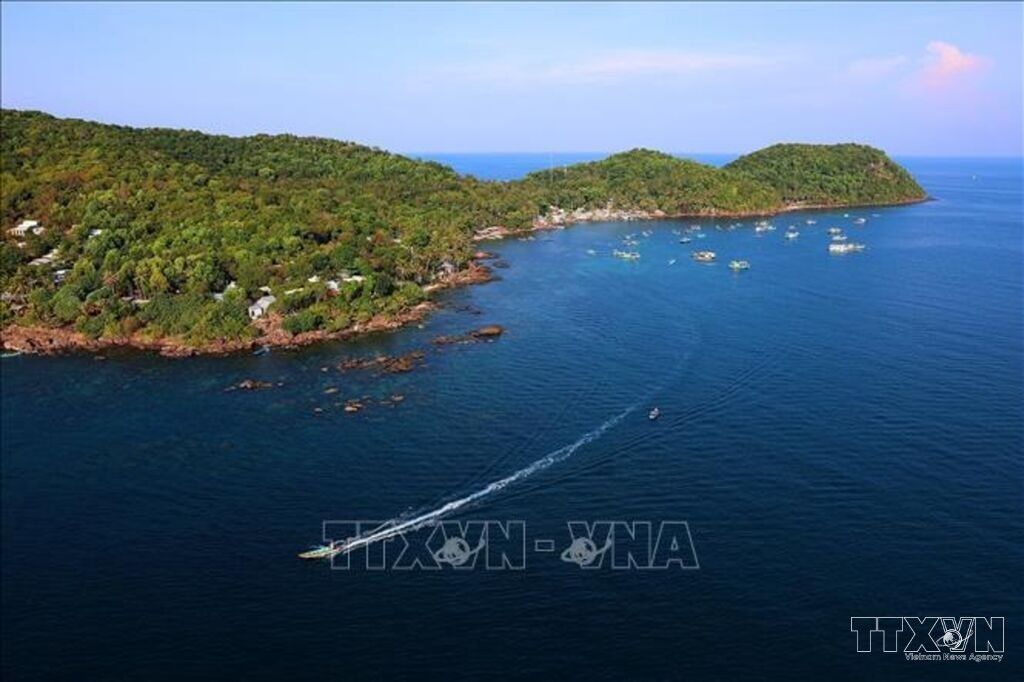
| The sea off the southern tip of Phu Quoc Island __Photo: VNA |
The draft revised Law on Marine and Island Resources and Environment (the draft) is being finalised for submission to the National Assembly, with the expectation of marking a major turning point in the management, exploitation and protection of the country’s marine space.
The practical management of seas and islands over the last decade has revealed severe challenges stemming from land-to-sea pollution, more and more marine litter and environmental incidents, the introduction of invasive species via ballast water, as well as the severe degradation of ecosystems and coastal risks, rendering the modernisation of management methods critically urgent.
To thoroughly address these issues, the draft dedicates a whole chapter consisting of 20 articles focused on the protection of the marine and island environment. This chapter lays emphasis on stricter control over polluting sources generated through maritime activities and in the mainland, the enhancement of marine waste management, risk zoning, emergency response capabilities, environmental improvement and restoration, the responsibility for compensation for oil spills damage, and the preservation of marine biodiversity.
One of the most significant gaps in the current legal framework is the absence of comprehensive and consistent institutions for the management and use of marine space at the statutory level.
Actual data indicates that by the end of 2025, the central authorities had allocated a total marine area of nearly 377,000 hectares, generating around VND 1.7 trillion from the marine area use levy, alongside thousands of marine areas allocated by local authorities for various purposes.
However, the drafting agency acknowledges that these outcomes remain modest compared to the immense potential and advantages of the national marine space. Consequently, the draft introduces a totally new chapter regulating marine space management and use, marking a strategic shift from fragmented, sector-based management towards integrated, unified marine space governance.
The draft establishes principles and criteria for distribution and coordination of marine space, while providing mechanisms for resolving overlapping interests or conflicts among sectors such as offshore wind power, maritime transportation, oil and gas exploration and exploitation, and aquaculture. A prominent highlight is the application of shared-use and multi-purpose utilisation approaches within appropriate spatial scopes, and based on different layers, tiers, timeframes and objectives in order to maximise resource utilisation efficiency.
Alongside space management, the draft also introduces a novel approach to marine area use rights in order to unblock investment sources, transparently and specifically regulating the allocation, lease, registration, auction, and issuance or revocation of marine area use rights certificates, accompanied by maritime administrative records, financial regimes, and economic transactions such as transfer, sublease, capital contribution and mortgage.
Notably, regarding the auction of marine area use rights, the draft moves beyond mere price competition by requiring auction participants to first meet rigorous criteria regarding capacity, experience, technology, finance, environmental protection standards, maritime safety, national defense and security. Preferential and support policies are also provided to promote the development of modern, green, smart and hi-tech marine economies, shared infrastructure, dual-use facilities, innovation, technology transfer, and blue marine finance.
Regarding support governance, the draft focuses on improving regulations on basic surveys, monitoring, supervision, information systems, and national databases, while strongly promoting scientific research, technological innovation, and digital transformation.
Statistics show that to date, comprehensive marine resource surveys have covered only about 38.7 per cent of marine areas at a scale of 1:500,000, failing to reach the targeted 50 per cent. Meanwhile, many deep-sea and offshore areas still lack basic data, increasing risks and costs for major project deployment.
The new legal framework aims to connect, share and reuse digital data, applying remote sensing and forecasting technologies to establish a solid foundation for management.
The environmental impact assessment mechanism is also expanded to cover activities by Vietnamese entities in areas beyond the national jurisdiction that pose risks of adverse impacts, helping Vietnam rigorously fulfill international obligations, including the Agreement on Marine Biological Diversity of Areas Beyond National Jurisdiction.
Finally, the draft elevates the role of coastal and island communities by safeguarding their rights to access the sea, access information, participate in, and monitor, resource management, while promoting the decentralisation and delegation of authority to the two-tier local government structure with clearer tasks and responsibilities.- (VLLF)