 |
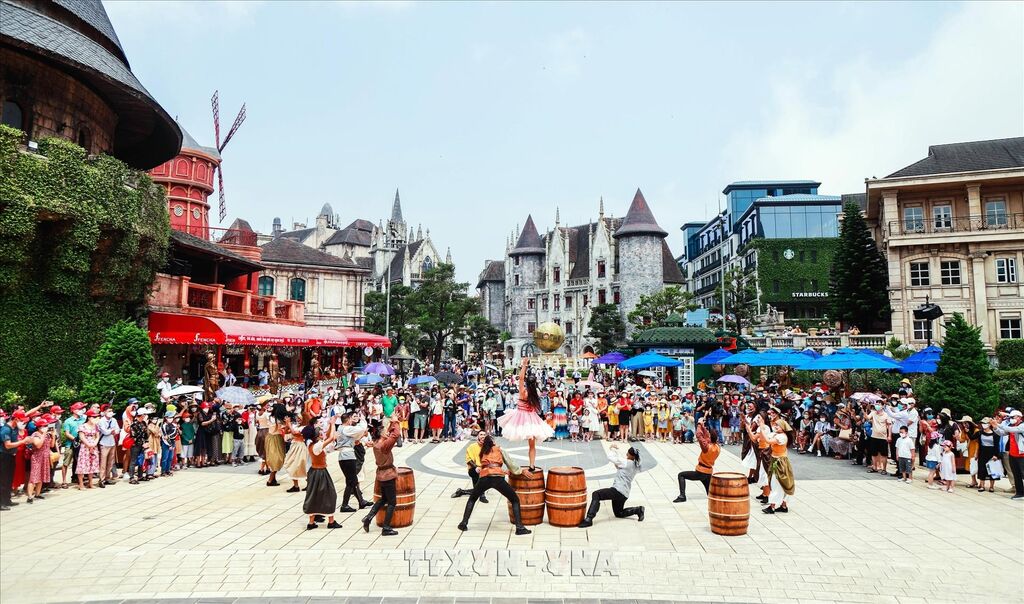
| Artistic performances at a tourist attraction in Da Nang city__Photo: VNA |
Vietnam’s tourism should focus on attracting investment in major tourism projects, developing hospitality human resources and brands, promoting innovated business models, and improving tourism service infrastructure.
Such special mechanisms are proposed by the Ministry of Culture, Sports and Tourism in the National Assembly’s draft resolution (the draft), aimed at transforming tourism into a spearhead sector in the coming period.
Incentives for major projects
Under the draft, qualifying landmark tourism projects would be entitled to a preferential corporate income tax (CIT) rate of 10 per cent for 10 years, along with a 50 per cent reduction in other taxes payable during the first five years of operation.
The preferential CIT rate would apply from the first year a project generates turnover, while the tax exemption and reduction period would begin in the first year of generation of taxable income. If a project generates turnover but no taxable income during its first three years, the incentive period would begin in the fourth year.
For existing projects, incentives would apply only to income generated from certified expansion activities. In case separate accounting of such income is not feasible, eligible income would be determined based on the ratio of the additional historical cost to the total historical cost of fixed assets.
Such proposed incentives would apply regardless of whether a project falls within a sector eligible for special investment incentives or meets the minimum capital requirement for such incentives.
The policy would also apply to project expansions approved before March 1, 2026, provided that expanded operations had not commenced before the resolution takes effect.
Enterprises would be allowed to choose which incentive scheme to apply to the same income, but may not renew incentive periods. They would also remain liable for any additional CIT amounts payable under the Global Anti-Base Erosion (GloBE) rules.
To qualify for these incentives, projects must be located in designated areas, have all the necessary legal documentation, and take the form of integrated tourism, cultural, sports, entertainment and shopping malls, night-time commercial complexes, or large-scale tourism infrastructure facilities.
Projects are required to create new products or upgrade existing ones to increase supply capacity by at least 20 per cent compared to the preceding year’s capacity. This indicator is measured by design specifications, operational capacity, service volume or product category, while routine maintenance and price hikes are excluded from the calculation.
Every new project must generate at least 300 regular, direct jobs, while an expansion project must create at least 100 additional jobs above the previous year’s average, fully satisfying this requirement by the end of their third year of operation at the latest.
Enterprises must also work out plans on human resource training, resource conservation, waste reduction and environmental protection. They would have to comply with intellectual property requirements, fulfill conservation obligations and respect the public’s legal right of access.
From the third year of operation, turnover from new products must account for at least 30 per cent of the total turnover of the project component eligible for incentives.
Casinos, winnings-offering electronic gaming facilities, betting businesses and golf courses would be excluded from the proposed incentives.
Investment in workforce training, branding and market development
To enhance the sector’s capacity and market reach, the draft proposes allowing Vietnamese tourism companies that establish new training facilities for at least 500 trainees annually to include 150 per cent of eligible actual training expenses in deductible expenses for the first five years.
The additional 50 per cent deduction would be applied as a tax incentive rather than a direct state budget subsidy.
Eligible expenses would cover tourism workforce training and retraining; and registration and protection of trademarks, trade names and intellectual property rights under laws of host countries in connection with products and services provided in Vietnam. They would also cover market research, product presentations, participation in trade fairs, direct promotional activities and international marketing campaigns.
The draft also seeks to address regulatory gaps affecting emerging tourism segments, including long-stay visitors, digital nomads and community-based tourism.
Such proposed mechanisms aim to support the achievement of the objectives set forth in Resolution 26-NQ/TW. Specifically, by 2030, Vietnam will develop three major tourism growth poles in Ha Noi, Ho Chi Minh City and Da Nang, along with 10 key tourism centres and 20 national tourism areas. The country also aims to establish 15 internationally competitive tourism companies with strong brands, expand accommodation capacity to approximately 1.5 million rooms, and create 2.3 million direct jobs and 3.5 million indirect jobs.- (VLLF)