 |
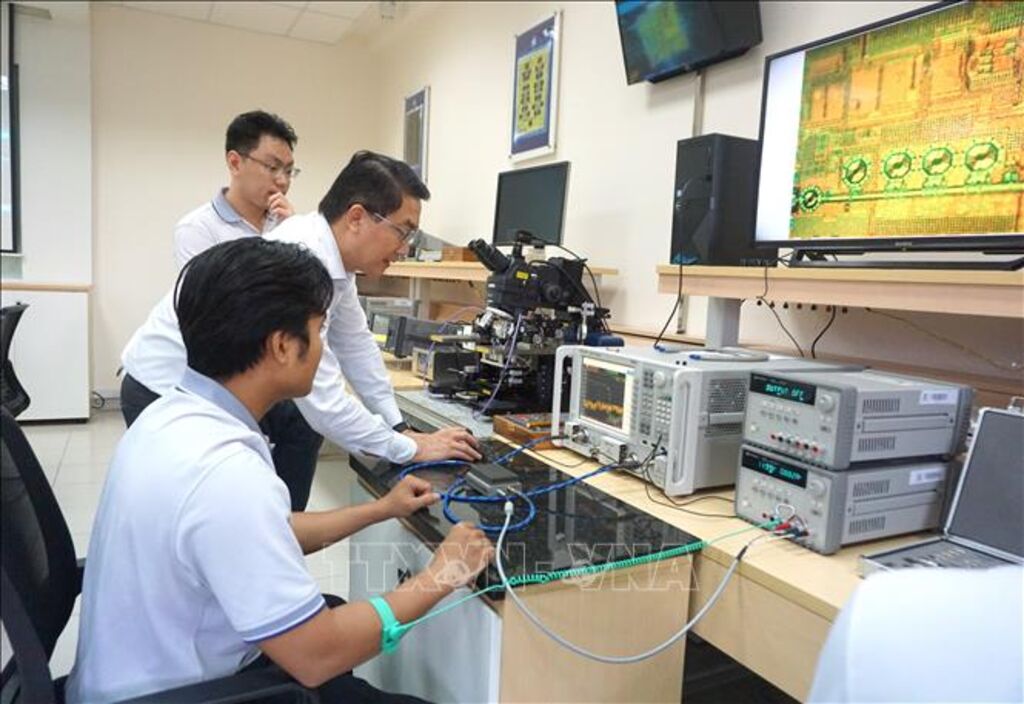
| The Microchip and Radio-Frequency Systems Laboratory at the Vietnam National University, Ho Chi Minh City, features a modern and fully integrated equipment system__Photo: Thu Hoai/VNA |
The Ministry of Education and Training has released a draft document on standards for PhD training programmes in semiconductors, proposing incentives for doctoral candidates while setting high requirements for postgraduate training in this hi-tech field.
Under the draft, doctoral candidates in the semiconductor research discipline would have their tuition fees waived and even receive scholarships.
For receiving the support, doctoral candidates would be required to study and conduct research on a full-time basis at training institutions. Those employed elsewhere would have to temporarily take leave from their jobs to focus entirely on research for a period of three years to four years, thereby ensuring the research quality.
Upon the completion of research, they would be able to lead research teams, generate new knowledge, and develop advanced technologies. Accordingly, they would be regarded not merely as learners but oriented to become fully fledged researchers who actively participate in scientific projects at training institutions.
In terms of admission criteria, doctoral candidates must have graduated with honors from a bachelor’s or master’s programme in a field relevant to semiconductors, possess research experience, and demonstrate foreign language proficiency at level 4 in the six-level Foreign Language Proficiency Framework for Vietnam, equivalent to B2.
As for graduation requirements, candidates must meet knowledge and skills standards and have at least two scientific papers on semiconductors published in international journals indexed in ISI/Scopus, with priority given to those published in Q1 or Q2 journals.
Noteworthily, the draft stipulates that training institutions may enrol only doctoral candidates who have appropriate semiconductor research projects and must have sufficient financial resources to support candidates’ training and research activities. Though these requirements are not mandatory for all higher education institutions, schools meeting such requirements would receive investment from the State and assigned semiconductor-related research projects.
Commenting on the draft, Assoc. Prof. Dr. Nguyen Van Quy, head of the Department of Electronic Materials and Components at the School of Materials, Hanoi University of Science and Technology, said the requirement for PhD candidates to pursue full-time study and research at training institutions is consistent with international practices and the nature of doctoral training.
In the developed countries, PhD candidates are required to work on a full-time basis, conducting research as their sole responsibility. In the semiconductor field that is characterised by high scientific and technological demands, intensive research workload and continuous experimentation, such requirement is even more necessary, he said.
Hence, the State's comprehensive support for doctoral candidates would enable them to fully devote themselves to study and research. This would not only improve the training quality but also create stronger motivation for young researchers to pursue advanced study in this critical field, he added.- (VLLF)