 |
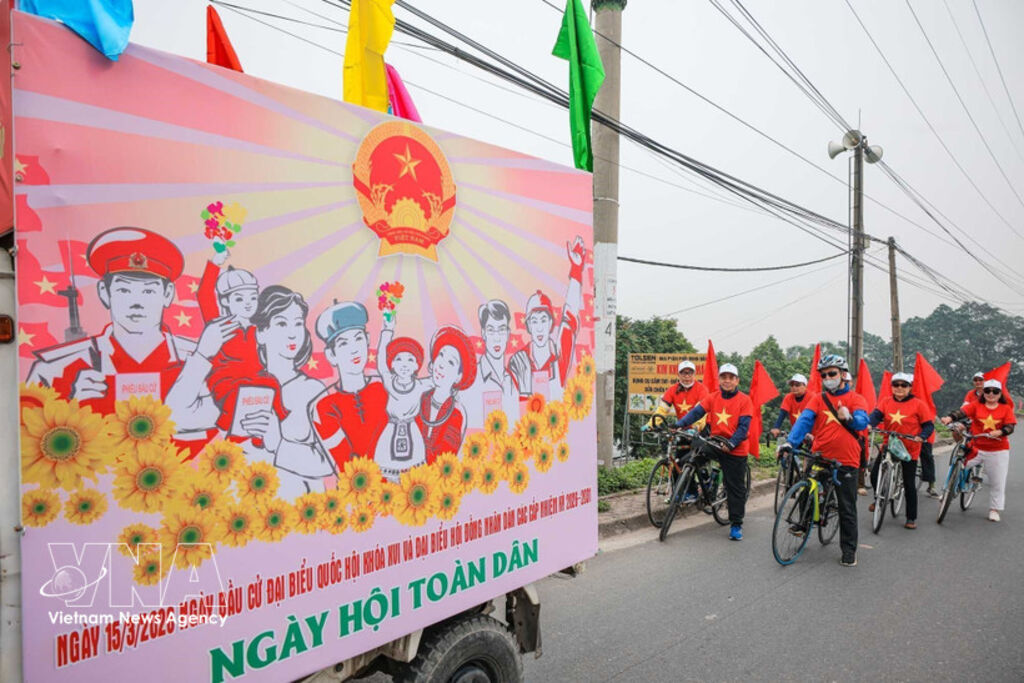
| A communication team of O Dien commune in Hanoi cycle to support the general election __Photo: VNA |
As nearly 79 million voters across Vietnam are taking part in the election of deputies to the 16th National Assembly and People’s Councils at all levels for the 2026–2031 term, the festive atmosphere is also felt among overseas Vietnamese communities whose members have closely followed the event while expressing strong confidence in and expectations for the country’s continued development.
For the community of more than 6.5 million Vietnamese living in over 130 countries and territories, the election represents not only a major political event but also an opportunity to demonstrate their enduring attachment to the homeland.
Speaking to the Vietnam News Agency correspondents, many overseas Vietnamese voiced their confidence that the newly elected National Assembly and People’s Councils will continue representing the will and aspirations of the people while introducing policies that promote socio-economic development and strengthen connections with overseas Vietnamese communities.
Nguyen Duy Anh, Honorary President of the Vietnamese Association in Fukuoka, Japan, and Secretary-General of the Global Network for Teaching Vietnamese Language and Culture, expressed his hope that deputies in the new term will continue to represent the people effectively while demonstrating the vision and determination needed to formulate long-term policies in the context of globalisation and digital transformation.
Prof. Dr Nguyen Ngoc Que of the Korean–Vietnamese Interpretation and Translation Graduate Department at the Graduate School of Language Education in the Republic of Korea praised recent improvements in Vietnam’s legislative activities. According to him, many recently adopted laws have closely reflected practical needs, helping improve the investment climate and laying a foundation for long-term development while creating additional opportunities for international cooperation.
From the business community’s viewpoint, Denise Pham (Ngoc Seoul), CEO of real estate company KOVIRE, noted that institutional reforms and investment environment improvements in Vietnam have strengthened the confidence of overseas investors. She expressed her hope that the 16th National Assembly will continue advancing reforms, particularly in digital transformation and market management.
In Canada, many intellectuals and members of the Vietnamese community said the National Assembly and People’s Councils should continue promoting institutional reform and building a more transparent and favourable business environment, especially in areas such as innovation, digital transformation and sustainable development.
Luong The Huan, a Vietnamese engineer working in Malaysia, expressed expectations for significant breakthroughs in the legal framework once the new National Assembly and People’s Councils begin their term. In his view, legislative activities should shift strongly from a “management-oriented” mindset to one focused on service and development facilitation.
Future legal frameworks should anticipate emerging trends and provide legal foundations for new economic models such as the digital economy, green economy and the recognition of intangible assets, he stated. The development of a “digital National Assembly” and “electronic People’s Councils” through the application of VNeID will help shorten the distance between voters and elected bodies while enhancing transparency and oversight of major national projects, Huan added.
Nguyen Huu Dong, President of the Vietnamese Association in Mexico and the first Vietnamese introduced by the Government to work for the United Nations in the early 1980s, who has served for decades as an international election monitoring expert in more than 40 countries, suggested expanding policy consultation mechanisms, particularly with Vietnamese experts abroad. Such measures, he said, will help the National Assembly gain more diverse perspectives and better align with international standards, especially as it plays a key role in translating the Party’s strategic resolutions into legislation.
He also highlighted the importance of strengthening inter-parliamentary cooperation and actively participating in multilateral parliamentary forums, which would allow Vietnam to share legislative experience while promoting the country’s image internationally and fostering a favourable external environment for development.
Pham Do Nhat Quang, 84, a Vietnamese expatriate in Algeria, said he is impressed by the dynamism and proactive decision-making demonstrated by the National Assembly in supporting the country’s recovery and development amid global uncertainties. For the new legislature, he expects more substantive and lively debates in parliamentary sessions, noting that frank and diverse discussions among deputies would help improve the quality of policymaking while reinforcing the National Assembly’s role as the highest representative body of the people. In Germany, Nguyen Duc Thang, a member of the Executive Committee of the Germany–Vietnam Association, expressed confidence that the election will further strengthen ties between overseas Vietnamese communities and the country’s development process. He noted that more than six million Vietnamese living abroad constitute an inseparable part of the national community and are increasingly attentive to policies related to their rights and connections with the homeland.
Sharing similar views, Dao Tuan Hung, President of the General Association of Vietnamese in the Republic of Korea, said the Vietnamese community there continues to grow, with many intellectuals and specialists working in high-tech fields such as semiconductors, artificial intelligence and innovation. With effective connectivity mechanisms, the intellectual resources of overseas Vietnamese could become an important driver contributing to Vietnam’s sci-tech and economic development.
Young Vietnamese studying abroad are also paying close attention to the country’s progress. Many students expressed hope for additional policies enabling them to contribute to national development after completing their study.
Ngo Thi Huyen Trang, a doctoral candidate studying in Beijing, said she hopes deputies of the new National Assembly will continue listening to and reflecting the aspirations of voters both at home and abroad.
Referring to policies adopted by the National Assembly to improve higher education quality, promote scientific research and innovation, and develop high-quality human resources, Vu Anh Kiet, a doctoral student at Prince of Songkla University, and Tran Huu Dat, a doctoral student at Chulalongkorn University in Thailand, noted that such policies have created favourable conditions for Vietnamese students to access international academic environments and eventually contribute to the country’s development.
Wherever they may be, the overseas Vietnamese community's devotion and commitment to the homeland remain a strong bond connecting Vietnamese people around the world. Amid the vibrant atmosphere of the “national festival,” from polling stations across the S-shaped country to hearts abroad that always look toward the homeland, all share a common belief that Vietnam will continue moving forward on its development path with the support of its people both at home and overseas.- (VNA/VLLF)