 |
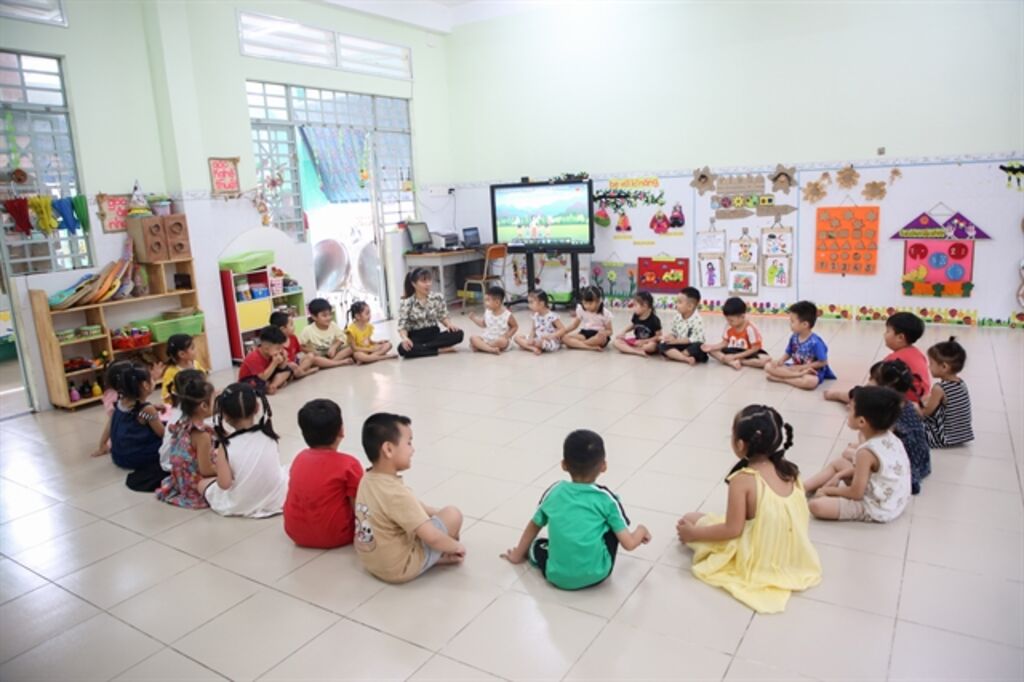
| A preschool class in Tay Ninh province__Photo: VNA |
The Government has approved a program that will introduce Chinese, Japanese and Korean language learning at the preschool level on a trial basis, and will also focus on teaching Southeast Asian languages including Lao and Khmer in border areas.
The newly approved initiative is aimed at strengthening foreign language education through 2035 to build a young generation with strong language proficiency and help meet the country's sustainable development requirements in the new era.
It seeks to enhance learners’ foreign language skills to meet their needs for study, communication and access to global knowledge, culture, science and technology, as well as international integration, helping improve the competitiveness of the workforce in both domestic and international labor markets.
Under the project, Vietnam will develop and implement teaching programs for languages from several ASEAN countries, with priority given to Lao and Khmer languages, at educational institutions that have demand and meet required conditions, particularly in border-area communes.
Schools will continue to pilot optional programs introducing Chinese, Russian, French, German, Japanese and Korean for first- and second-grade students, and will expand the teaching of Korean and German at institutions that are eligible and have demand.
The project also calls for strengthening foreign language teaching and training across the national education system, including in Chinese, Japanese and Korean, in line with learners’ needs and local conditions.
Teaching and learning Russian, French, German and other foreign languages will also be promoted under the initiative.
Eight key solutions have been outlined to advance foreign language education, including increasing the number of foreign language teachers while improving their skills.
The education sector is tasked with stepping up the application of advanced technologies and artificial intelligence in foreign language teaching and learning, and with improving facilities and conditions for foreign language education, including instruction delivered in foreign languages.
The project also emphasizes fostering international cooperation to promote foreign language education in Vietnam.
It requires that the recruitment of foreign language teachers and lecturers, including foreign nationals, ensure quality and compliance with job requirements and professional standards, with priority given to strengthening teaching staff in border areas.
In addition, preferential policies will be introduced to attract graduates with strong foreign-language skills and qualified foreign language teachers to work in socio-economically disadvantaged areas, while mechanisms allowing foreigners to teach at public educational institutions will be studied.
Foreign language teaching will also be integrated into subjects such as mathematics, natural sciences, social sciences and science, as well as training majors and disciplines, with a focus on key fields including artificial intelligence, semiconductors, biomedicine, security and national defense.- (VNS/VLLF)