 |
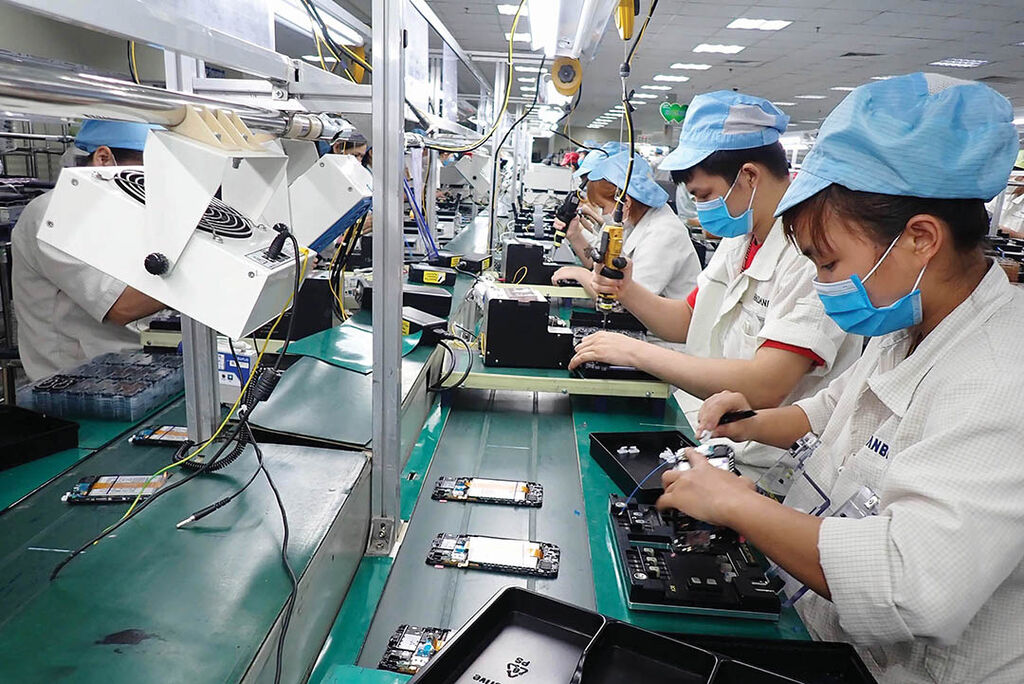
| Inside a phone component assembly workshop at Diem Thuy Industrial Park, Thai Nguyen province__Photo: Anh Tuan/VNA |
The Government’s latest resolutions on cutting, decentralising and simplifying administrative procedures and business conditions go beyond technical reform. By reducing institutional friction that has long delayed projects, raised compliance costs and weakened business confidence, they offer enterprises a major form of support without adding pressure on the state budget.
A reform package of 11 resolutions
Within less than a month since April 29, the Government issued 11 resolutions on cutting, decentralising and simplifying administrative procedures and business conditions across key sectors.
The resolutions cover a wide range of fields, from agriculture and environment, industry and trade, science and technology, health, education and training, culture, sports and tourism, to public security, finance, construction, justice, banking, national defence and foreign affairs. Together, they are designed to remove procedures that are no longer necessary, decentralise authority from central agencies to local administrations, simplify business-related requirements and reduce conditional business lines.
The scale of the reform is notable. The 11 resolutions abolish 56 conditional business lines and amend 14 others, decentralise 321 administrative procedures, remove 697 procedures, simplify 704 procedures and cut 1,754 business conditions. They are also expected to reduce the time needed to complete administrative procedures by more than half and save around VND 23 trillion in compliance costs each year.
Eight sector-specific resolutions
The reform package began with eight sector-specific resolutions issued on April 29, which took effect on the same day, except certain provisions. Each resolution targets a specific sector or group of sectors, but together they point to the same policy direction: fewer unnecessary procedures, clearer decentralisation, relaxed business conditions and stronger post-licensing supervision.
Resolution 17/2026/NQ-CP covers 15 sectors and fields under the management of the Ministry of Agriculture and Environment, including fisheries and fisheries surveillance; forestry and forest ranger forces; nature and biodiversity conservation; survey, mapping and remote sensing; land; hydraulic work; water resources; environmental protection; integrated management of sea and islands; geology and minerals; agricultural extension; climate change response; crop production and plant protection; livestock and veterinary medicine; and hydrometeorology.
Resolution 18/2026/NQ-CP focuses on decentralising and simplifying procedures while removing several business and production conditions related to art performances, festivals, competitions, beauty and model contests, and Vietnamese individuals travelling abroad to participate in such contests.
Resolution 19/2026/NQ-CP applies to 10 sectors under the Ministry of Industry and Trade, including chemicals, electricity, tobacco, petroleum, e-commerce, international trade, import and export, trade promotion, commodity exchanges and local industry.
Resolution 20/2026/NQ-CP concerns six fields under the Ministry of Science and Technology, including standards, metrology and quality, telecommunications and the Internet, radiation and nuclear safety, postal services, information technology and electronics, and science and technology.
Resolution 21/2026/NQ-CP decentralises a number of procedures from the Ministry of Health to chairpersons of provincial-level People’s Committees, including procedures related to health supplement advertising content, the import of clinical specimen samples, medical practice licences and certain operating licences for private hospitals.
Resolution 22/2026/NQ-CP reduces administrative procedures under the Ministry of Public Security in citizen identification, electronic identification and authentication, including procedures related to biometric data and electronic identification accounts.
Resolution 23/2026/NQ-CP addresses procedures and business conditions under the Ministry of Education and Training, covering early childhood, general and higher education institutions, foreign-invested education institutions, overseas study consulting services, continuing education and vocational education activities.
Resolution 24/2026/NQ-CP covers a broader group of areas under the authority of the Government and the Prime Minister, including national defence, home affairs, finance, construction, foreign affairs, justice and banking.
Three resolutions for implementing Politburo Resolution 66
The package was expanded in May with three further resolutions issued in the spirit of Politburo Resolution 66 on renovation of law-making and law enforcement, and under the 2025-26 programme on cutting and simplifying business-related procedures.
Issued on May 15, Resolution 66.17/2026/NQ-CP revises the list of conditional business investment sectors and trades in Appendix IV to Investment Law 143/2025/QH15. It reduces the number of conditional business lines from 198 to 142, covering areas such as securities, insurance, gold trading, petrol and oil trading, air transport, real estate, medical examination and treatment, higher education, general education and early childhood education, telecommunications and social network services, as well as legal practice, notarisation and judicial expertise.
Released on May 18, Resolution 66.18/2026/NQ-CP identifies documents proposed for amendment and supplementation to ensure consistency in the decentralisation, reduction and simplification of administrative procedures and business conditions. The list comprises 45 laws, 72 decrees and 34 circulars under 11 sectors and fields, including public security, industry and trade, science and technology, home affairs, national defence, justice, finance, construction, culture, sports and tourism, health, and education and training.
Promulgated on the same day, Resolution 66.19/2026/NQ-CP continues to decentralise and simplify administrative procedures and reduce business conditions in 11 sectors under the Ministry of Agriculture and Environment.
Institutional reform as business support
Experts say the significance of the 11 resolutions should not be measured only by the number of procedures or business conditions removed. Their larger value lies in reducing the institutional friction that has long raised costs, delayed projects and weakened enterprise confidence.
Assoc. Prof. Dr. Ngo Tri Long from the Vietnam Financial Consulting Association said business costs do not come only from loan interest, input prices, wages, taxes or fees. A growing burden, though harder to quantify, is the cost of legal compliance. This includes time spent waiting for licences, repeated requests to supplement dossiers, travel expenses, consultancy costs and opportunity costs when projects are delayed, orders are missed and cash flows are disrupted.
In practice, many enterprises have capital, markets and partners, yet still fail to implement projects on schedule because of obstacles related to land, construction, fire protection, environmental procedures, inspection requirements or specialised licences. Some projects are delayed not because investors lack resources, but because they have to pass through too many procedural layers, rounds of consultation and different interpretations among enforcement agencies.
In business, time is itself a cost. A one-month delay in completing administrative procedures may increase loan interest, cause enterprises to miss market opportunities or orders, and erode investor confidence. From this perspective, unnecessary administrative procedures and business conditions operate like an “invisible tax” on enterprise competitiveness.
Dr. Nguyen Si Dung, former Vice Chairman of the National Assembly Office, described such barriers as “institutional friction” - invisible forces that slow the movement of the economy. These include lengthy procedures, overlapping regulations, sub-licences, unclear enforcement, fear of responsibility and unexpected costs. They may not cause an immediate crisis, but they quietly drain the development energy of businesses and society.
This is why the latest reform drive can be seen as more than an administrative exercise. Unlike budget-funded support packages such as tax reductions, fee exemptions, interest subsidies or higher public spending, institutional reform supports enterprises by removing barriers that prevent capital, projects and business opportunities from moving faster. It does not require additional budget spending, but it can release resources already trapped inside the economy.
If each unreasonable business condition removed, each process shortened and each rule clarified helps enterprises save time and money, the combined effect across the whole economy could become a significant source of growth. In that sense, the 11 resolutions amount to an institutional support package: one that reduces compliance costs, improves predictability and gives enterprises more room to invest, expand production and create jobs.
The real test, however, lies in implementation. Cutting procedures on paper will mean little if old requirements return in new forms, online dossiers still require paper copies, or decentralised powers are met with hesitation at the local level.
For enterprises, what matters most is not the number of procedures removed, but whether projects can move faster, compliance costs actually fall and rules are applied consistently across agencies and localities. The reform package will unlock growth only when the spirit of simplification is carried through to daily administrative practice.
In the end, institutional reform must be measured not by official figures alone, but by the confidence it restores to businesses, investors and the wider economy.- (VLLF)