Vu Van Anh
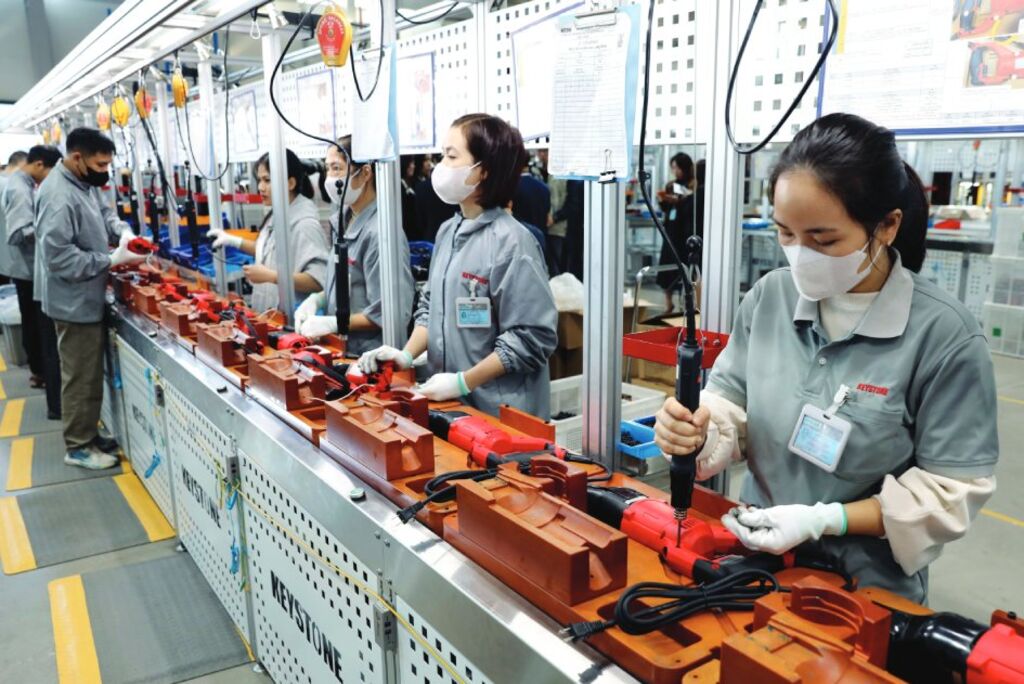 |
| Workers produce handheld electrical tools at the Keystone Electrical Vietnam factory in Lien Ha Thai Industrial Park, Thai Thuy commune, Hung Yen province__Photo: The Duyet/VNA |
The Government on March 31 issued Decree 96, detailing and guiding the implementation of several provisions of the Law on Investment, in an effort to improve the legal framework and remove administrative bottlenecks for, and facilitate the attraction of, high-quality capital into key sectors.
The Decree takes effect on March 31 and replaces Decree 31 of 2021, Decree 19 and Decree 239 of 2025.
Aligned with the spirit of Politburo Resolution 57-NQ/TW dated December 22, 2024, the decree introduces notable provisions on eligible beneficiaries of investment incentives, preferential policies, and special investment support for investment in science, technology, innovation, and national digital transformation.
More sectors eligible for investment incentives
To promote the development and restructuring of sectors and trades prioritised for investment, Appendix II to Decree 96 adds new sectors and trades to the list of those eligible for investment incentives.
The decree significantly expands the list of sectors and trades eligible for special investment incentives, focusing on high technologies and strategic technologies in such fields as innovation, digital transformation, artificial intelligence (AI), and digital technology industry infrastructure, while broadening activities in the pharmaceutical and medical sectors, including research, production and technology transfer for medicines, vaccines, biologicals, and domestic medicinal materials.
Notably, national important projects and key sectoral projects approved by the Prime Minister are, for the first time, included in the category eligible for special investment incentives.
At the same time, sectors and trades eligible for investment incentives are listed in a more selective manner. The manufacture of dual-use technology products is added to the sectors and trades prioritised for investment incentives, bringing the total to 23 sectors in the field of science and technology. Incentives for agriculture are expanded to 13 specific sectors associated with input supply chains such as the production of medicinal materials, plant protection products, and veterinary drugs, as well as the inclusion of activities related to the building and upgrading of wholesale markets and the manufacturing of environmental industry equipment. Meanwhile, the sectors and trades in the fields of culture, social affairs, sports and healthcare have been streamlined in quantity but added with new ones related to human resource training serving science, technology, and digital transformation.
Beneficiaries of special investment incentives and support mechanisms
Article 21 of Decree 96 introduces special investment incentives and support mechanisms applicable to large-scale projects, hi-tech projects, and projects playing a leading role in the economy.
The first eligible group includes new investment projects (including their expansions) involving the establishment of innovation centres, research and development (R&D) centres; investment projects for building big data centre infrastructure, cloud computing infrastructure, 5G and next-generations mobile networks, and other digital infrastructure in strategic technology sectors as decided by the Prime Minister, and investment projects in strategic technology sectors or for the manufacturing of strategic technology products as decided by the Prime Minister.
To qualify, such a project must have the total investment capital of at least VND 3 trillion and disbursement of a minimum of VND 1 trillion within three years from the date of issuance of its investment registration certificate or investment policy approval.
The National Innovation Centre established under the Prime Minister’s decision is also listed in this group.
The second group comprises investment projects on manufacturing of key digital technology products; projects on research and development, design, manufacturing, packaging, and testing of semiconductor chips; and projects on construction of AI data centres in accordance with the law on the digital technology industry. Each of these projects must have the total investment capital of at least VND 6 trillion and be fully disbursed within five years after its investment registration certificate or investment policy approval is issued.
Apart from the technology sector, particularly large scale projects in specially incentivized industries are also eligible for incentive consideration. Specifically, a project with the total investment capital of at least VND 3 trillion and disbursement of at least VND 10 trillion within three years may be qualified for the special incentive mechanism.
Investment projects (including both new and expanded ones) in sectors and trades eligible for special investment incentives are also eligible for special investment incentives provided that they each have the total investment capital of at least VND 30 trillion and disbursement of a minimum of VND 10 trillion within three years from the date of issuance of the investment registration certificate or investment policy approval.
Forms of investment support include (i) support for the development of technical infrastructure and social infrastructure systems both inside and outside the boundaries of the investment project; (ii) support for human resource training and development; (iii) credit (loan) support; (iv) support for access to production and business premises, and support for relocation of production and business establishments under decisions of competent state authorities; (v) support for science, technology, and technology transfer; (vi) support for market development and information provision; and (vii) support for research and development.
Meanwhile, special incentives will focus on corporate income tax, and land and water surface rentals in accordance with the law on corporate income tax and the law on land.
As per Article 21.5, the Prime Minister will decide on levels and duration of special investment incentives based on criteria such as the level of high technology, technology transfer capacity, the extent of participation of Vietnamese enterprises in the value chain, and domestic value creation.
Notably, investors wishing to enjoy special investment incentives must commit to meeting the law-specified conditions on investment sectors/trades, total registered investment capital, disbursed capital, and disbursement schedule, as well as other conditions specified in their investment registration certificates, decisions on approval of investment policy, or written agreements with competent state authorities under the Prime Minister’s decisions.
Special investment procedures
Articles 46 through 50 of Decree 96 focus on the concretisation of special investment procedures, a mechanism exclusively applicable to projects implemented in industrial parks, export-processing zones, hi-tech parks, and economic zones.
Specifically, to be eligible for this mechanism, investors must file their requests and commit to meeting conditions on business sectors, investment capital, capital disbursement progress, and satisfaction of the conditions stated in their investment licences or agreements with competent state agencies.
Instead of undergoing the prolonged and complicated construction, environmental protection and fire protection condition appraisal process as specified in previous regulations, investors are only required to submit application dossiers together with written commitments to complying with applicable national standards and technical regulations to management boards of economic zones or hi-tech parks. Management boards will process application dossiers and issue an investment registration certificate within 15 working days.
However, if a project fails to fulfil its commitments after commencing its operation, the investor may face stringent sanctions, including project operation suspension or termination. This reflects a significant shift in regulatory approach, from pre-licensing inspection to post-licensing inspection, placing greater trust in investors’ self-compliance while maintaining legal discipline.
Secured investment incentives upon statutory changes
In order to protect the lawful rights and interests of investors, Decree 96 specifies mechanisms to secure investment incentives in case of a statutory change.
Specifically, Article 4 stipulates: “In case newly issued legal documents contain provisions that alter the investment incentives applied to investors prior to the effective date of such documents, investors shall be secured of continued enjoyment of investment incentives in accordance with Article 12 of the Law on Investment”.
Secured investment incentives include both investment incentives specified in investment licenses, business licenses, investment incentive certificates, investment certificates, investment registration certificates, decisions approving investment policy, or other documents issued by competent persons or state authorities in accordance with law; and investment incentives to which investors are entitled in accordance with law.
To apply for investment security measures, an investor is required to file a written request to the investment registration agency, together with relevant documents proving its entitlement to incentives as stated above.
Such a request must clearly state the investor’s information, incentives currently applied, new legal provisions that change such incentives, and the proposed specific security measures.
Within 30 days after receiving a complete and valid dossier, the investment registration agency will have to decide on the application of investment security measures. In case the request is beyond its competent, the agency will forward the dossier to the competent state agency for consideration and decision.
Market access restrictions for foreign investors
The decree establishes a detailed legal framework governing market access for foreign investors.
Compared to Decree 31 of 2021 (as revised under Decree 239 of 2025), Appendix I to Decree 96 adds construction activities of foreign contractors to the list of sectors and trades with restricted market access for foreign investors (the List), thereby increasing the total number of such restricted sectors and trades to 62.
Under Article 16, the List applies to foreign investors and economic organisations carrying out investment activities such as establishing other economic organisations; contributing capital, purchasing shares, or acquiring capital contributions in other economic organisations; or investing under business cooperation contracts.
Notably, investors who are Vietnamese citizens and also hold foreign nationalities are entitled to choose to apply market access conditions and investment procedures applicable to either domestic investors or foreign investors. In case such investors choose to apply conditions and procedures applicable to domestic investors, they will not be entitled to exercise the rights and obligations provided/specified for foreign investors.
Regarding market access conditions for sectors where Vietnam has not committed to provide market access for foreign investors in treaties on investment, in case Vietnam’s law has not stipulated any market access restrictions for such sectors, foreign investors will be entitled to market access under the same conditions as domestic investors.
In case Vietnam’s law specifies market access conditions for foreign investors in sectors where Vietnam has not made commitments, investors must comply with such provisions.
If foreign investors establish new economic organisations, implement new investment projects, acquire investment projects, contribute capital to, purchase shares or capital contributions in, other economic organisations, or adjust or add objectives or business lines which, under newly issued legal documents, require compliance with market access conditions applicable to foreign investors, such conditions must be satisfied.
Conditional business sectors and trades
As per the decree, both domestic and foreign investors are allowed to conduct business in the conditional business lines provided in Appendix IV to the Law on Investment once they have fully satisfied the law-specified conditions, and must maintain their satisfaction of such conditions throughout the course of their investment and business operations.
The decree reaffirms the principle that, except sectors included in the List of sectors and trades with restricted market access, foreign investors are entitled to market access and equal treatment on par with domestic investors.-