Luu Tien Ngoc, Le Quynh Anh and Nguyen Thi Thanh Xuan
Vision & Associates[1]
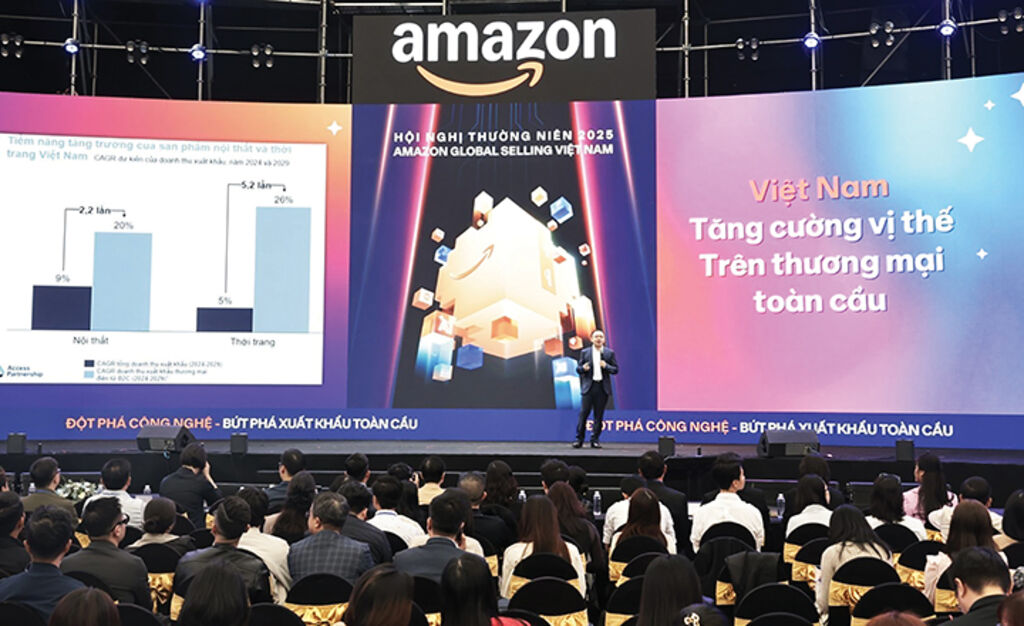 |
| A view of the 2025 Amazon Global Selling Vietnam annual conference, which aims at boosting global exports of Vietnamese goods through e-commerce__Photo: Tran Viet/VNA |
Currently, e-commerce activities in Vietnam are primarily regulated by Government Decree 52/2013/ND-CP dated May 16, 2013, on e-commerce (Decree 52). However, as from July 1 this year, Law 122/2025/QH15 on E-Commerce (the Law), passed by the 15th National Assembly on December 10, 2025, will take effect, marking the first time Vietnam has a separate law comprehensively regulating the field of e-commerce. Below are notable contents of the Law regarding foreign investment in this field and foreign e-commerce platforms operating in Vietnam.
Scope of regulation
The Law has a broad scope of regulation, encompassing several e-commerce activities in the spheres regulated by specialised laws, such as financial services, banking, credit, insurance, lottery; buying and selling, and exchanging currency, gold, foreign exchange and other payment instruments; betting services or games with prizes; distribution and publishing services of digital information content products, broadcasting and television services, which were previously not regulated by Decree 52.
According to the Law, e-commerce activity is defined as “a commercial activity conducted partially or entirely in an electronic environment”. Thus, compared to Decree 52, e-commerce activities are regulated in a more comprehensive manner regarding technological platforms, and are not limited to specific technical infrastructure, such as the Internet, mobile telecommunications networks or other open networks.
Furthermore, the Law introduces, for the first time, a system of new concepts to reflect the evolving e-commerce business models in practice, including: e-commerce platform; business-to-consumer (B2C) e-commerce platform; intermediary e-commerce platform; social media platform engaged in e-commerce; integrated e-commerce platform; e-commerce platform manager; online ordering function; online communication function; livestream sales; livestream sales presenter; affiliate marketing services in e-commerce; organisations and individuals providing affiliate marketing services in e-commerce; affiliate marketer in e-commerce; etc.
Foreign investment in e-commerce
Similar to the approach of the 2025 Investment Law, the Law provides the management and operation of intermediary e-commerce platforms, social media platforms engaged in e-commerce, and integrated e-commerce platforms as a sector in which market access is conditional for foreign investors, belonging to the List of sectors subject to restricted market access as provided by the investment law. The Government will provide in detail the conditions on market access applicable to foreign investors.
Management and operation of foreign e-commerce platforms
Compared to Decree 52, the Law provides more comprehensive provisions on the management and operation of foreign e-commerce platforms operating in Vietnam. These platforms are defined as foreign e-commerce platforms whose managers are foreign organisations lawfully operating in accordance with foreign laws and which are operated under a mechanism allowing the selection of Vietnamese as the display language, or which use the Vietnam national domain name “.vn”, or reach a transaction threshold with buyers in Vietnam, excluding B2C e-commerce platforms without an online ordering function.
The Law says that the managing entity of a foreign e-commerce platform operating in Vietnam must carry out registration procedures with the competent state agency. In addition, depending on the operational features of an e-commerce platform, the platform manager must satisfy the following requirements:
(i) The manager of a foreign B2C e-commerce platform with an online ordering function must designate an authorised legal person in Vietnam before the platform selects Vietnamese as the display language or uses the Vietnam national domain name “.vn”, or after it reaches the transaction threshold with buyers in Vietnam, unless otherwise provided by law.
(ii) The manager of an intermediary e-commerce platform without an online ordering function or a social media platform engaged in e-commerce without an online ordering function must designate an authorised representative in Vietnam before the platform selects Vietnamese as the display language or uses the Vietnam national domain name “.vn”, and meets the conditions for managing and operating e-commerce platforms.
(iii) The manager of an intermediary e-commerce platform with an online ordering function or a social media platform engaged in e-commerce with an online ordering function or an integrated e-commerce platform must establish a legal person in Vietnam before the platform selects Vietnamese as the display language or uses the Vietnam national domain name “.vn”, or after it reaches the transaction threshold with buyers in Vietnam, unless otherwise provided by law. The platform manager is not required to establish a legal person in case a treaty to which Vietnam is a contracting party contains a commitment not to require the establishment of a legal person, but must: designate an authorised legal person in Vietnam; pay a deposit at a Vietnam-based commercial bank or foreign bank branch to pay compensation to consumers and fulfil financial obligations towards the State of Vietnam; and satisfy the conditions on the management and operation of e-commerce platforms.
The Government will specify transaction thresholds with buyers in Vietnam; conditions for managing and operating e-commerce platforms; deposit payment; and the competence and procedures for registering, and modifying, supplementing and terminating the registration of, foreign e-commerce platforms operating in Vietnam.
Responsibilities of Vietnam-based authorised representatives of managers of foreign e-commerce platforms operating in Vietnam
The Vietnam-based authorised representative of the manager of an intermediary e-commerce platform without an online ordering function or of a social media platform engaged in e-commerce without an online ordering function is responsible for: (a) carrying out under authorisation the legal procedures regarding e-commerce activities with the competent state agency; (b) complying with the competent state agency’s requests for resolving disputes and complaints, conducting investigation, and handling violations; and (c) submitting periodical online reports through the e-commerce activity management system or as required by the competent state agency.
For Vietnam-based authorised legal persons of managers of B2C e-commerce platforms with an online ordering function or of intermediary e-commerce platforms with an online ordering function or of social media platforms engaged in e-commerce with an online ordering function that are not required to establish a legal person in Vietnam according to treaties of which Vietnam is a member; and of integrated e-commerce platforms, they should note the following:
First, they must be authorised to:
- Carry out legal procedures regarding e-commerce activities with competent state agencies;
- Conduct inspection and review, and promptly handle violations upon detection or receipt of reports thereon; and remove information about the violating goods and services after receiving a request from a competent state agency as prescribed by the Government;
- Coordinate in resolving reports, requests and complaints on goods and services from buyers in Vietnam;
- Receive information and coordinate in the handling of goods supplied by sellers that do not conform to the content announced, published, listed, advertised, introduced, concluded and committed on the platforms;
- Request the platform managers to disclose information on the platforms, directly notify the buyers thereof, and coordinate in the recall of goods, in case of detecting goods with defects as prescribed by the law on protection of consumers’ rights. The determination of responsibility, the handling of goods with defects, and the payment of compensation must comply with the civil law and the law on protection of consumer rights; and,
- Perform the responsibilities of platform managers as provided in the Law, the laws on data, cybersecurity, product and goods quality, advertising, and protection of consumer rights, and other relevant laws.
Furthermore, these authorised legal persons must also be authorised to implement compliance measures regarding cross-border data transfer and processing as well as personal data protection as prescribed by law; and perform the responsibilities as prescribed by the laws on data and cybersecurity other relevant laws.
Second, they must comply with competent state agencies’ requests for resolving disputes and complaints, conducting investigation, and handling violations; and submit periodical online reports through the e-commerce activity management system or as required by competent state agencies.
Information disclosure
According to the Law, an e-commerce platform has to:
(i) Disclose basic information about the conditions for operation on the platform, including information about the platform manager; privacy policy; rights and obligations of the parties; and methods for receiving and resolving feedback, requests and complaints. Such information must be displayed in a prominent location on the platform, in Vietnamese, understandable, not misleading, not falling into cases prohibited by law, not contrary to social ethics, ensuring equality between the parties, and complying with the civil, commercial, advertising, competition, and consumer protection laws and other relevant laws; and,
(ii) Apply a mechanism for users to express their consent to the above-mentioned information before opening an account on the platform.
Moreover, an e-commerce platform with an online ordering function must disclose general information applicable to goods and services, including policies on pricing, delivery/service provision methods, return or service termination, and refund.
Such a platform must clearly, fully and accurately display the content of the contractual agreement to involved parties; and have a mechanism allowing buyers to express their agreement to the terms and conditions of the transaction before placing an order, such as goods/services, delivery/service provision methods and timeframes, applicable promotional offers, value of goods/services; taxes; shipping costs and other costs; and payment methods. The platform must also apply a mechanism that allows buyers to review and modify specific terms and conditions of the transaction before deciding to place an order.
An e-commerce platform that integrates an automated electronic contract signing system must display specific terms and conditions of the transaction before a contract is signed. The platform manager is responsible for the platform’s technical conditions, ensuring that the signing, implementation and termination of automated contracts are conducted transparently, securely and traceably.
After an order is placed, the aforementioned details must be displayed and accessible from the buyer’s account.-
[1] VISION & ASSOCIATES
Hanoi Office: Unit 308-310, Floor 3, Hanoi Towers
49 Hai Ba Trung St., Cua Nam ward., Hanoi, Vietnam
Tel: +84-24-3934 0629 Fax: +84-24-3934 0631
Email: vision@vision-associates.com
Ho Chi Minh City Office: Unit 905, Floor 9, CitiLight Tower
45 Vo Thi Sau St., Tan Dinh ward, HCMC, Vietnam
Tel: +84-28-3823 6495 Fax: +84-28-3823 6496
Email: hcmvision@vision-associates.com
Website: http://www.vision-associates.com