Prof. Dr. Nguyen Van Kim and Ph.D candidate Tran Thi Hoa
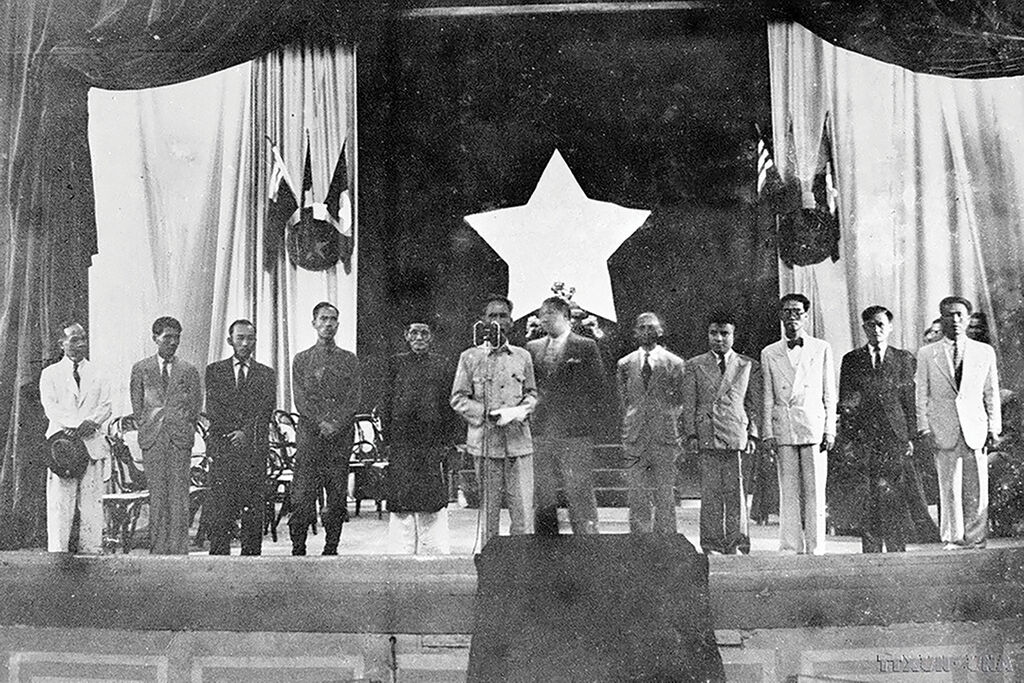 |
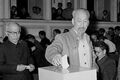
| President Ho Chi Minh takes the oath before the National Assembly at its first session (March 2, 1946)__Photo VNA |
In the progression of every modern nation’s history, the constitution is an extremely important political-legal document, the highest legal foundation affirming the national sovereignty and regulating the most fundamental and essential issues oriented to sustainable and stable national development. Therefore, immediately after the founding of the Democratic Republic of Vietnam, President Ho Chi Minh identified that the urgent and necessary task for affirming the national sovereignty and consolidating the independence is to quickly organise elections to officially establish a lawful National Assembly, and promulgate a constitution. On November 9, 1946, the first National Assembly of Vietnam passed the first Constitution of the Democratic Republic of Vietnam - the 1946 Constitution.
Historical context and basic contents of the Constitution
The birth of the Democratic Republic of Vietnam marked a turning point in our country’s history, transitioning the nation from a feudal-colonial monarchy to an independent, democratic and progressive state. However, the revolutionary government was established in a complex political situation, with fairly weak armed forces, and the challenges of famine, illiteracy and foreign invaders. The missions of the Vietnamese revolution at that time were to resolutely defend the infant independence while establishing a new political foundation, i.e., building a truly democratic regime for the people. To achieve that, a general election, the promulgation of a constitution, and the building of a constitutional government were regarded as vital.
In the first government meeting on September 3, 1945, one of the six urgent tasks set by President Ho Chi Minh was to promulgate a Constitution. He wrote: “Previously, we were ruled by an absolute autocratic monarchy, then by an autocratic colonial regime, so our country had no constitution. Our people did not enjoy freedom and democracy. We must have a democratic constitution”[2]. Later, on September 20, 1945, he signed Decree 34-SL establishing the Constitution Drafting Committee. On January 6, 1946, the General Election took place nationwide to elect the first National Assembly. At its first session, the National Assembly officially elected the Constitution Drafting Committee. Then, on November 9, 1946, at its second session, the National Assembly officially passed the Constitution of the Democratic Republic of Vietnam.
The 1946 Constitution consisted of a Preamble and seven chapters. The Preamble defined the nation’s tasks in this period and the fundamental principles of the constitution. Chapter 1 provided the form of the Government. Chapter 2 specified the obligations and rights of citizens. Chapter 3 provided the People’s Parliament as the supreme state authority. Chapter 4 defined the Government as the highest state administrative body. Chapter 5 regulated the state power bodies and administrative bodies at the local levels. Chapter 6 provided the judicial bodies. Finally, Chapter 7 ruled the issue of constitutional amendment.
Due to wartime circumstances, the 1946 Constitution was not formally promulgated, and the general elections for the People’s Parliament could not be organised. Actually, the first National Assembly assumed the role of the People’s Parliament. President Ho Chi Minh and the Government, along with the Standing Committee of the National Assembly, always relied on the spirit and content of the constitution to govern all state activities until the enactment of the 1959 Constitution.
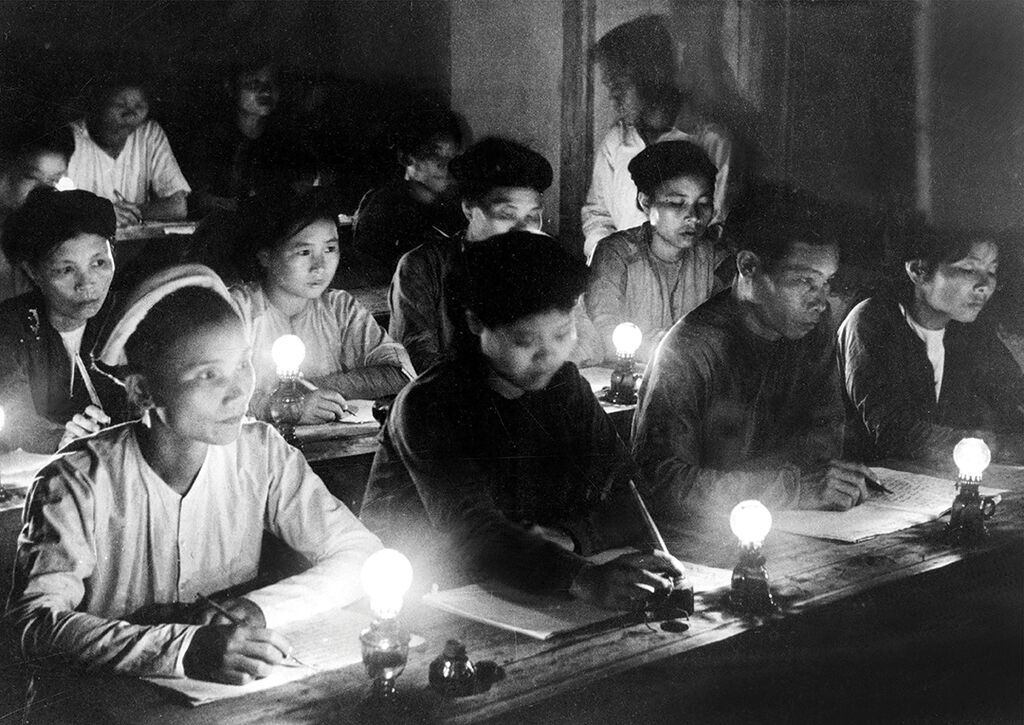 |
| A “mass literacy” class in Hanoi in the early days of independence__Photo VNA |
The 1946 Constitution embodied a humanistic vision and profound humanitarian spirit
Under the direction of President Ho Chi Minh, the 1946 Constitution was drafted by patriotic intellectuals and jurists who had early exposure to and immersion in the western bourgeois democracy. When drawing up the first Constitution of the Democratic Republic of Vietnam, President Ho Chi Minh and the constitution-makers used the highest legal document of a nation to affirm the fundamental rights of the Vietnamese nation, people and citizens.
Firstly, the 1946 Constitution affirmed the independence and unity of the Vietnamese nation. In Article 2, it affirmed: “Vietnam is a unified bloc indivisible throughout the North, the Central and the South, with unified territory, population, national flag and national anthem.” This affirmation of the fundamental sovereignty of the nation helped promote the struggle of oppressed nations worldwide and was in line with the human civilisation’s development.
Secondly, the 1946 Constitution recognised the right of the Vietnamese people to serve as masters of the country. This was an adoption of progressive democratic thought from human civilisation, reflecting the contemporary vision of President Ho Chi Minh and the nation-founders and constitution-makers. Right in Article 1, the 1946 Constitution affirmed: “All powers in the country belong to the entire Vietnamese people.” By this affirmation, the Vietnamese people rose from a position of slavers to become masters of the country, deciding the fate of the nation and of themselves as well.
Thirdly, the 1946 Constitution recognised and protected the fundamental human rights and citizens’ rights. This was the absorption and affirmation of the values of human civilisation. In the 17th and 18th centuries’ western bourgeois democratic movement, alongside the doctrine of “popular sovereignty,” thinkers launched and developed the doctrine of “natural rights of man”. The 1789 Bill of Rights (part of the U.S. Constitution), and the Declaration of the Rights of Man and of the Citizen, 1789, affirmed the natural rights of man that no one has the right to deny or violate. When the first Constitution was drafted, once again, the fundamental human rights and citizens’ rights were solemnly and formally affirmed in the highest legal document of the state.
The 1946 Constitution devoted Chapter 2 with 16 out of 18 articles to providing citizens’ rights. Accordingly, citizens have the right to equality before law; equal rights in political, economic and cultural aspects; the rights to freedom of speech, publication, assembly, movement, religious belief; property rights; personal freedom rights; the right to vote; the right to stand for election, etc.
Along with many contents related to fundamental human freedoms, the 1946 Constitution established the principle of universal and equal suffrage, stipulating that Vietnamese citizens who are aged 18 and over, regardless of gender, ethnicity and religion, have the right to vote and stand for election[3]. Right in the first general election, before the 1946 Constitution was promulgated, this principle was vividly implemented in practice. Vietnamese citizens became voters, especially women who, for the first time, held ballots to exercise their right to mastery. Among the elected female deputies to the first National Assembly, and even within the Constitution Drafting Committee, there was one female member, namely Nguyen Thi Thuc Vien. Additionally, the 1946 Constitution paid attention to vulnerable societal groups, such as ethnic minorities, poor students, the elderly, and people with disabilities. This showed not only the progressiveness but also the profound humanity of the Constitution.
Fourthly, while adopting the western democracy’s values, President Ho Chi Minh and the constitution-makers did not overlook the eastern values. This was clearly shown in the epigraph opening the 1946 Constitution: “Democratic Republic of Vietnam/ Independence - Freedom - Happiness.” That was the adoption of the most quintessential values of Sun Yat-sen’s Three Principles of the People: nationalism, democracy and livelihood. At the same time, the 1946 Constitution’s Chapter 2 on the obligations and rights of citizens devoted Section C to the matters of election, recall and referendum. This provision, not found in any western constitution, represented the acquisition of influence from Sun Yat-sen’s thought on democracy[4] and the Constitutions of the Republic of China. Sun Yat-sen believed that to realise “politics in the hands of the people” and “ruled by the people,” full democracy must first of all be implemented[5]. The absorption of these quintessential values in the eastern political-legal culture made the 1946 Constitution even more aligned with the general trends and values of humanity while still having national and regional cultural identities retained.
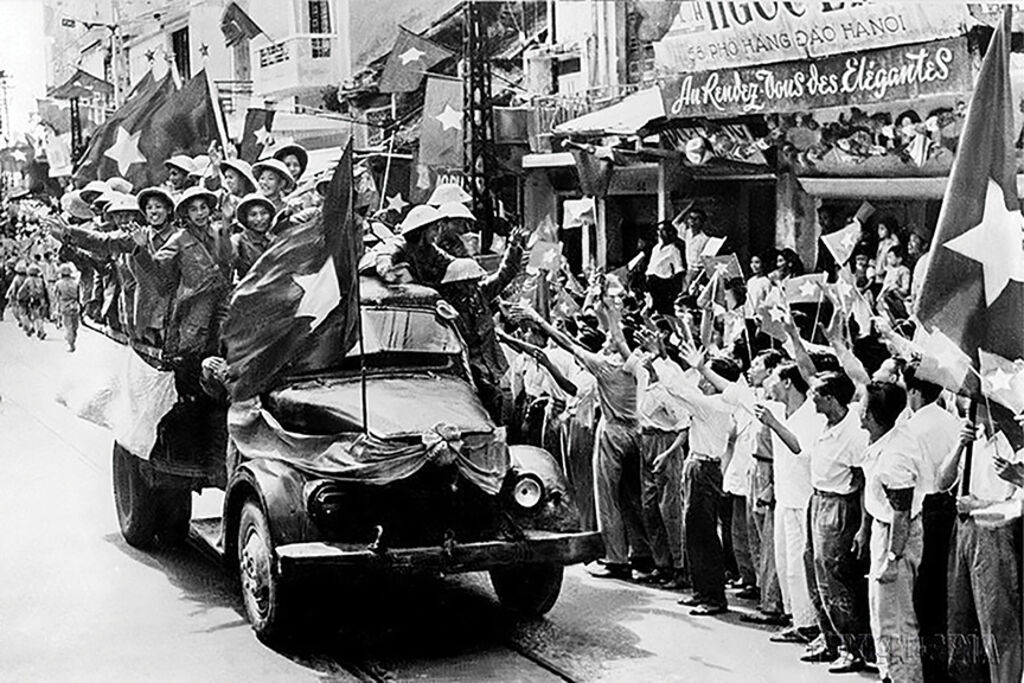 |
| On the morning of October 10, 1954, soldiers of the 308th Vanguard Division, led by the Capital Regiment, march into Hanoi to take over the capital__Photo VNA |
The 1946 Constitution introduced a new model of state
During the constitution-drafting process, the Constitution Drafting Committee, headed by President Ho Chi Minh, worked with the guiding ideology: “to build a democratic Constitution for Vietnam in the spirit of people’s democracy, new democracy.” Accordingly, the committee, after many discussions, designed a new model of state based on appropriate and progressive elements from the state power organisation models of the western and eastern countries, while creatively adapting them to the practical requirements of the Vietnamese revolution.
Regarding the political regime, the 1946 Constitution clearly showed the orientation towards building a “democratic republic” State of Vietnam, a relatively modern, progressive and open country, meeting the requirements of national unity and the purpose of the government in the early stage of national independence, and in line with the modern trend of human civilisation.
The core of the new model of the people’s democratic state embodied in the 1946 Constitution lies in the choice of the People’s Parliament as the highest state organ of power as stated in Article 22: “The People’s Parliament is the supreme organ of power of the Democratic Republic of Vietnam”. Directly elected by voters nationwide, representing the will of the people, the People’s Parliament was not a bourgeois-style parliament. This was a significant difference compared to the constitutions of the then western bourgeois democracies. The Constitution’s provision on the People’s Parliament represented a new form of democracy of the republican regime first established in a colonial, semi-feudal country like Vietnam.
The 1946 Constitution also built a new type of government. According to Articles 43 and 44, the Government was “the highest administrative body of the whole country”, established by the People’s Parliament, and composed of the President, the Vice President(s), and the Cabinet composed of the Prime Minister, possibly Deputy Prime Minister(s), Ministers, and Deputy Ministers. Within the Government’s structure, the President is elected by the Parliament, acting as the head of state who represents the country in internal and external affairs, and also acting as the head the Government with significant powers. The term of office of the President is five years, different from the Parliament’s three-year tenure, and the President “is not held responsible except in case of high treason”. It can be seen that the model of the French Government in the French Third Republic during 1875-1940 significantly influenced the organisation of the Vietnamese Government under the 1946 Constitution for the reason that Vietnam was then a colony directly ruled by France, not to mention the fact that many of the constitution-makers at that time were jurists trained by the French education system, including President Ho Chi Minh who had significant knowledge about France’s political-legal institutions.
However, as per the 1946 Constitution, the Democratic Republic of Vietnam’s Government, established by the People’s Parliament, is not the latter’s executive body, and its cabinet is headed by the Prime Minister.
The 1946 Constitution also established a progressive and modern judicial system. Its Article 63 stipulated: “The judicial bodies of the Democratic Republic of Vietnam include the Supreme Court; Appellate Courts; and Secondary Instance and Primary Instance Courts.” Judges are appointed by the Government. Fundamentally, the constitution organised an independent judicial system with France-influenced organisational and operational principles: Courts are separate from administrative bodies; only courts may perform the adjudicating function; when adjudicating, judges abide only by law, etc. This showed that the revolutionary state, though young, had absorbed the ideas of rule of law and the separation of state powers as the progressive political-legal value, contributing to the protection of justice, human rights and citizens’ rights.
The 1946 Constitution organised local administrations after a new model. It said: “Vietnam is administratively divided into three regions: the North, the Central and the South. Each region is divided into provinces, each province into districts, and each district into communes.” The system of a local administration consisted of People’s Council and Administrative Committee. This was a totally novel way of organising local administration uniquely applied by Vietnamese constitution-makers based on lessons learned from the local administration model of the Soviet Union[6]. The 1946 Constitution also stipulated: “In provinces, cities, towns and communes, there are People’s Councils elected by universal and direct suffrage. People’s Councils of provinces, cities, towns or communes elect Administrative Committees.” “Administrative Committees take responsibility before their superiors and People’s Councils of their localities.”[7]
What made the Constitution special was that People’s Councils were only organised at the provincial and commune levels, meaning that these two levels had both an elected body, i.e., decision-making body, and an executive body. Meanwhile, at the regional and district levels, which were intermediary administrative levels, such structures were not necessarily present in full.
The 1946 Constitution built a flexible operation mechanism for for a state of independence, democracy and modernity
The 1946 Constitution was promulgated to build a state operation mechanism in adherence to core principles while ensuring its flexibility suitable to the country’s conditions. This is manifested in the aspects below.
First, it established the foundational and core principles for organising and operating the state apparatus: “State power belongs to the people.” This principle manifests the essence of the Vietnamese State as a democratic state of the people, by the people and for the people, serving as the foundation for the Party and the Government to formulate policies and strategies to perform all immediate and long-term tasks. The National Assembly and the Government were also organised according to this principle, with the participation of various political forces and socio-political organisations, and with the people exercising their right to mastery through direct and representative democracy forms. Notably, under the Constitution, the people do not delegate all their powers to the State. Instead, they have the right to decide on major national issues: the right to make and to amend the constitution, the right to decide on important matters related to the nation’s destiny, the right to recall elected representatives, etc. Popular sovereignty stood as the core issue, and the principle “State power belongs to the people” became a consistent and overarching foundational principle in Vietnam’s constitutional history. The subsequent constitutions of 1959, 1980, 1992 and 2013 all stipulate this principle.
Second, the 1946 Constitution established a mechanism for exercising the state power with clear and transparent assignment and coordination among agencies in the state apparatus. Throughout the course of building the principles of operation of the state apparatus, the Constitution, though not explicitly stipulating the separation of powers principle, adopted this principle to a certain extent, expressed in the very clear and transparent delegation of the state power with the inspection and supervision mechanism practised among the branches of power.
The 1946 Constitution clearly stipulated the division of powers among the People’s Parliament, the Government and the Courts. The People’s Parliament is the legislative body[8]; the Government is the highest state administrative body[9]; and the Courts are the judicial bodies[10]. The clear demarcation of powers among the three bodies not only helped avoid centralism and authoritarianism but also facilitated specialisation and helped improve the operational efficiency of the state apparatus. The three bodies were independent while applying mechanisms for coordination and mutual supervision, especially between the People’s Parliament and the Government. Establishing the Government, the People’s Parliament may supervise and control the Government’s operations through the right to conduct vote of confidence in a Minister or the entire Cabinet[11]. Meanwhile, the Government may also influence the Parliament through the President’s power to sign bills into laws or request the Parliament to reconsider laws already passed by the Parliament[12]. The Courts were independent, but the judges were appointed by the Government headed by the President.
Third, the 1946 Constitution built a flexible mechanism for operating the state apparatus through the particularly emphasised role of the President. The President concurrently served as the head of state and the head of government. This was a flexible power design aimed at ensuring concentration in running the country when the Government was still young. With such a legal status, the President has very broad and quite independent powers. Notably, as mentioned above, the President had to bear no responsibility except in case of high treason. This provision was quite suitable to our country’s situation at that time, which required a strong administration to unite and rally the entire people for resistance and national construction. At the second session of the first National Assembly in late October and early November of 1946, when speaking about formation of a new government, President Ho Chi Minh declared: “The forthcoming government will be an incorruptible government... a government that knows how to work, has courage, and is determined to achieve its goals, internally for reconstruction, externally for winning independence and national unity.”[13] The constitutional provisions on the Government’s organisational structure and operation, especially the President’s role, met the demands of that time, and also provided President Ho Chi Minh with the legal basis to devise appropriate strategies and policies to steer the Vietnamese revolution through the critical situation. To this day, the Constitution’s provisions on the President are still regarded as the most “unique” and distinctive provisions in the history of the head of state institution in Vietnam.
Conclusion
The 1946 Constitution was the first constitution in the history of Vietnam, the most democratic and progressive constitution in Southeast Asia at that time. It elevated the Vietnamese people from a position of slavers to become masters of the country, the subject holding the highest state power. The people had their fundamental human rights and citizens’ rights recognised and guaranteed. With the provisions on an outstanding feature of the state apparatus organisation model, the 1946 Constitution highlighted the role of the People’s Parliament in supervising the Government; upheld the independence and flexibility of the President; and guaranteed the independence of the Courts. Moreover, the reasonable core provisions of the 1946 Constitution provided many insights during the process of drafting the 2013 Constitution. To this day, these values continue to be studied, used and promoted in the process of reforming the state apparatus and administrative procedures in Vietnam to enhance the effectiveness and efficiency of national governance.-
[1] The Vietnamese version of this article was published on the Journal of History of the Communist Party of Vietnam (the issue of December 2025).
[2] Ho Chi Minh: Complete Works, (2011), Volume 4, National Political Publishing House, Hanoi, p.7.
[3] Articles 9 and 18.
[4] Sun Yat-sen (1866-1925) is revered as the founding father of the Republic of China for his pivotal role in overthrowing the imperial system and founding the first republic in modern China.
[5] Full democracy embraces four rights: the right to election, the right to recall, the right to initiative, and the right to referendum.
[6] The 1936 Soviet Union Constitution stipulated that the bodies of state power in border areas, provinces, autonomous provinces, regions, districts, cities and villages are the Soviets of Working People’s Deputies elected by the working people, and the executive bodies of the Soviets of Working People’s Deputies are the Executive Committees elected by the respective Soviets and accountable to them (Articles 94, 95 and 99).
[7] Articles 58 and 60.
[8] Article 23.
[9] Article 43.
[10] Article 63.
[11] Article 54.
[12] Article 31.
[13] Ho Chi Minh: Complete Works, Volume 4, ibid., p.478.