 |
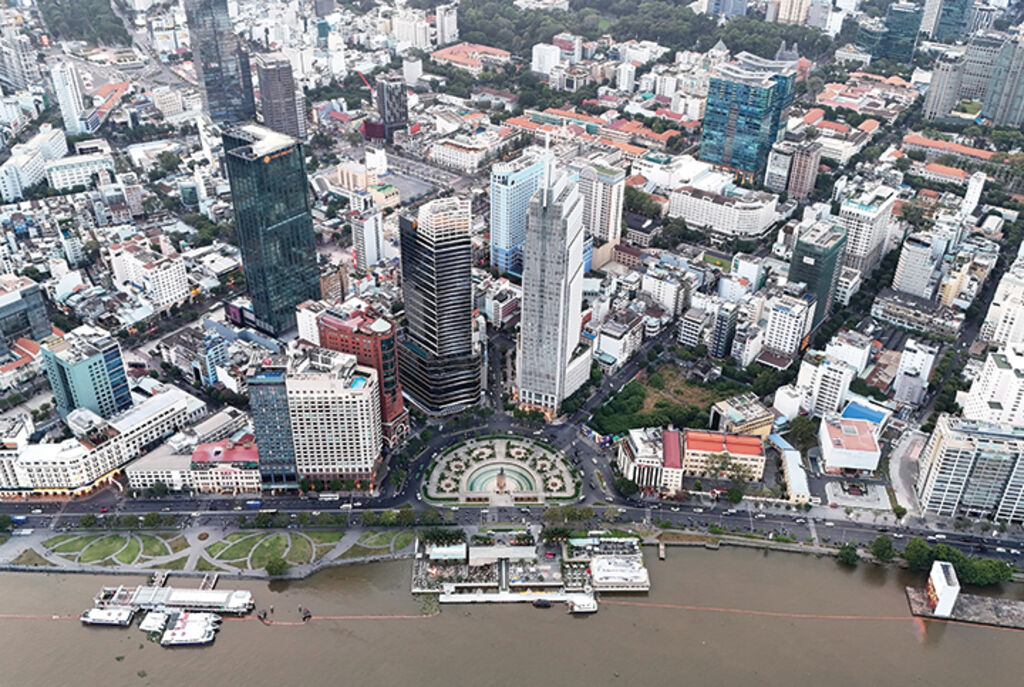
| The Ho Chi Minh City International Financial Center in the Ben Thanh area__Photo: Hong Dat/VNA |
Effective as of January 1, 2026, the Law on Specialized Court at the International Financial Center (IFC) (the Law) provides an integral component and constitutes a critical prerequisite for the effective operation of the IFC.
With 44 articles arranged in five chapters, the Law aims to establish a modern and transparent judicial institution capable of resolving investment and business disputes in the international financial environment, and is expected to enhance the legal certainty for investors, bringing Vietnam’s judicial system closer to international standards and affirming the Vietnamese State’s commitment to reform and international integration.
Special organizational structure and jurisdiction
The specialized court is designed to operate within the system of the people’s courts of Vietnam while enjoying a more flexible organizational and operational mechanism. It is permitted to apply special procedural rules aligned with international standards and practices in order to meet the expectations of both domestic and foreign investors.
Under the Law, the specialized court will be established in Ho Chi Minh City. Its organizational structure comprises a first-instance tribunal, an appellate tribunal and an assisting apparatus. It will be staffed with a chief justice, deputy chief justices, presidents and vice presidents of tribunals, judges, court clerks, other civil servants and workers.
The Chief Justice of the Supreme People’s Court is empowered to decide on the establishment and define functions, tasks and powers of the assisting apparatus of the specialized court.
As per Article 13 of the Law, the specialized court has jurisdiction to settle (i) investment and business disputes among IFC members, or between IFC members and non-member organizations or individuals; (ii) requests for recognition and permission for enforcement in Vietnam of judgments and rulings of foreign courts and foreign arbitral awards for disputes among IFC members or between IFC members and non-member organizations or individuals; (iii) requests relating to arbitral settlement of disputes among IFC members, or between IFC members and non-member organizations or individuals, in accordance with the law on commercial arbitration; and (iv) other cases or matters relating to investment and business activities at the IFC in which at least one party is an IFC member, as determined by the Supreme People’s Court.
Upon the occurrence of a jurisdictional dispute between the specialized court and other people’s courts, the chief justice of the specialized court will decide whether or not the case falls under the specialized court’s jurisdiction. Any complaints against such decision will be resolved by the Supreme People’s Court whose decision will be final.
Judge appointments
In order to consolidate foreign investors’ confidence in dispute settlement and safeguard the independence, credibility and professional standards of the specialized court, the Law broadens the sources of judicial appointments. Accordingly, judges of the specialized court may be either foreign nationals or Vietnamese citizens. Appointments may be made by the President based on proposals of the Chief Justice of the Supreme People’s Court, with each judge serving a five-year term of office from the date of appointment.
Foreigners wishing to be appointed as judges must fully meet such criteria as (i) having served or currently serving as judges; (ii) being reputable lawyers or experts with good moral quality, appropriate professional qualifications, and a deep grasp of investment and business laws of Vietnam; (iii) having at least 10 years’ experience in adjudicating or resolving cases and matters related to investment and business activities; (iv) demonstrating proficiency in English in order to conduct proceedings at the specialized court; and (v) being no more than 75 years of age and in good health for duty performance.
For Vietnamese citizens, the Law sets out different standards based on the source of appointment.
To be appointed as judges of the specialized court, civil servants, lawyers, arbitrators, university lecturers, scientists or other experts are required to meet high professional and ethical standards and possess relevant expertise and in-depth knowledge about investment and business laws. They must also have at least 10 years’ experience in resolving investment- and business-related cases, have sufficient English proficiency, and be no more than 75 years of age and in good health for judicial duty performance.
Meanwhile, appointees selected from among sitting judges of the people’s courts will have to demonstrate adequate professional expertise and understanding of investment and business laws. They must also have at least 10 years’ experience in adjudicating or resolving disputes and possess English proficiency to perform judicial duties at the specialized court.
Novel adjudication model
Regarding the composition of trial panels, the Law stipulates that first-instance cases are to be heard by a single judge, without the involvement of assessors. In complex cases, and at the request of the parties, the specialized court’s chief justice may decide that the first-instance trial be conducted by a panel of three judges. Appellate hearings will be held by a three-judge panel.
For transactions involving at least one foreign individual or organization, the Law allows the parties to agree on the application of Vietnam’s law, foreign law or international practices among commercial courts. Appellate judgments and rulings are final and will not be protested against according to cassation or reopening procedures.
The Law permits the extensive use of electronic procedures in the adjudication and settlement of cases at the specialized court. The filing and processing of lawsuits, notification of procedural documents, payment of court fees and litigation costs, submission of documents and evidence, hearings, and other procedural steps may also be carried out electronically. The Supreme People’s Court is tasked with developing an electronic specialized court to adjudicate and resolve cases and matters.
The spoken and written language used in the specialized court’s judgments and rulings is English or English accompanied by Vietnamese translations.- (VLLF)