Tran Nam Anh
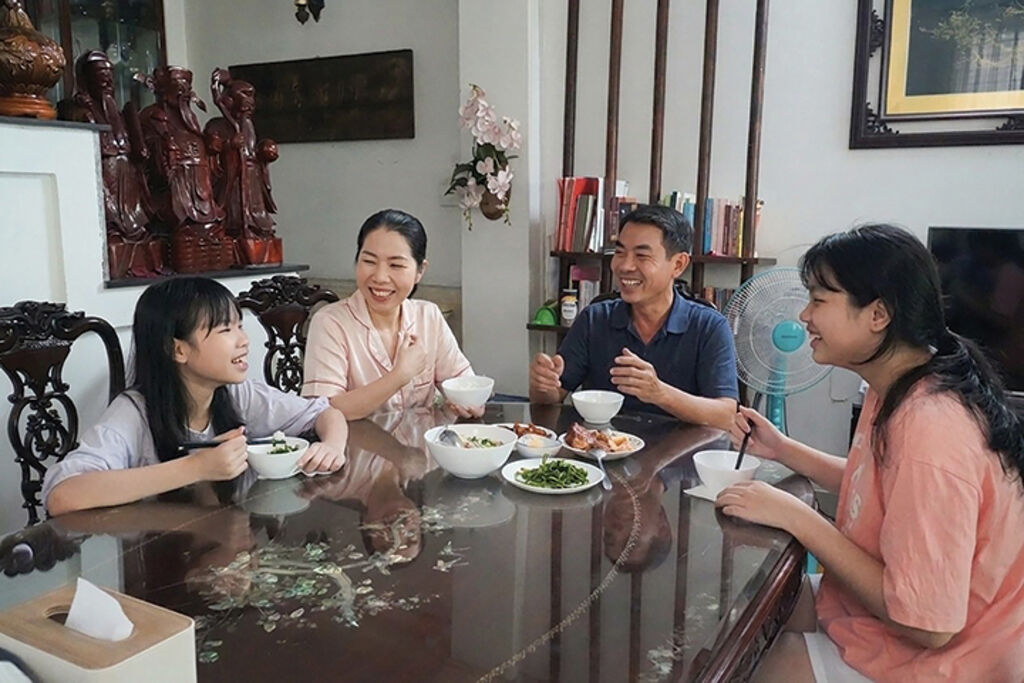 |
| A family enjoys a meal together__Photo: Huu Duyen/VNA |
Introduction
The development of marriage and family law in Vietnam reflects broader changes in the country’s legal system and society, particularly in the status of women, matrimonial property relations and individual autonomy. From feudal regulations influenced by Confucian principles to modern legislation recognising greater freedom and equality within marriage, each stage has marked a shift in the legal treatment of family relations. Alongside these developments, new issues such as prenuptial agreements, digital assets and intellectual property rights are presenting challenges for the existing legal framework.
From feudal traditions to progressive legal values
Throughout Vietnamese history, the family has occupied a particularly important position, not only as a unit for maintaining family lineage but also as a social institution associated with moral norms and community order. Marriage and family relations consequently became subject to legal regulation from an early stage.
During the feudal period, marriage was regarded not merely as a union between two individuals but also as an arrangement closely linked to family interests and lineage continuity. Under the influence of Confucian thought, family relations were organised according to hierarchical principles, with decision-making power concentrated in the hands of male heads of the household.
The traditional practice of allowing parents to determine their children’s marriages reflected the limited freedom of individuals to choose their spouses. In many cases, marriages were arranged by parents rather than based on the free consent of the prospective spouses.
Moreover, male preference, polygamy and restrictive moral norms placed women in a disadvantaged position regarding autonomy in matters of marriage, property ownership and the termination of marital relationships.
However, Vietnamese feudal law was not entirely uniform in its treatment of women’s interests. The Quoc Trieu Hinh Luat (National Dynasty Penal Code), commonly known as the Hong Duc Code, promulgated under the Le dynasty, contained notable provisions on property, inheritance and family relations, including certain rights for women. These provisions suggest that, alongside Confucian influence, traditional Vietnamese law also reflected distinct features of local economic life and indigenous customs.
Under the Nguyen dynasty, the Hoang Viet Luat le (Vietnamese Imperial Code), commonly known as the Gia Long Code, continued to regulate family relations within a predominantly patriarchal legal framework.
During the French colonial period, the absorption of Western legal concepts introduced certain changes in the civil and marital spheres. Provisions on marriage, matrimonial property relations and divorce were gradually incorporated into more systematic legal documents. However, due to the colonial administrative apparatus, the legal regimes at the time were not uniformly applied across the three regions. Whilst some urban areas were increasingly influenced by Western civil-law concepts, many rural areas continued to maintain traditional marriage customs. Consequently, child marriage, forced marriage and inequalities between spouses persisted.
Overall, marriage and family law before the August Revolution of 1945 reflected an interweaving of indigenous traditions, Confucian thought and foreign legal elements. Despite the emergence of certain progressive provisions, freedom of marriage and substantive equality between spouses had yet to become consistently established principles of the legal system.
The August Revolution and the transformation of marriage and family law
The August Revolution marked a turning point in the construction of the Vietnamese State and legal system, including the regulation of marriage and family relations.
The establishment of a new social regime required the transformation of unequal family relations, gradually liberating women from feudal constraints and protecting individual freedom in marriage.
In the early years following independence, despite great difficulties, the Democratic Republic of Vietnam promulgated important legal documents laying the groundwork for reform. These included Decree 97-SL of May 22, 1950, amending certain rules in civil law, and Decree 159-SL of November 17, 1950, on divorce.
Decree 97-SL embodied progressive thinking by recognising the independent legal capacity of married women and gradually abolishing restrictions on their civil rights. Decree 159-SL created a legal basis for the settlement of divorce cases, including divorce by mutual consent. These provisions represented a change in the concept of family: marriage was no longer seen as a relationship to be maintained at all costs, regardless of the wishes or interests of the parties.
A decisive milestone was the adoption of the Law on Marriage and Family on December 29, 1959, which entered into force on January 13, 1960. As the first marriage and family law of the Democratic Republic of Vietnam, it established a new system of principles: free and progressive marriage, monogamy, equality between men and women, and protection of women and children.
The recognition of voluntary marriage was particularly significant. The right to decide on marriage belonged to the man and woman themselves, rather than depending on parental wishes or arrangements between families. The Law stipulated a minimum marriage age of 20 for men and 18 for women, prohibited forced marriage and provided the legal basis for abolishing polygamy.
In spousal relations, the Law shifted from privileging the husband’s authority to recognising equality between spouses. This was not only a legislative achievement but also a profound social reform.
During the period of national division from 1954 to 1975, marriage and family law in southern Viet Nam developed differently. The Republic of Viet Nam promulgated the 1959 Family Law (Law 1/59), Decree-Law 15/64 and the 1972 Civil Code. Although these documents abolished polygamy, aspects of their provisions continued to reflect patriarchal conceptions of marital relations, particularly regarding the husband’s status. Notably, Law 1/59 prohibited divorce, reflecting a legislative approach that prioritised the preservation of marriage while imposing significant restrictions on individual autonomy.
From national reunification to the doi moi (renewal) era
Following national reunification in 1975, the need to build a unified legal system became urgent. The progressive principles introduced by the 1959 Law on Marriage and Family continued to provide the foundation for improving marriage and family law.
The 1986 Law on Marriage and Family, passed on December 29, 1986, retained the previously established basic principles whilst specifying the rights and obligations of spouses and of parents and children, and emphasising marriage registration as the legal basis for the State’s recognition and protection of marital relations.
By the late 20th century, with the development of the multi-sector economy, business activities and property relations became more diverse. The 2000 Law on Marriage and Family, effective from January 1, 2001, marked significant progress by focusing on the identification of common and separate property of spouses and the settlement of disputes during marriage and upon divorce. Family property no longer consisted mainly of land and housing but also included assets formed from production, business and investment activities. The Law also devoted a separate chapter to marriage and family relations involving foreign elements (inter-country marriages). However, it continued to prohibit same-sex marriage and did not recognise surrogacy.
The 2014 Law on Marriage and Family, which was adopted on June 19, 2014, and entered into force on January 1, 2015, marked a new stage and remains the primary legal foundation to this day.
One significant change was the expansion of spousal autonomy in property relations. Previously, only the statutory matrimonial property regime existed. Under Articles 47 and 48 of the 2014 Law, before marriage, a man and a woman may enter into a written agreement on common and separate property, which must be notarised or authenticated and takes effect from the date of marriage registration. This represents a shift from imposing a framework to recognising individuals’ autonomy in arranging the family’s financial matters.
Another important development was the introduction of gestational surrogacy for humanitarian purposes under strict conditions, creating a legal basis to support couples experiencing infertility while preventing commercial surrogacy.
The law also introduced a different approach to same-sex marriage. Rather than expressly prohibiting such marriages, it provides that the State does not recognise marriage between persons of the same sex. Although same-sex marriage remains legally unrecognised, this change marked a shift from an explicit prohibition towards defining the scope of the State’s recognition.
The law also strengthened child protection, affirmed equality among children regardless of their parents’ marital status and enshrined the principle that domestic labour is regarded as income-generating labour when dividing common property upon divorce. This is of great significance for protecting spouses who devote time to childcare and household responsibilities.
The 2014 Law has subsequently been amended and consolidated, and continues to provide the principal legislative framework governing marriage and family relations in Vietnam.
Core progressive values and emerging challenges
Looking back, progress lies not only in the number of enacted laws but also in core legal values.
A fundamental change is the transition from marriage dominated by family and clan interests to marriage based on individual voluntary consent. Voluntary consent is both a condition for the validity of a marriage and a basis for protecting individual dignity.
Another important achievement is the establishment and consolidation of substantive gender equality. Where women once faced restrictions on their personal and economic rights, the law now recognises equality in decisions concerning residence, the organisation of family life, childcare and property management, and acknowledges the value of domestic work.
A further development is the expansion of autonomy in property relations, coupled with the legal responsibilities of family members. Property agreements must comply with the law and not infringe upon the interests of family members and third parties, reflecting a balance between individual freedom and legal responsibility.
However, the existence of progressive principles does not mean that backward customs have disappeared. Child marriage, forced marriage, domestic violence and prolonged disputes over property and child custody still require greater public awareness and stronger enforcement.
In modern society, the market economy and technological developments pose new challenges.
One emerging issue concerns prenuptial agreements. In practice, many couples, especially those engaged in business and investment activities or owning high-value property, wish to reach an agreement on property arrangements before marriage to prevent future disputes. The 2014 Law on Marriage and Family recognises a matrimonial property regime by agreement, but its scope is limited to the determination of common and separate property and the principles of division, rather than providing for a comprehensive prenuptial contract as understood in some jurisdictions. Personal relations, maintenance and child-rearing obligations must still comply with mandatory provisions and cannot be excluded by agreement. There is a need to clarify the content, scope and legal effects of prenuptial agreements while ensuring that such agreements do not exclude basic obligations or infringe upon children’s rights.
Another challenge concerns new forms of assets. While assets were traditionally mainly tangible, they now include online business platforms, rights to exploit digital products, crypto-assets and intellectual property. The 2025 Law on Digital Technology Industry, effective on January 1, 2026, provides for digital assets, creating a basis for the identification and management of such assets. However, the verification of their origin, valuation and division upon divorce remains complex due to electronic storage, ease of transfer and special authentication mechanisms, which require improvements in evidentiary mechanisms.
A further issue involves intellectual property rights within marriage. A literary work, an invention or a trademark may generate substantial income. Under the 2014 Law on Marriage and Family, yields and profits arising from separate property during marriage are, in principle, treated as common property, whilst intellectual property rights are separate property. It is necessary to distinguish between the intellectual property rights themselves and the income derived from their utilisation. When intellectual property is created during marriage with an indirect contribution from the other spouse through family care, the assessment of contributions must be fair and adhere to the principle that domestic labour is regarded as income-generating labour.
Ultimately, the objective of marriage and family law is not only to regulate relations but also to create a solid legal foundation for each family to become a safe, equal and humane environment, contributing to sustainable social development.-