 |
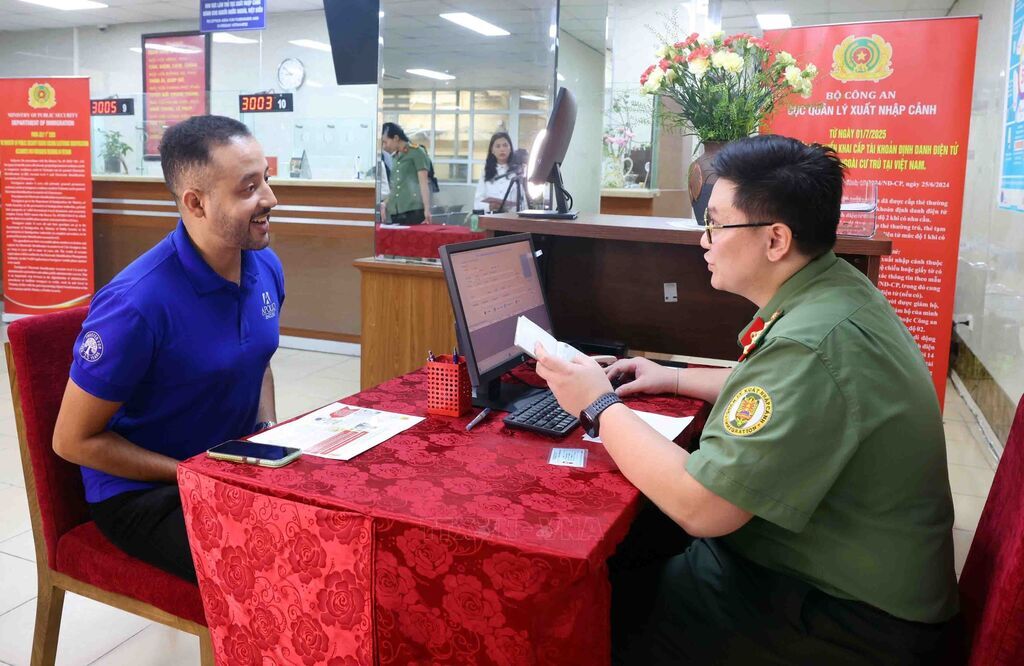
| The MPS' Immigration Department officer guides a foreigner residing in Vietnam to complete procedures for obtaining an e-identification account__Photo: VNA |
The proposal, outlined in a draft decree recently submitted to the Ministry of Justice for appraisal, would replace the current Government Decree 65/2015, which officials say no longer reflects current realities.
Authorities say there is a need to ensure more effective management of foreign nationals while supporting Vietnam's broader economic and talent attraction goals.
According to the ministry, 222 criminal cases involving foreign nationals were recorded nationwide in 2024, with 228 suspects. Authorities also imposed administrative penalties on more than 10,000 foreigners and handled nearly 2,500 cases of illegal entry or stay - a 126 per cent increase year-on-year.
In 2025, more than 21,500 violations of various degrees were detected, mostly involving overstay, illegal entry, misuse of visa purposes, or failure to meet sponsorship obligations. Dozens of cases linked to organising illegal entry or residence were also prosecuted.
Gaps in coordination
Officials say current regulations, which require ministries and localities to provide data on foreign residents only upon request, have led to fragmented oversight.
In practice, this has resulted in local administrations relying heavily on provincial-level police forces to compile statistics and monitor the situation, rather than maintaining a shared system of information exchange.
The proposed changes aim to address this by clarifying responsibilities and mandating more regular data sharing among ministries, agencies and local governments.
Under the draft decree, the Ministry of Public Security (MPS) would take the lead in sharing policies and operational measures with the Ministry of Foreign Affairs, the Ministry of National Defence, other relevant bodies and provincial authorities.
Immigration authorities would notify border control units under the defence ministry about foreigners granted visas at international checkpoints before their arrival. The Ministry of Foreign Affairs would be required to update visa and temporary residence data on the national immigration database, or transfer such information to immigration authorities within five working days of issuance.
In addition, ministries and local governments would be tasked with coordinating closely on data related to visas, investment registration certificates, enterprise registration, work permits, professional licences, training programmes and conferences involving foreign nationals – including those entering under e-visas or visa exemptions.
Balancing control and openness
The public security ministry emphasised that stronger coordination is essential as Vietnam rolls out more open and preferential immigration policies to attract highly skilled workers, experts and scientists –particularly in strategic sectors such as semiconductors and core digital technologies – to stimulate national economic development.
These groups are increasingly being drawn to emerging economic models, including planned international financial centres and free trade zones.
The MPS would coordinate inspections with other ministries and local authorities to ensure compliance with the new rules.
Cases detected by border control units under the Ministry of National Defence would be handled within their jurisdiction. Where criminal signs fall under the investigative authority of the public security forces, coordination mechanisms would be activated for joint handling.- (VNS/VLLF)