 |
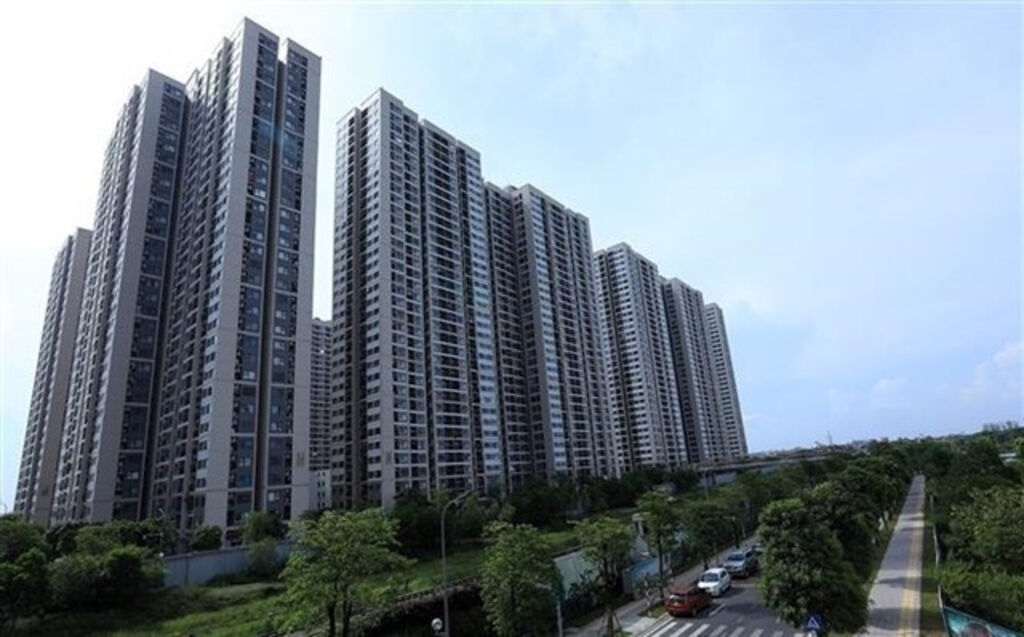
| A residential apartment project in Hanoi __Photo: VNA |
The Ministry of Construction (MOC) has submitted to the Government a draft Resolution on the pilot development of affordable commercial houses, proposing a raft of incentives to encourage developers to enter this new segment of the housing market.
As per the proposal, provincial-level People’s Committees would decide on the development of affordable commercial housing projects based on the people’s actual demand. They would be vested with authority to formulate or adjust housing development programmes and plans, permitting the formulation or revision of detailed plans concurrently with zoning plans or master plans.
Regarding land allocation, local authorities would reserve land areas for affordable commercial housing projects and determine the land categories eligible for such development. Land use levy and land rental would be calculated based on land prices in official land price tables and the law-specified applicable land price adjustment coefficients.
Provincial-level People’s Committees would approve investment policies for eligible projects and directly assign project owners without going through auction or bidding procedures. Project owners might also choose to carry out construction procedures such as appraisal of feasibility study reports, fire safety appraisal, and issuance of construction permits, either under the pilot mechanism applied to social housing development or in accordance with current construction regulations.
Noteworthily, the draft resolution specifies that project owners may enjoy a maximum profit ratio of 15 per cent of total construction investment of their projects. They would not be required to allocate land areas within their projects for social housing development and would face fewer conditions for capital raising. They may access preferential loans with lower interest rates and longer terms compared to those for conventional commercial housing projects.
Provincial-level People’s Councils would also be allowed to give additional incentives within their authority and in compliance with relevant regulations.
Project owners would determine sale and lease-purchase prices based on the principle of fully and accurately accounting for land and construction investment expenses and other related expenses, plus a maximum regulated profit ratio of 15 per cent of total project investment. They would have to make and submit audit and account-finalisation reports to specialised agencies under provincial-level People’s Committees for verification of sale and lease-purchase prices.
Every Vietnamese citizen would be permitted to purchase or hire-purchase only one house from project owners and would not be allowed to resell such house within the first five years. Purchasers would be refunded the difference if the audit results show that the sale or lease-purchase prices are lower than the contracted prices, and would not be required to pay additional amounts if the audit results show the contrary.
According to the MOC, the resolution is scheduled to come into force from the date of its signing until February 28, 2027.
Expressing support for the draft resolution, Nguyen Van Dinh, Vice Chairman of the Vietnam Real Estate Association, said the development of affordable commercial housing projects would serve as an intermediate pillar in the housing ecosystem, helping bridge the gap between social housing and high-end commercial housing.
Nguyen Anh Que, Chairman of the Board of Directors of G6 Group, said the incentives proposed in the draft resolution are quite attractive compared to current incentives for commercial housing projects.
Once adopted, the resolution could provide a valuable opportunity for both real estate developers and homebuyers whose financial capacity exceeds the threshold for social houses but who still find it difficult to access high-end commercial houses.- (VLLF)