 |
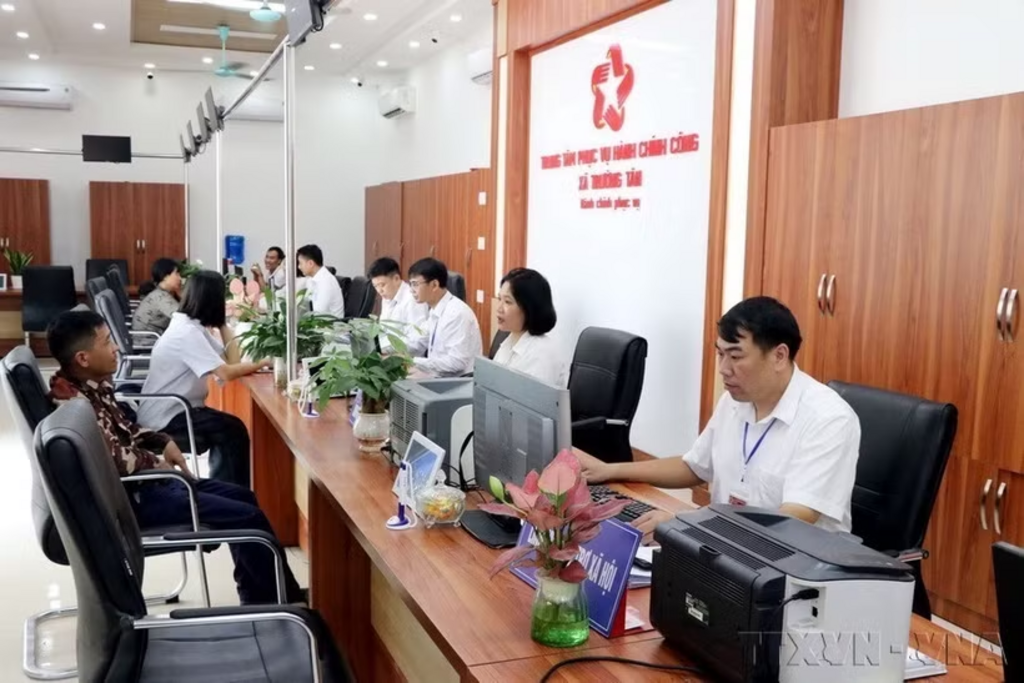
| The Public Administrative Service Centre of Truong Tan commune, Hai Phong city, operates on both Saturdays and Sundays to serve citizens__Photo: VNA |
Vice President and General Secretary of the Vietnam Fatherland Front (VFF) Central Committee Ha Thi Nga on June 18 signed a plan to organise activities in the “Month for listening to the people”.
Under the plan, activities will be carried out nationwide at all administrative levels, from provinces and centrally run cities to communes, wards and special zones. VFF committees and socio-political organisations are required to engage directly with local communities through dialogues and meetings, with special attention given to vulnerable groups and those outside mass organisations.
The effectiveness of the initiative will be measured by the actual resolution of public concerns and the satisfaction of residents, members and affiliates. The plan aims to ensure that 100 per cent of petitions, recommendations and feedback are forwarded to competent authorities for handling within the prescribed timeframe.
The activities will be organised annually, linked to the traditional commemorative days of each organisation and aligned with the mandates of VFF committees and socio-political organisations.
A key feature of the programme is the organisation of “People’s Forums” or “Listening to the People” forums. At the central level, direct dialogues between Party and State leaders and the public will continue, focusing on major policies and issues affecting people's lives. Citizens will be encouraged to contribute opinions, express aspirations and propose solutions to practical challenges.
At provincial and grassroots levels, forums will be organised according to local conditions, with priority given to commune-level and residential community gatherings.
Discussion topics will include improving the operation of the two-tier local administration model; preserving cultural and historical values; mobilising public resources for private-sector development, innovation and technology application; policies on ethnicity, religion and social welfare; land management, urban planning, major infrastructure projects, environmental protection, healthcare, education, food safety, new-style rural building and other matters of public concern.
Annual listening themes will be selected based on local priorities, focusing on socio-economic development policies, livelihood-related programmes, social welfare, issues affecting specific demographic groups and unresolved concerns repeatedly raised by residents.
Forums may be held in person, online or in hybrid formats. Digital platforms, social media channels and official communication outlets will be used to collect feedback from residents, members and affiliates.
The plan also calls for maintaining and expanding effective public engagement models already implemented across the country, while encouraging localities to develop new initiatives suited to their circumstances. Authorities are urged to diversify channels for public participation through digital technologies, ensuring that all feedback is recorded in a centralised system and that progress and outcomes are publicly disclosed to enhance transparency and public oversight.
The initiative also emphasises strengthening citizen reception and direct dialogue between Party committees, local administrations and residents, particularly at the grassroots level. Commune leaders and local officials are encouraged to meet residents regularly to better understand their concerns and aspirations.
Successful engagement models will be reviewed, promoted and multiplied nationwide. Localities are also encouraged to organise cultural, sports and community activities alongside the programme, as well as exhibitions highlighting effective initiatives and achievements in addressing public concerns.
To broaden public participation, a dedicated “Month for listening to the people” section will be launched on the Digital Front Portal, alongside specialised pages on VFF and socio-political organisation media platforms. Responsibilities for receiving, processing and responding to public feedback will be clearly assigned, and results will be publicly disclosed to facilitate public monitoring.
The Standing Board of the VFF Central Committee requested central socio-political organisations and provincial-level VFF committees to promptly develop implementation plans suited to local conditions.
Every six months, annually, and before and after National Assembly and People's Council sessions, provincial VFF committees and socio-political organisations will submit reports summarising implementation results and public recommendations to the VFF Central Committee for consolidation and forwarding to the National Assembly and relevant agencies, while monitoring the settlement of public concerns.- (VNA/VLLF)