Le Van Chien, Phung Duc Tung, Vu Thai Hanh, Dang Anh Tuyet, Pham Minh Thanh and Do Thanh Huyen
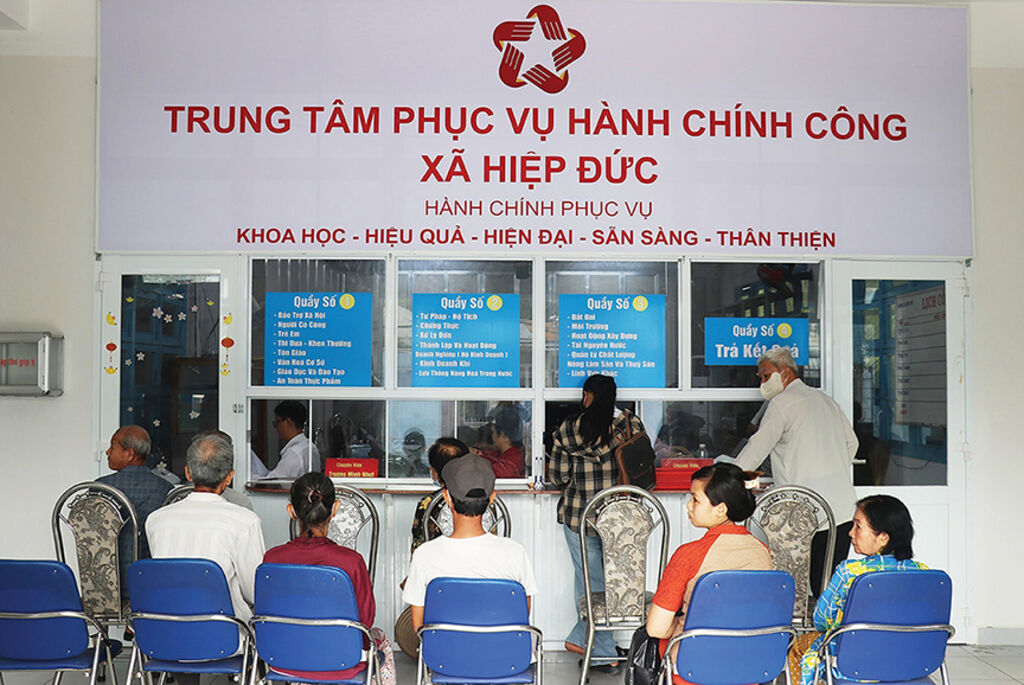 |
| Citizens awaiting the settlement of administrative procedures at the Public Administration Service Centre of Hiep Duc commune, Dong Thap province__Photo: Huu Chi/VNA |
Introduction
On July 1, 2025, Vietnam operationalised a landmark administrative restructuring, transitioning from a three-tier to a two-tier local government model. The study “Rapid assessment of public service delivery in the context of two-tier local government” evaluates the early-stage impact of this transition - which abolished the district tier and transferred state management functions to the grassroots level regarding public service delivery. Utilising a mixed-methods design, the research, conducted in the first quarter of 2026, synthesises quantitative data from a nationwide telephone survey of 4,932 citizens (including 299 persons with disabilities) with qualitative evidence from case studies in Bac Ninh and Hung Yen provinces.
This article presents key qualitative and quantitative findings and their policy implications. For the qualitative component, the article focuses on an analysis of citizens’ experiences since the two-tier local government model was implemented. For the qualitative component, the article synthesises documentary evidence and analyses the current state of public service delivery from the perspective of cadres and civil servants, those who directly perform civil service duties in Bac Ninh and Hung Yen provinces. Drawing on both quantitative and qualitative research findings, the article provides a number of evidence-based policy implications, as well as room and opportunities for local governments in the 2026-31 term to implement far-reaching changes to meet the expectations of both citizens and grassroots-level cadres and civil servants.
Key research findings indicate trust in but identify gaps in access to public services in the two-tier government context
The nationwide telephone-based survey with a sample of 4,932 citizens, among whom 299 are persons with disabilities, was conducted from January to March 2026 - a period of six to eight months after the apparatus restructuring. The questionnaire was designed to capture citizens’ perceptions and experiences of using essential public services during this period. The survey focused on four thematic areas: trust and priorities, e-service experiences, access to essential services (health and education), and environmental quality assessments, thereby identifying citizens’ perspectives on accessing and using public services in the post-transition period.
Citizens’ trust and priorities
Citizens’ trust in the restructuring of the local government system
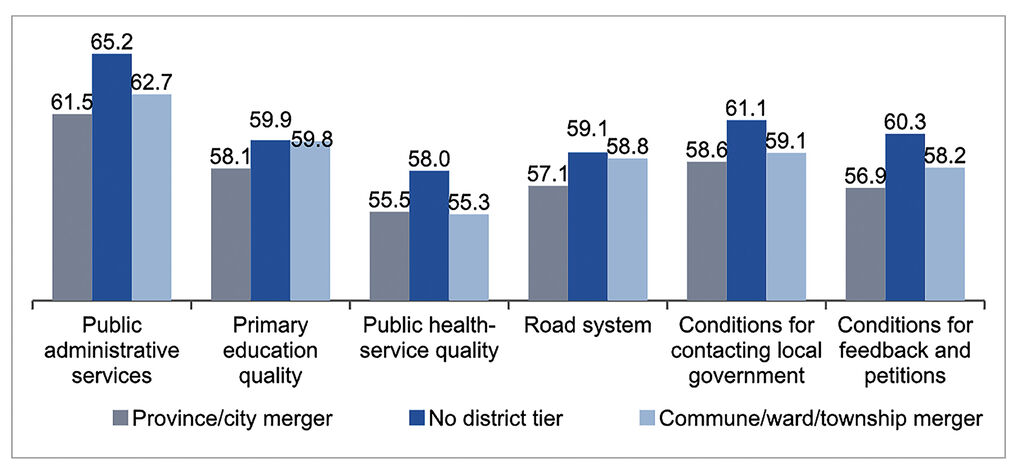
The initial phase of the transition suggests a robust degree of public buy-in for the government’s streamlining efforts. Survey results indicate that citizens view the restructuring from three tiers to two tiers positively, with the abolition of the district tier identified as the primary contributor to improvements, albeit modest, in public administrative services. As Figure 1 indicates, respondents specifically noted that the reduction of intermediate layers created more direct conditions for contacting local authorities and filing complaints.
Figure 1: Share with POSITIVE assessments by scenario (% of respondents)
 |
Despite this broad support, the data reveals a significant gap in direct interaction between citizens and commune-level authorities and grassroots-level government representatives in the first eight months following the transition. The percentage of respondents reported having contacted commune/ward officials and village heads/residential group leaders was low at 8.63 per cent and 16.84 per cent, respectively. Concurrently, the rate of positive assessment of the effectiveness of such meetings was only at 81.5 per cent and 84 per cent for the two positions, respectively. This reflects adjustment challenges as roles and procedures were being reorganised during the early phase of the transition. These results also indicate that nearly 20 per cent of respondents assessed the outcomes of their meetings with local authorities as unsatisfactory. For cadres closest to the people, such as commune-level officials and village/hamlet heads, the rate of positive assessment is generally expected to exceed 90 per cent.
Citizens’ priorities in the new context
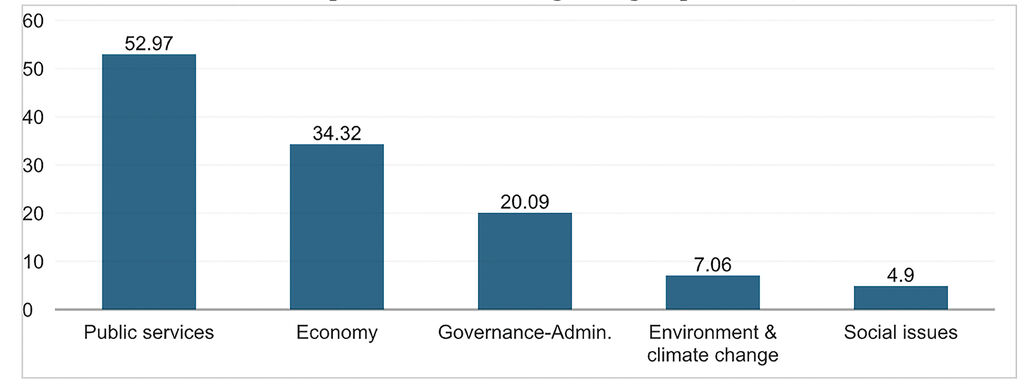
When asked to identify the most pressing issues for the State to address in this new context, citizens’ expectations were firmly rooted in daily service delivery rather than abstract political reform. As Figure 2 indicates, the top five priorities are: (i) public service delivery, (ii) economy growth, (iii) governance and public administration, (iv) environmental quality and climate change; and (v) social issues. Notably, more than half of respondents (53 per cent) mentioned public service-related issues.
Figure 2: Top five groups of issues respondents expect the State to prioritise (% of respondents mentioning each group of issues)
 |
Regarding specific priorities, areas closely tied to citizens’ direct and frequent experiences - such as transport, education, healthcare, administrative procedures, and taxes/fees - were most frequently cited. In addition, concerns about environmental and climate change issues were also notable. Conversely, concerns regarding corruption were mentioned by only 0.3 per cent of respondents, far lower than issues tied to daily survival.
Assessment findings also focused on the experiences of persons with disabilities, based on their own assessment, reveal increased service access challenges for persons with disabilities in the new context. Although the most-cited groups of issues do not differ substantially from those of the general population (public services, the economy, and governance and public administration), respondents who are persons with disabilities held less positive assessment of their current household economic situation and are more pessimistic about future household economic prospects.
Digital divide and administrative efficiency as experienced by citizens
Assessment of National E-Service Portal usage
A cornerstone of the two-tier transition was the consolidation of digital entry points. As of July 1, 2025, 63 provincial e-service portals were discontinued, establishing the National E-Service Portal (NESP) as the sole “electronic one-stop shop” for citizens. However, the assessment indicates that the “digital shift” has not yet reached a critical mass of the population, revealing a state of institutional and operational disequilibrium.
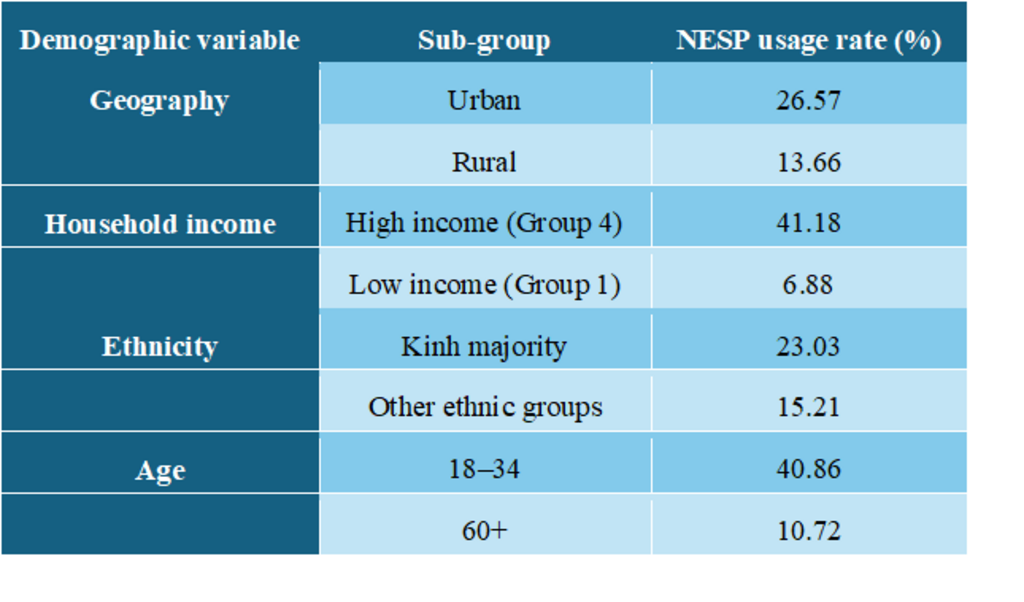
Rapid survey results indicate that only 21.8 per cent of citizens utilised the NESP post-transition. However, disparities in NESP usage rates across population groups remain substantial. As Table 1 shows, usage rates are higher among younger people, urban residents, higher-income earners, and the Kinh ethnic majority compared to other groups.
Table 1: Digital inequality and NESP usage rates
 |
Meanwhile, user satisfaction with online public administrative services on the NESP remained modest at 87 per cent, with 27 per cent of citizens encountering difficulties during use and 34 per cent expressing concerns about personal data security. The most notable disparity between persons without and with disabilities lies in access to the NESP. Only 6.4 per cent of persons with disabilities reported they have used the NESP, a 15.4 percentage point deficit compared to those without disabilities. This is driven by lower rates of internet access (79.79 per cent vs 90.23 per cent) and computer ownership (26.76 per cent vs 49.95 per cent). This indicates that the NESP has considerable room for improvement in expanding the user base, improving user experience and building user trust, underscoring the urgency of continued system optimisation, particularly as user numbers increase.
Varied satisfaction with civil and land administrative services provided by commune-level governments
Following the transition, citizens’ experiences with administrative procedures at commune-level authorities during the initial phase of the two-tier local government were assessed as fairly satisfactory. Satisfaction with commune-level administrative procedural services scored 4.1 on a scale of 1 to 5. The proportion of citizens having to make multiple trips or go through numerous intermediary steps to complete procedures stood at 11.26 per cent. At the same time, indicators reflecting the professional competence of civil servants and timeliness of results delivery stood at 91 per cent and 94 per cent, respectively, as assessed by citizens who completed procedures post-transition. In addition, nearly 3 per cent of citizens still had to use “brokers” for administrative procedures, and nearly 4 per cent still had to pay unofficial fees to get things done. For persons with disabilities, they reported lower satisfaction and less positive assessments of the transparency of procedural fees and the professional competence of civil servants responsible for processing administrative procedures.
The assessment of land use rights certificates (LURC) reveals the most pronounced “functional overload” at the commune level. As a complex mandate previously managed at the district level, LURC delivery lags significantly. The on-time delivery rate for LURCs was only 71 per cent, and the usage of “middlemen” or brokers stood at around 12 per cent - nearly 10 percentage points higher than for other civil administrative procedures also processed by commune government personnel. This disparity highlights the “inter-sectoral friction” where complex legal tasks have been transferred without sufficient procedural standardisation or specialised training for commune staff. Despite this, a positive finding is that the proportion of users who did not have to pay unofficial fees to complete LURC procedures was high, at nearly 94 per cent.
Citizens’ assessment of essential public services: room to improve quality
The transition aimed to strengthen primary healthcare and education, yet the findings suggest that citizens still rely heavily on higher-level facilities, reflecting a “perceived quality deficit” at the grassroots level.
Healthcare bypassing and insurance gaps
The incidence of patients bypassing the designated referral level for medical treatment was fairly high following the local government restructuring. As shown in Figure 3, the proportion of citizens using services at provincial-level hospitals was 34.47 per cent and was primarily prevalent among higher-income households. In contrast, only 1.4 per cent of the citizens utilised commune health stations in the latter half of 2025. The proportion attending regional health centres (district-level hospitals prior to the transition) was approximately 40 per cent, more prevalent among rural households.
Figure 3: Percentage of respondents seeking care at medical facilities in provinces/cities since July 1, 2025
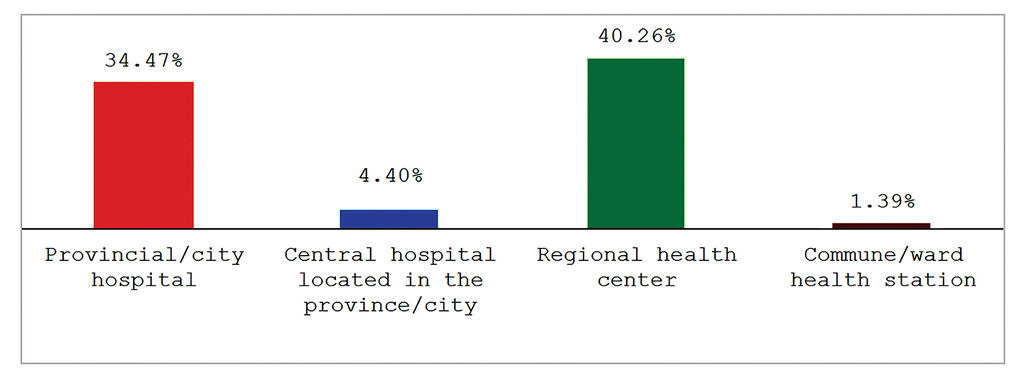 |
These findings indicate that public trust in the quality of grassroots-level healthcare services at regional health centres remain low, despite some positivity in basic service condition indicators at regional health centres. Notably, the proportion of patients treated at regional health centres who reported “the injury/disease was cured” was only 85 per cent, and approximately 12 per cent reported having to share a bed with another patient. These indicators reflect both challenges and opportunities in ensuring the quality of healthcare services at the regional and commune levels going forward.
Health insurance (HI) coverage is remarkably high but the effectiveness of protection during the most recent medical visit has not been commensurate. The national HI coverage is at 93.19 per cent; however, its perceived effectiveness is lagging. Only 82.78 per cent of respondents felt that HI provided adequate financial protection for their most recent visit. This financial protection gap may be linked to the bypassing trend reported earlier.
Access to public primary education: quality matters
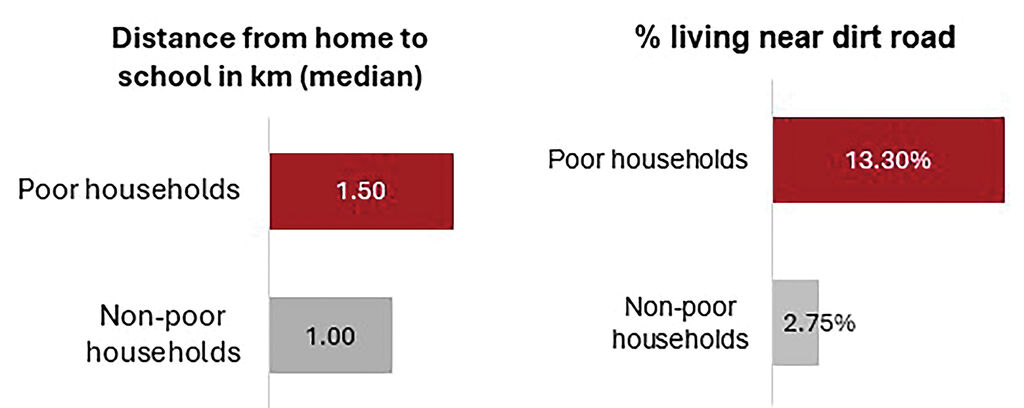
Access to the public primary school network after the transition has been generally favourable, with a median distance from home to school of 1 kilometre, and a travel time of approximately 5 minutes. However, survey findings illustrated in Figure 4 reveal significant disparities in access for students from poor households and those in remote and disadvantaged areas, who face greater geographical distances and less favourable road and travel conditions.
Figure 4: Disparities facing school children from poor households
 |
Further survey findings reveal that, while basic infrastructure is largely in place (with 0.35 per cent reporting non-brick walls), 20.28 per cent of respondents reported that class sizes exceed the 36-pupil limit. Approximately 14 per cent reported that teachers showed favouritism towards pupils who attended extra classes organised by the teacher. Furthermore, accessibility conditions for students with disabilities are noteworthy, as nearly 30 per cent reported that their children’s public primary schools lacked ramps and handrails for wheelchair access, and more than 21 per cent reported that classrooms were not wheelchair-friendly. This suggests that the time has come to shift the focus from ensuring input factors to enhancing the quality and inclusiveness of public education.
Living environment conditions through air and water quality need improvement
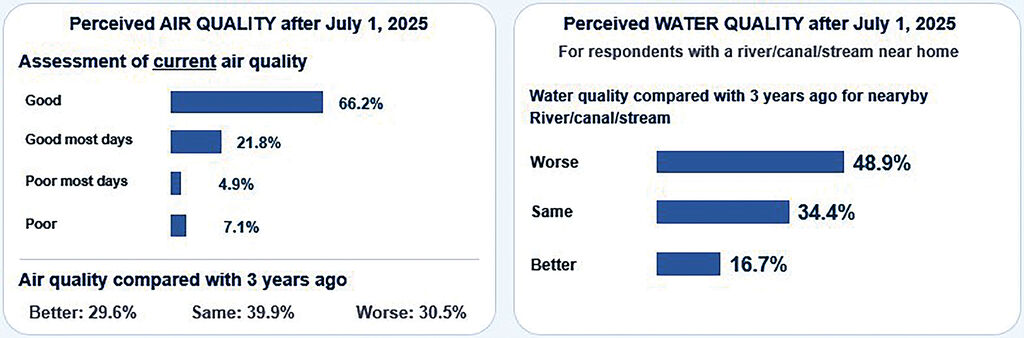
As noted above, environmental and climate change issues is the fourth-ranked concern among the five groups of issues that citizens expect the State to prioritise in the coming period. The rapid survey results (see Figure 5) indicate that the proportion of respondents who considered air quality to be good was 66.2 per cent, and nearly one-third of respondents perceived air quality as having deteriorated compared to three years ago.
The domestic water situation is more dire. The proportion of citizens who considered the quality of water from nearby lakes, ponds, rivers and streams to be worsening compared to three years ago was high at nearly 49 per cent, and the proportion reporting it as “unchanged” also accounted for more than one-third of respondents. This suggests that domestic water quality is at an extremely poor level.
Figure 5: Perceived quality of air and water sources
 |
Qualitative discussions from Bac Ninh and Hung Yen provinces confirm room for improvement from the supply side
The case studies in Bac Ninh and Hung Yen provinces provide the systemic context for the quantitative symptoms, revealing a state of “institutional and operational disequilibrium” across the four pillars of the 4M analytical framework: Mechanism (institutional and policy arrangements); Manpower (human resources); Machinery (technical infrastructure and technology); and Money (finance and budget). The case studies adopt a primarily qualitative methodology, combining documentary analysis and field investigation through focus group discussions, in-depth interviews, and direct observation of public service delivery processes. Comparisons across levels of government and between the pre- and post-transition periods in the two selected provinces are used to elucidate substantive changes and provide an empirical basis for refining the two-tier local government model going forward.
Mechanism: reallocation versus redesign
The research findings have identified a phenomenon of “institutions leading, operations lagging.” Authority has been transferred to the commune level much faster than internal processes have been standardised. While administrative procedures were reportedly simplified for the citizen-facing front end, the internal processing workflows remain ambiguous and time-consuming. For instance, a Director of a Ward Public Administration Service Centre noted that land regulations are fragmented across multiple ministries, meaning that although the citizen submits a single application, the internal “measurement time” is often excluded from official deadlines, leading to hidden delays. The reform has largely been a “reallocation of authority” without a “redesign of processes.”
Manpower: functional overload and mechanical assembly
Regarding human resources, the research findings reveal considerable pressure on grassroots-level cadres and civil servants. Extensive decentralisation has induced a state of “functional overload.” In a ward of Bac Ninh province, 49 civil servants serve 66,000 residents, a ratio of 1:1,347. Commune-level staff are now expected to manage multi-disciplinary portfolios previously handled by specialised district bureaus. A Vice Head of a Commune’s Socio-Culture Bureau reported that their team of 12 must handle a workload equivalent to six provincial departments.
This pressure is exacerbated by what some civil servants mentioned as the “mechanical assembly” of personnel. Former district cadres (possessing specialised skills but lacking local knowledge) must work alongside former commune cadres (possessing local knowledge but lacking specialised legal skills). This has created a “simultaneous surplus and shortage,” where headcount may meet quotas, but the functional competency for complex tasks like LURC issuance is missing.
Machinery: the illusion of digital streamlining
Regarding infrastructure and technology, the research findings reveal a significant gap between expectations and reality. In theory, digital transformation was expected to play a crucial role in standardising, interconnecting, and enhancing the transparency of procedures. In practice, however, when data has not been fully digitised, systems lack interoperability, and infrastructure conditions remain fragmented with some equipment being outdated and unable to meet work requirements, technology has not only failed to resolve bottlenecks but has at times generated new intermediary layers, creating additional burdens for cadres and civil servants.
Thus, technology, intended to be a solution, is said to have occasionally created “new intermediary layers.” Because data is not yet fully digitised or interoperable across ministries (e.g., Public Security and Science and Technology), civil servants often engage in redundant data entry into multiple unconnected systems. Outdated equipment and a lack of stable digital signatures at the commune level hinder the efficiency of the NESP. As one Deputy Director of a Provincial Public Administration Service Centre noted, technology is only effective when situated in a “synchronised ecosystem,” which the current two-tier model lacks.
Money: the fiscal-mandate mismatch
Regarding finance and resource assurance, a lack of synchronisation between reform orientations and resource allocation persists. While the new model requires substantial investment in key areas such as data digitisation, capacity building for cadres, and infrastructure development, budget allocation remains spread thin and does not genuinely prioritise critical, long-term tasks. Furthermore, some mandated functions have not been provided with corresponding financial resources, and the salaries of cadres and civil servants do not adequately reflect the volume and nature of work under the new model.
Implications and recommendations for navigating the paradigm shift in local governance
The nationwide survey of 4,932 citizens and the case studies in Bac Ninh and Hung Yen provinces together present a consistent picture: the two-tier local government model, with the reduction of intermediary layers and strengthened decentralisation to the grassroots level, enjoys public support in terms of its policy orientation and direction. Nonetheless, the initial operational phase has revealed a systemic imbalance, whereby institutional decentralisation has outpaced the standardisation of processes, and resources (operational mechanisms, human resources, technological infrastructure, and finance-budget) have not kept pace with the volume of new functions, tasks and authorities devolved to grassroots-level governments. This, in return, calls for a shift from a piecemeal reform mindset to a system-building approach, with the effectiveness of public service delivery to citizens and businesses at its core. To address the “systematic imbalance” identified, the research proposes a series of targeted recommendations at three levels of government.
For commune-level governments: strengthening substantive operational capacity
Within their mandated authority, commune-level governments should focus on improving the structure and modality of internal operations, including:
- Standardising dossier-processing procedures and reassigning tasks to clearly delineate the responsibilities and authority of each cadre and civil servant;
- Strengthening cross-departmental coordination and establishing flexible coordination mechanisms based on actual workload and available personnel to enhance work efficiency given the limited scope for increasing staffing quotas;
- Proactively organising needs-based training, particularly in multi-disciplinary skills, digital competencies, and situational problem-solving in accordance with the new requirements for grassroots-level cadres under the two-tier local government model; and,
- Establishing rapid feedback mechanisms with citizens to ensure that communication channels between grassroots-level authorities and citizens are not disrupted while the apparatus is undergoing restructuring and consolidation.
For the Central Government: ensuring foundational conditions
The following recommendations are intended to support ongoing efforts to strengthen balance and synchronisation between the decentralisation of authority and the allocation of resources and implementation conditions:
- Providing targeted fiscal-budgetary support during the transitional period, prioritising data digitisation, system interoperability, and investment in technical-technological infrastructure for grassroots-level governments;
- Enhancing professional and public finance management capacity at the commune level;
- Reforming salary structures based on job positions to accurately reflect the volume and nature of new responsibilities of grassroots-level cadres and civil servants;
- Stabilising the policy environment after the rearrangement to reduce the load of frequently issued regulations for the grassroots-level cadres and civil servants so that they can focus on implementation; and,
- Requiring line ministries to apply a ‘co-creation’ approach in the development of public e-service and digital platforms, ensuring that no one is left behind.
For ministries: long-term system design
Ministries and central agencies should focus designing policies and guiding documents with a long-term and inclusive vision, shifting from an “input management” mindset to “capacity- and results-based governance” by:
- Transitioning from headcount-based management to human resource governance, designing flexible staffing allocation mechanisms based on the actual workload of each locality to address the issue of simultaneous local surplus and shortage;
- Refining the legal framework for decentralisation, delegation and authorisation; improving the quality of professional guidance from central authorities to reduce confusion, responsibility avoidance, and the practice of escalating matters beyond the prescribed level;
- Shifting performance measurement from “quantity” to “quality” in basic public service delivery, for example, shifting the focus of assessment from infrastructure to class sizes and the capacity for inclusive education; concentrating on treatment outcomes and the ability of grassroots-level healthcare to meet medical examination and treatment needs, rather than focusing solely on coverage ratios;
- Mainstreaming inclusiveness in service design, processes and technology systems from the planning and design stage, incorporating co-creation approaches in order to narrow access gaps among population groups, particularly persons with disabilities, ethnic minorities, the elderly and poor households; and,
- Developing a stable and standardised organisational framework for the two-tier local government system to serve as the basis for long-term operation rather than continuous ad hoc adjustments.
Conclusion
The transition to Vietnam’s two-tier local government model is an ambitious and necessary step towards a modern, efficient state. The rapid assessment findings demonstrate that the model enjoys broad public support, particularly the elimination of redundant intermediate layers. However, the transition is currently defined by a “systemic imbalance” where the delegation of authority has outpaced the provision of resources and the standardisation of internal processes.
The “operational logic” has shifted, but the “operational capacity” at the grassroots level is struggling to keep pace. Moving forward, the Government must shift to a “systems-building approach.” Strengthening the commune level - not merely through the transfer of authority or Mechanism, but through the synchronisation of Manpower, Machinery and Money - is the only way to ensure that the two-tier model fulfils its promise of a governance system that is truly functional, effective, inclusive and people-centred.-
[1] This article is an extract from the study report “Rapid assessment of public service delivery in the context of two-tier local government” conducted by Ho Chi Minh National Academy of Politics (HCMA) and Mekong Development Research Institute (MDRI) in 2026, with technical support from the United Nations Development Programme (UNDP) and financial support from the Australian Department of Foreign Affairs and Trade (DFAT) and the Embassy of Ireland in Vietnam. The study findings can be found at https://papi.org.vn/eng/danh-gia-nhanh-ve-hieu-qua-cung-ung-dich-vu-cong-khi-trien-khai-mo-hinh-chinh-quyen-dia-phuong-2-cap/.