United Nations Development Programme in Vietnam
 |
| A citizen looks up public services online at the Khanh Hoa Provincial Public Administrative Service Centre__Photo: Xuan Trieu/VNA |
Introduction
Vietnam stands at a critical juncture in accelerating its digital transformation journey.[1] Since late 2020, the country has made stronger commitments to digitalising public services, with its first-ever National Digital Transformation Programme through 2025 with orientation towards 2030. In the same year, the Ministry of Information and Communications (now the Ministry of Science and Technology) issued Circular 26/2020/TT-BTTTT on application of assistive technology for users with disabilities to access information in the digital environment. In December 2024, Resolution 57-NQ/TW further reinforced this agenda by highlighting breakthroughs in science, technology, innovation and national digital transformation. These documents deliver a clear message: digital transformation is no longer “a tick in the box” - it is now the key driver for economic growth, governance modernisation, and national competitiveness.
The year 2025 witnessed major reforms in the national public administration landscape - most notably the shift to a two-tier local government system, reshaping how public services are organised and delivered. While these changes bring opportunities for more streamlined and efficient government, they also risk widening the physical and digital distance between citizens and frontline service providers if not carefully managed. In this context, digital transformation becomes increasingly recognised as a catalyst for improving public service delivery, strengthening transparency and accountability, and fostering more responsive and inclusive state-citizen relations in a rapidly evolving administrative landscape.
In reality, however, citizens experience uneven access and challenges in meeting their differentiated needs regarding digital services. Since the introduction of the E-Governance dimension in 2018, the United Nations Development Programme (UNDP)’s flagship PAPI Research and Advisory Programme[2] has generated valuable insights into citizens’ perceptions of digital governance. Research findings over the years consistently highlight a digital divide: citizens in urban areas tend to report better e-governance performance and access to digital services than those living in rural, mountainous and ethnic minority areas.[3] These disparities underscore the importance of ensuring that digital transformation efforts do not leave anyone behind.
To support national and local authorities in narrowing this digital gap, UNDP has supported several locally-led initiatives aimed at promoting more inclusive digital governance. These include piloting locally-led innovation initiatives at the grassroots level, developing an artificial intelligence (AI)-powered chatbot assistant to support citizens’ access to public services, and conducting assessments of digital public service portals and feedback response mechanisms. Together, these initiatives have generated practical insights and evidence on how digital policies and platforms can be designed and implemented, so that everyone can benefit from digital transformation.
This article synthesises insights and knowledge from recent PAPI research findings, UNDP-supported digital governance initiatives, and field-based experiences across several provinces in Vietnam to inform evidence-based policymaking. It emphasises the importance of co-creating solutions with marginalised groups, strengthening digital competencies and data governance, and ensuring the inclusive deployment of digital tools - including AI. Ultimately, Vietnam’s digital transformation will succeed not simply when systems are online, but when all citizens - regardless of location, income, ethnicity, age, gender or ability - can meaningfully use those systems to exercise their rights, access services, and meaningfully participate in governance. This article also proposes policy recommendations and specific priorities and proposals for action for 2026, a pivotal year when digital government moves decisively from aspiration to implementation.
Key insights from evidence and practice
Drawn from citizen survey data, technical support to grassroots levels, and citizen-centric research conducted by UNDP and national partners since 2020, the following insights highlight key challenges and opportunities to support policymakers in formulating evidence-based policies, thereby accelerating Vietnam’s digital transformation process.
Digital access improved, but use remains uneven and needs are differentiated
Between 2020 and 2024, the PAPI E-Governance dimension recorded a 20 per cent increase in internet access alongside rising awareness of provincial e-service portals.[4] However, significant gaps in uneven access and challenge in meeting differentiated needs persist when data is disaggregated by ethnicity, region and migrant status. For instance, ethnic minority households in mountainous areas and migrant populations continue to face irregular connectivity. Meanwhile, a 2024 study conducted by UNDP and its research partner[5] revealed that 52 per cent of surveyed persons with disabilities did not have the means to use the Internet at home due to limited financial capacity and underdeveloped technical infrastructure in some remote areas.
These findings underscore the need for targeted policy considerations, investments in digital infrastructure and digital literacy - prioritising underserved communities and user groups.
The establishment of local digitalisation support teams has become widespread, yet investment in their operations remains limited
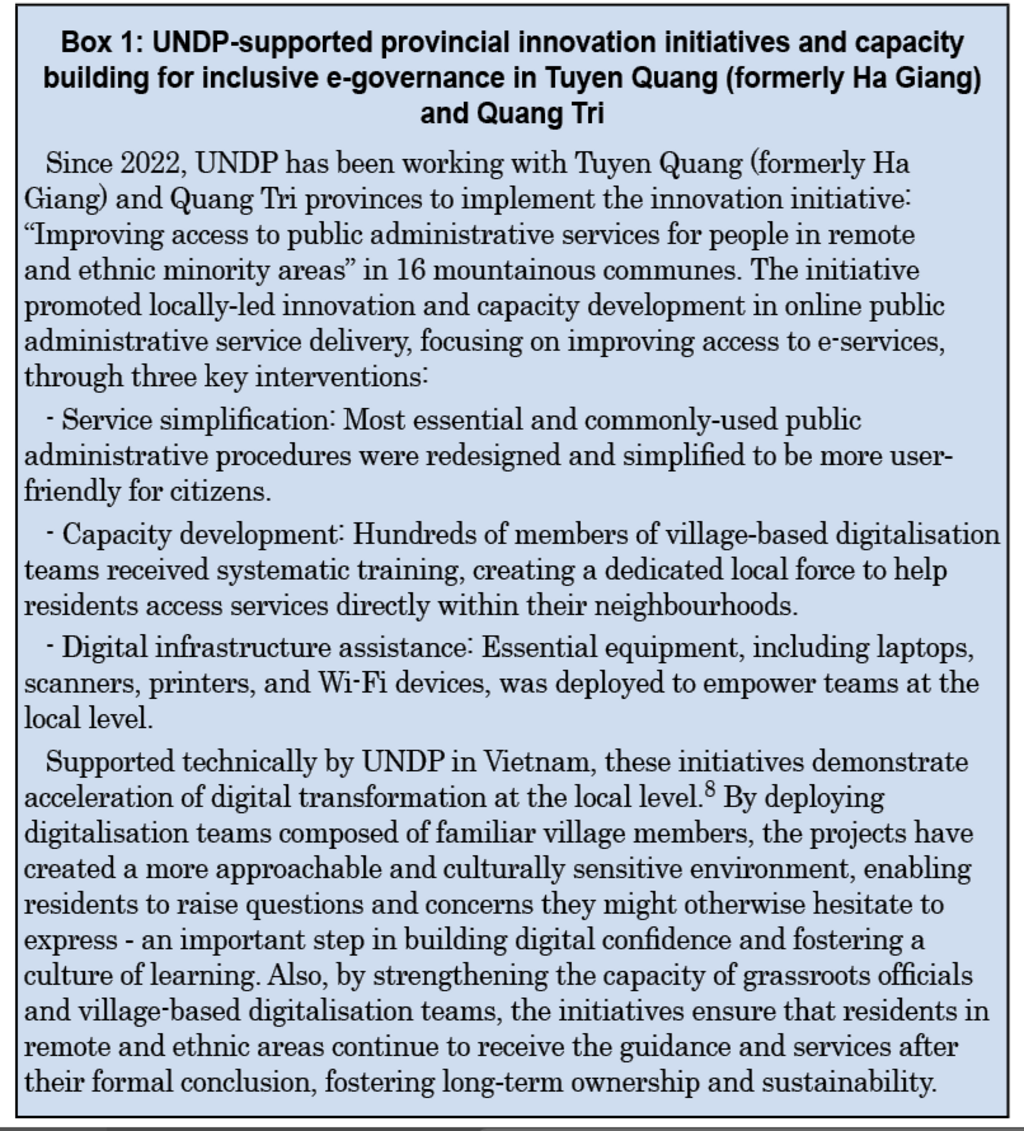
Across Vietnam, local digitalisation support teams have been established in most communes to assist citizens in accessing digital public services and to support digital transformation at the grassroots level. However, their operations remain difficult to sustain due to limited funding for essential needs such as training, equipment and community outreach activities, as a series of in-depth research and advisory work by UNDP and Ho Chi Minh National Academy of Politics (HCMA) from 2021-24 revealed.[6] This challenge has been also revealed through UNDP’s technically supported projects and initiatives in Thua Thien Hue province (now Hue city), Tay Ninh and Quang Tri provinces, and Ha Giang province (now Tuyen Quang province) since 2021.[7]
This highlights the need to transition from ad hoc or volunteer-based arrangements to a more formalised and institutionalised support model, with clear mandates and sustained financing mechanisms at both central and local levels to ensure consistent and effective service delivery.
 |
Citizens need substantial support with using online public services
The 2024 PAPI survey report indicates that only approximately nine per cent of respondents used provincial e-service portals. This is consistent with UNDP’s operational experience in supporting Tuyen Quang and Quang Tri provinces, where awareness of e-services remains very low among ethnic minority communities. Almost every citizen in these communities requires significant assistance to navigate service portals and applications (including VNeID app), portals of provinces, ministries and the National Assembly. These platforms have been even more challenging for users with disabilities as they often fail to comply with the accessibility standards specified in Circular 26/2020/TT-BTTTT.[9]
These gaps between technical availability and actual usability stem from systemic design issues, including overly complex and inaccessible interfaces, inconsistent instructions, unclear process flows, and insufficient help functions. Addressing these differentiated needs requires a systematic shift towards user-centred design at every phase of e-service development.
Responsiveness to citizen feedback can be further strengthened
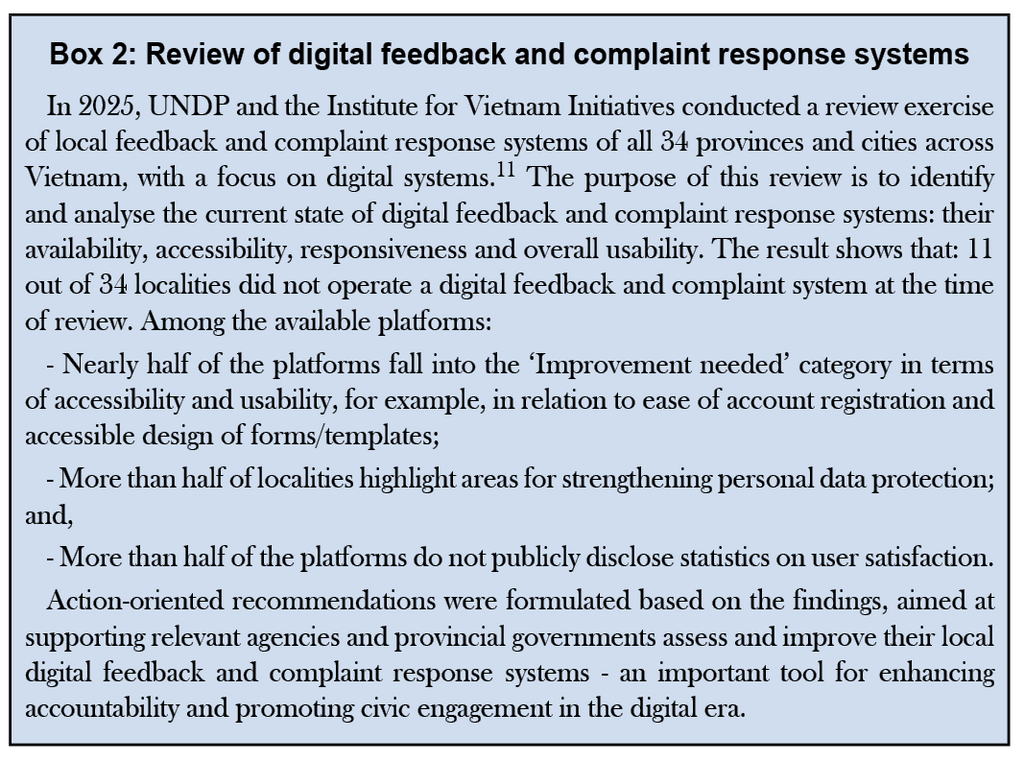
While digital platforms have been deployed to facilitate feedback and complaints, data indicates an existing opportunity to further enhance the responsiveness of these systems. The E-Responsiveness sub-dimension in the PAPI index showed little improvement from 2020 to 2024, suggesting that the potential for digital tools to strengthen accountability and citizen engagement has yet to be fully realised. This aligns with PAPI’s broader findings that transparency and accountability continue to present challenges across provinces.[10]
Box 2 details a 2025 review by UNDP and its national research partner on digital feedback and complaint systems across all provinces following the administrative transitions of July 2025. In the post-merger context, ensuring responsiveness, accessibility and inclusiveness of these digital feedback platforms becomes highly relevant to maintain effective communication between citizens and local authorities. Optimising the platforms is for the timely resolution of issues arising from administrative reforms and for fostering a more responsive governance dynamic.
 |
Data systems require further integration to support seamless e-service delivery
Effective digital government relies on interoperable, real-time data systems. Action research on e-governance since 2020[12] repeatedly highlight that data systems across levels are still evolving, with inconsistencies persisting in how administrative data is recorded, updated, and shared vertically and horizontally. The data systems are not yet fully integrated across ministerial and provincial levels, creating challenges for automating procedures, reducing duplication, and providing seamless “once only” public administrative services. As of the 2025 reviews, a centralised data centre for shared resources was still in the process of becoming operational to support the smooth functioning of online public administrative services.
Policy recommendations
Based on UNDP’s research evidence and field experience in inclusive digital governance, this article proposes several policy recommendations.
Institutionalise the adoption of a comprehensive user-centric design approach when designing, testing and launching digital platforms
User-centric design using user-experience and co-creation approaches must become standard practice across ministries and provinces, for any digital tools or service platforms.
This includes conducting user journey assessments, simplifying and standardising interfaces, harmonising terminology, and testing platforms with diverse user groups, including ethnic minorities, the elderly and persons with disabilities.
Institutionalise and sustain funding mechanisms to support local digitalisation support teams to assist vulnerable groups in accessing digital services
The central and local governments should officially recognise the roles of local digitalisation support teams at the commune and village levels. Concrete actions include defining clear mandates, standard operation procedures, accountability standards and allowance mechanisms to ensure these groups operate consistently and effectively across villages, especially in underserved communities.
In line with Resolution 57-NQ/TW, provinces could consider allocating at least 3 per cent of total annual budget expenditure to the development of science, technology, innovation and national digital transformation. This budget should cover essential equipment, mobile data subsidies, and travel stipends for community outreach for both commune and village-level digitalisation support teams.
Provinces with large ethnic minority populations should explicitly integrate requests for support for commune and village digitalisation support teams into the framework of and implementation of the National Target Programme on Socio-Economic Development in Ethnic Minority and Mountainous Areas for 2026-35 period. This would help ensure targeted investment in digital inclusion and sustained access to digital public services for vulnerable and hard-to-reach communities.
Strengthen back-end systems, interoperability and data governance
It is suggested to enable seamless “once only” digital services and data system interoperability. The Government should establish national data standards and a central coordination mechanism to ensure interoperability. Strengthening privacy protections across all actors and platforms within the national data centre is equally critical.
Effective vertical and horizontal data coordination is essential, requiring the active participation of local governments to identify procedural bottlenecks and ensure functional data interoperability. Ultimately, high-quality data - securely stored and ethically governed - forms the essential backbone of a proactive and integrated national data governance framework.
Ensure human-in-the-loop AI tools
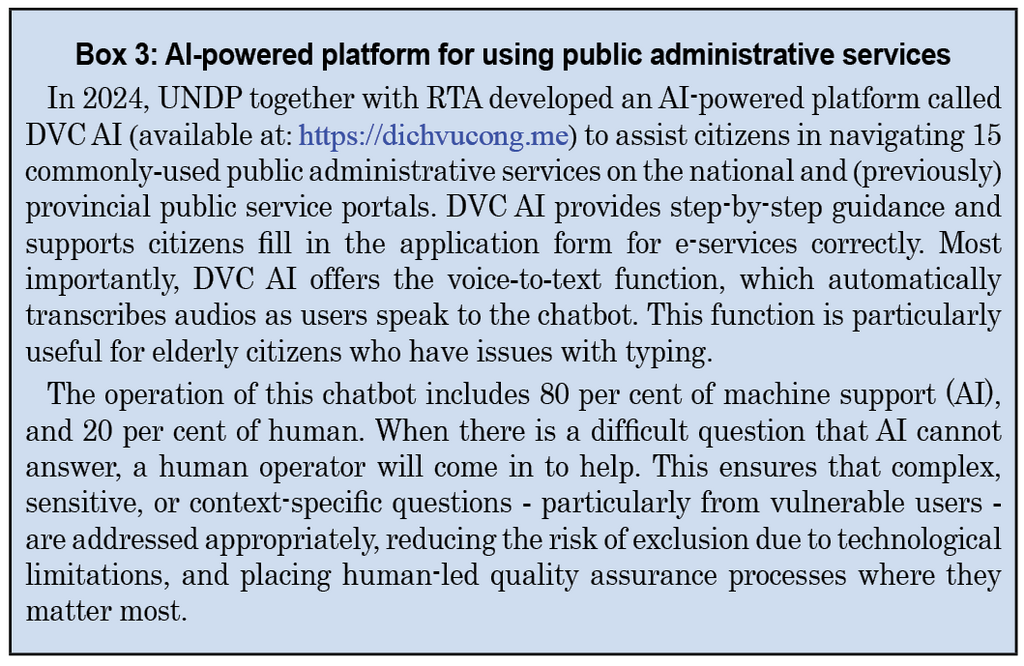
With high-quality data, the application of AI tools for enhanced user experiences with e-services will be facilitated. AI-facilitated tools can stimulate user experiences, improve service navigation, and support predictive analytics. However, AI tools should complement - rather than replace - human interactions in public service provision. To protect users’ rights, AI-associated risks must be governed by ethical standards with human oversight.
Box 3 presents an example of an AI-powered platform developed by UNDP and Real-Time Analytics (RTA) for public use. This model applies the “80:20 rule”, wherein 80 per cent of queries are addressed through machine-led support and 20 per cent receive human support.
As digital portals with AI assistance expand, physical one-stop shops and human-led support must remain available. This dual machine-human approach ensures that populations who cannot or prefer not to use digital services are not excluded, thereby fulfilling the commitment to leave no one behind.
 |
Enhance responsiveness mechanisms to build citizen trust
Digital complaint systems must be paired with clear performance standards, real-time monitoring, and dedicated response teams. Provinces should be encouraged to publish response rates and turn-around times. This transparency can significantly strengthen citizen trust - one of the strongest determinants of governance satisfaction.
Suggested priorities for 2026
As Vietnam enters the decisive implementation phase of digital government in 2026, the following priorities are suggested to address the differentiated needs of citizens and civil servants. These actions are categorised into immediate “Quick wins” to improve usability and long-term “Structural reforms” to ensure sustainability.
Quick wins: enhancing usability and responsiveness
It is proposed to facilitate co-creation of digital services with citizens, particularly representatives of hard-to-reach populations, ensuring that redesign of the National E-Service Portal is accessible for citizens with diverse abilities and digital literacy levels.
Universal UX/UI design and AI assistance need to be adopted to address the low usage rates of the National E-Service Portal. The Portal should embed universal design principles and human-in-the-loop AI assistants (building on prototypes like dichvucong.me). This ensures that users with disabilities, the elderly, and those with low digital literacy and ethnic minority languages can navigate the platforms easily and independently.
A synchronised and AI-assisted feedback receipt and response channel like the case of Tay Ninh province’s model[13] should be established for local authorities and citizens to interact effectively to timely address citizen concerns.
Structural reforms: institutionalisation and integration
It is necessary to ensure simplification and coherence of administrative procedures, especially high-frequency services. For the new ministerial and sectoral public administration portals, a centralised dashboard should be developed to link data from all portals, allowing civil servants to easily track the cases under their responsibility and monitor their processing status.
Commitment to national data interoperability and standards should be made to resolve the issue of fragmented systems and poor vertical and horizontal data sharing. This is a prerequisite for the “once-only” principle, allowing for the seamless reuse of citizen data across different government and administrative levels.
Hands-on digital training programmes are needed, focusing on provinces with limited prior exposure to online service delivery or provinces with high proportions of ethnic minority community[14]. Training should focus on human-centric digital transformation, data governance, ethical AI governance and inclusive service delivery, enabling civil servants to manage digital tools responsibly while protecting users’ privacy.
Conclusion
Vietnam’s digital government transformation is progressing rapidly. However, the journey ahead requires a deliberate focus on inclusiveness, user experience, and human-centric digital governance. UNDP-supported evidence demonstrates that while digital access and service availability have improved substantially, uneven access and challenges in meeting differentiated needs persist. The transition to a two-tier local government system has reshaped the physical distance between citizens and frontline service providers, particularly in remote and scattered areas, thereby adding urgency to a more people-centred digital transformation framework. In response, UNDP has been supporting locally-led digital innovation initiatives drawn on lived experiences of different marginalised groups though digital platform assessments. Such initiatives have demonstrated practical approaches to improving service accessibility and strengthening citizen-government interaction.
A people-centred digital government must be co-created with its users, grounded in transparency and accountability, supported by responsible data systems, and reinforced through continual capacity building. As Vietnam enters its new development phase, UNDP remains committed to supporting a modern, effective and inclusive digital governance, through three strategic pillars: (i) generating participatory evidence, enabling key national and subnational institutions to access and use credible data on citizen needs and experiences; (ii) assisting in the organisation of inclusive policy dialogues, fostering meaningful engagements of communities and national-subnational authorities to co-design and shape policies; and (iii) supporting the strengthening of local capacities for policy implementation and innovation, through piloting locally-led initiatives, and testing successful models of digital transformation for potential nationwide replication. This is to ensure that digital transformation efforts remain human-centric, inclusive, and responsive to citizens’ needs, thus helping Vietnam advance a digital governance that is effective, accountable and accessible, leaving no one behind.-
[1] See https://mst.gov.vn/chuyen-doi-so-quoc-gia-tu-khoi-dong-den-tang-toc-huong-toi-gia-tri-thuc-197251021131237248.htm.
[2] See https://papi.org.vn/eng/bao-cao/.
[3] See Vietnam Law and Legal Forum, February 2026 issue. Vietnam’s two-tier government system: findings, implications and recommendations from 16 years of PAPI. Available at: https://vietnamlawmagazine.vn/vietnams-two-tier-government-system-findings-implications-and-recommendations-from-16-years-of-papi-78866.html.
[4] See the 2020-2024 PAPI Reports at: https://papi.org.vn/eng/bao-cao/.
[5] See UNDP and MDRI (2025). Assessment of Disability Inclusion in Local Governance in 2024. Available at: https://papi.org.vn/eng/danh-gia-muc-do-hoa-nhap-cua-nguoi-khuyet-tat-trong-quan-tri-dia-phuong-nam-2024/.
[6] See the series of action research by UNDP and HCMA from 2021 to 2025 at: https://papi.org.vn/eng/thematic-research-reports/?title=quan-tri-dien-tu.
[7] For further details about this initiative, please visit: https://papi.org.vn/eng/sang_kien_cppi_2/sang-kien-cpii/.
[8] See a shortened report from Tuyen Quang province at: https://sonoivu.tuyenquang.gov.vn/vi/tin-bai/tong-ket-du-an-cai-thien-dieu-kien-tiep-can-dich-vu-hanh-chinh-cong-do-undp-tai-tro?type=NEWS&id=180922.
[9] Experience of users with disabilities in using online public services is recorded in UNDP’s Annual Assessments of Disability Inclusion in Local Governance from 2022 to 2024, assessments of accessibility and usability of online public service portals from 2023 to 2025, and digital accessibility auditing of information e-portals of ministries, the Government Office and the National Assembly in 2025.
[10] See Vietnam Law and Legal Forum (February 2026). Vietnam’s two-tier government system: findings, implications and recommendations from 16 years of PAPI. Available at: https://vietnamlawmagazine.vn/vietnams-two-tier-government-system-findings-implications-and-recommendations-from-16-years-of-papi-78866.html.
[11] Detailed findings of this review could be found here: https://papi.org.vn/eng/cac-nen-tang-tiep-nhan-va-xu-ly-phan-anh-kien-nghi-tren-moi-truong-so-tai-dia-phuong-thuc-trang-va-giai-phap/
[12] See the series of the review reports at: https://papi.org.vn/eng/thematic-research-reports/?title=quan-tri-dien-tu/
[13] See Tay Ninh Province’s model here: https://papi.org.vn/wp-content/uploads/2022/04/CPII_Tay-Ninh_ENG_11.23.pdf.
[14] See information about a pilot training course for public officials and civil servants in Lai Chau province at: https://baolaichau.vn/chinh-tri/toa-dam-chuyen-de-nang-cao-nhan-thuc-va-nang-luc-trien-khai-chuyen-doi-so-cho-doi-ngu-can-bo-lanh-dao-quan-ly-va-cong-chuc-tren-dia-ban-tinh-lai-chau-1292597.