 |
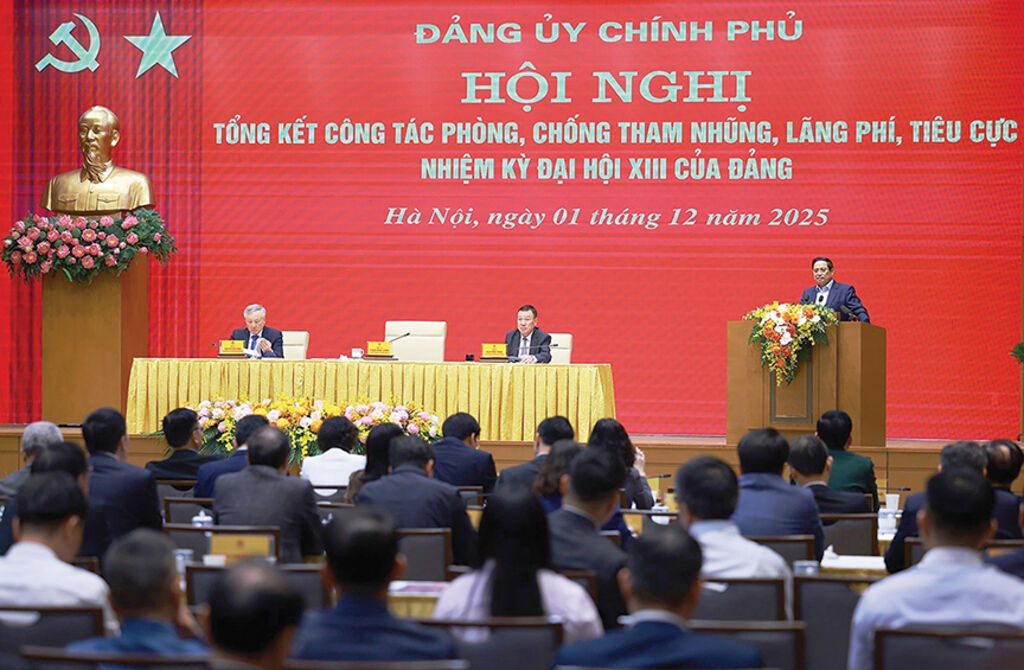
| Prime Minister Pham Minh Chinh delivers a keynote address at a Conference of the Government’s Party Committee reviewing efforts to prevent and combat corruption, waste and negative practices__Photo: VNA |
Mindset, awareness and methods in the fight against corruption, waste and negative practices must continue to be renewed in order to meet the goals set by the 14th National Party Congress, said Le Minh Tri, member of the Secretariat of the Party Central Committee and Permanent Vice Chairman of the Party Central Committee’s Commission for Internal Affairs.
The Political Report of the 13th Party Central Committee submitted to the 14th National Party Congress emphasizes that the fight against corruption, waste and negative practices has been carried out in a drastic, persistent, synchronous and comprehensive manner, recording notable results, consolidating public trust and enhancing discipline. The 14th National Party Congress’s documents continue to uphold the exemplary role of officials and Party members, especially heads of agencies; emphasize the requirements to maintain the Party’s disciplines and the State’s laws and to pursue the fight against corruption, waste and negative practices in order to build a disciplined, healthy, civilized, secure, safe and developed society.
On the occasion of the 14th National Party Congress, Le Minh Tri, member of the Secretariat of the Party Central Committee and Permanent Vice Chairman of the Party Central Committee’s Commission for Internal Affairs, grants an interview to VOV Times, reviewing the outstanding achievements in the prevention and combat of corruption, waste and negative practices during the 13th National Party Congress tenure while outlining key requirements and tasks for the coming period.
Could you highlight the most notable achievements in the prevention and combat of corruption, waste and negative practices during the 13th National Party Congress tenure?
Under the leadership of the Party, particularly the Politburo and the Central Steering Committee for Prevention and Control of Corruption, Waste and Negative Practices, the anti-corruption drive during the past tenure was carried out in a resolute, persistent, comprehensive and methodical manner, achieving significant breakthroughs and notable results.
Corruption, waste and negative practices have been gradually curbed and pushed back, contributing to building a cleaner and stronger Party and political system. Public confidence and support have continued to grow and the anti-corruption work has evolved into a broad-based movement not only at the central level but also across many localities.
Party discipline, order and power control have been intensified with violations handled in a synchronised manner through Party discipline measures, administrative sanctions and criminal proceedings. Authorities have uncovered and handled numerous particularly serious corruption and misconduct cases of unprecedented scale, involving large numbers of offenders, extensive losses and highly organised operations.
Notably, several cases involved closed “ecosystems” spanning banks, securities companies, valuation firms and private notarisation service providers, with hundreds of subsidiaries operating at home and abroad. These networks manipulated stocks, corporate bonds, auctions and bidding processes, interfered in the allocation of state budgets and public investment resources, and exploited epidemics-related circumstances for corruption purposes.
The recovery of state assets which are misappropriated and lost has improved markedly in both speed and effectiveness. Coordination between Party examination bodies and judicial agencies, as well as among judicial agencies at both central and local levels, has become closer and more effective, enhancing the overall efficiency of anti-corruption efforts. The fight against corruption, waste and negative practices has thus become a prominent pillar of Party building and rectification during the past tenure.
In your opinion, what are the key requirements and tasks for the fight against corruption, waste and negative practices in the 14th National Party Congress tenure and beyond?
In the coming period, the objectives and requirements set by the 14th National Party Congress must be fully implemented. First and foremost, this requires continued strengthening of the Party’s direct and comprehensive leadership, alongside promoting the responsibility of Party Committees, organisations and heads of agencies at all levels. Discipline and order must be upheld, ensuring that the handling of violations is carried out in a strict but humane and persuasive manner. Importantly, anti-corruption efforts must serve socio-economic development and contribute to sustaining double-digit economic growth in the years ahead.
To achieve this, mindset, awareness and working approaches in the fight against corruption, waste and negative practices must continue to be renewed in parallel with improving institutions and the legal system, ensuring consistency, coherence and close alignment with practice, as set out in Politburo Resolution 66 on the reform of lawmaking and law enforcement. Efforts should be concentrated on identifying appropriate conditions, criteria and approaches to effectively implement Politburo Resolution 68 on private economy development, thereby unlocking this vast resource for national development in the new era. It is also required to remove difficulties and obstacles, particularly for land-related investment projects while promptly sealing legal loopholes to prevent abuse and corruption, amending impractical or obstructive regulations, and dismantling structural bottlenecks to create a clear legal corridor and strong impetus for rapid and sustainable development.
Greater emphasis must also be placed on preventive measures, especially in combating waste. Attention will be paid to the exercise of statutory powers by the People’s Procuracy in initiating civil and administrative lawsuits to protect public interests and state interests, while encouraging proactive remediation of consequences and cooperation in handling violations. These factors should be considered important criteria in determining appropriate forms of sanction, contributing to promote early prevention, reduce criminal handling and recover state assets in a more effective manner.
At the same time, efforts must be made to enhance openness and transparency in social life, establish a suitable roadmap for completing a cashless payment system, and expand the categories of those subject to asset control across society. Anti-corruption institutions will continue to be refined to avoid overlaps in functions and ensure effective and efficient operations from central to local levels. It is necessary to study, formulate and enact policies and laws to encourage and protect innovation and creativity, as well as legal frameworks to mitigate risks for those who take initiative, should be studied, formulated and enacted. Meanwhile, strict sanctions must be imposed on individuals who deliberately shirk responsibility or fail to fulfil their duties.
Finally, communication, education and awareness-raising to foster a culture of integrity among officials, Party members and the public must be strengthened. Agencies tasked with anti-corruption work must themselves remain exemplary in integrity and conduct.- (VLLF)