 |
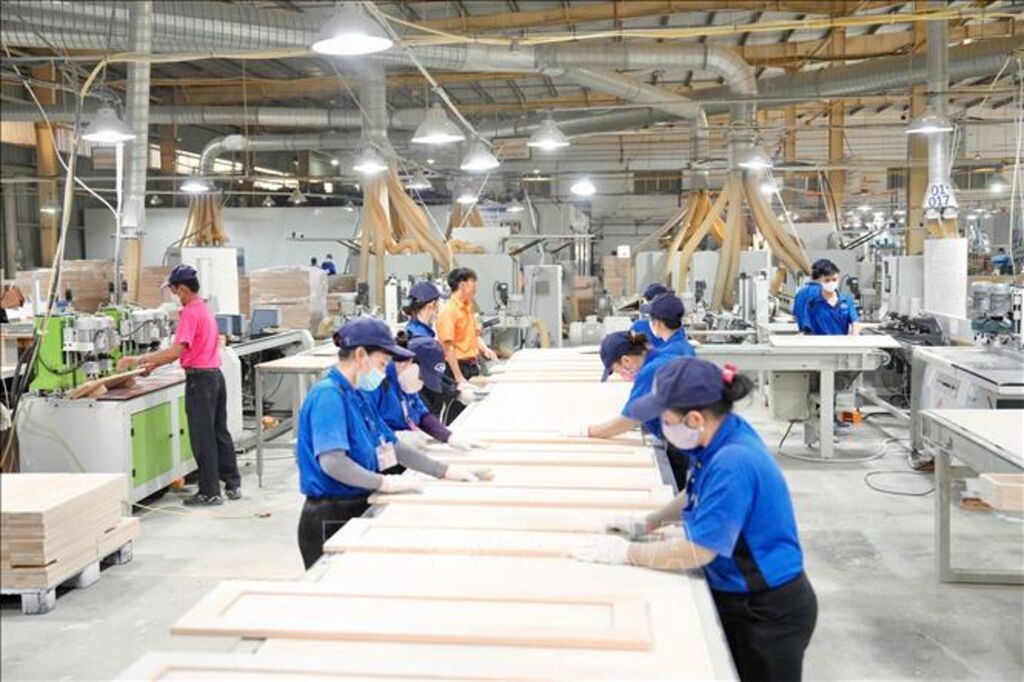
| At the Asia Italian Door Company, Ltd.__Photo: VNA |
After more than eight years of implementation, the Law on Support for Small- and Medium-Sized Enterprises (SME Law) now requires a comprehensive revision to address shortcomings in both policy design and enforcement.
Experience over the years has shown that the small- and medium-sized enteprise (SME) sector has affirmed its pivotal role in the economy, accounting for over 98 per cent of all enterprises, making significant contributions to job creation, mobilising social resources, and sustaining national economic growth. However, due to their small scale, limited financial capacity and weak resilience to market fluctuations, SMEs remain highly vulnerable.
Following the enactment of the 2017 Law on SMEs, the system of support policies has gradually taken shape, with numerous programmes on training, consultancy, digital transformation assistance and capacity building rolled out on a large scale. Millions of turns of businesses and workers have accessed these programmes, helping improve their awareness and managerial capacity.
Nevertheless, the overall effectiveness of policies introduced under the SME Law has yet to meet expectations. The level of support remains modest, while many businesses are still unable to access the assistance they need. The gap between policy design and implementation remains a major issue, particularly in the context of a rapidly changing business environment shaped by digital transformation, green transition and the restructuring of global supply chains.
The revision of the Law, therefore, aims not only to remedy existing shortcomings but also to establish a policy framework capable of adapting to long-term economic changes.
Under the draft revised SME Law, the drafting agency has designed policies in a way that shifts support from input-based assistance to output-oriented support, and from an administrative approach to a development-facilitation approach. In addition, instead of spreading resources too thinly, the proposed policies focus on sectors and groups of enterprises capable of creating spillover effects.
One notable change is the simplification of criteria for identifying SMEs by giving priority to easily measurable indicators such as revenue and labour size, while adding a legal basis for identifying priority groups of enterprises, including women-owned enterprises, enterprises owned by vulnerable groups, and enterprises pursuing sustainable development standards.
In recent appraisal comments on the draft, a representative of the Vietnam Chamber of Commerce and Industry (VCCI) said the draft has expanded eligible beneficiaries to include SMEs owned by persons with disabilities or ethnic minorities, sustainable and inclusive SMEs applying environmental, social and governance (ESG) standards, and pioneering SMEs.
However, to ensure that these policies produce substantive results, the VCCI representative suggested introducing additional support mechanisms from the initial stage, particularly technical and financial assistance to help SMEs access green standards, eco-labels and sustainability certificates. Such support would enable SMEs to participate more deeply in modern markets and supply chains.
Emphasising the growing role of e-commerce in export activities, VCCI also noted that SMEs no longer participate only in the supply chains of large enterprises but can now directly access international markets through digital platforms. Support policies, therefore, should focus more on strengthening enterprises’ digital capacity and their ability to meet international standards.
Commenting on the draft, a representative of the State Bank of Vietnam suggested that the drafting agency continue revising the support policies specified in the Law to ensure they truly hit the mark, respond to what SMEs need most, and become more feasible in practice, particularly policies on interest rate support and credit guarantees.-(VLLF)