 |
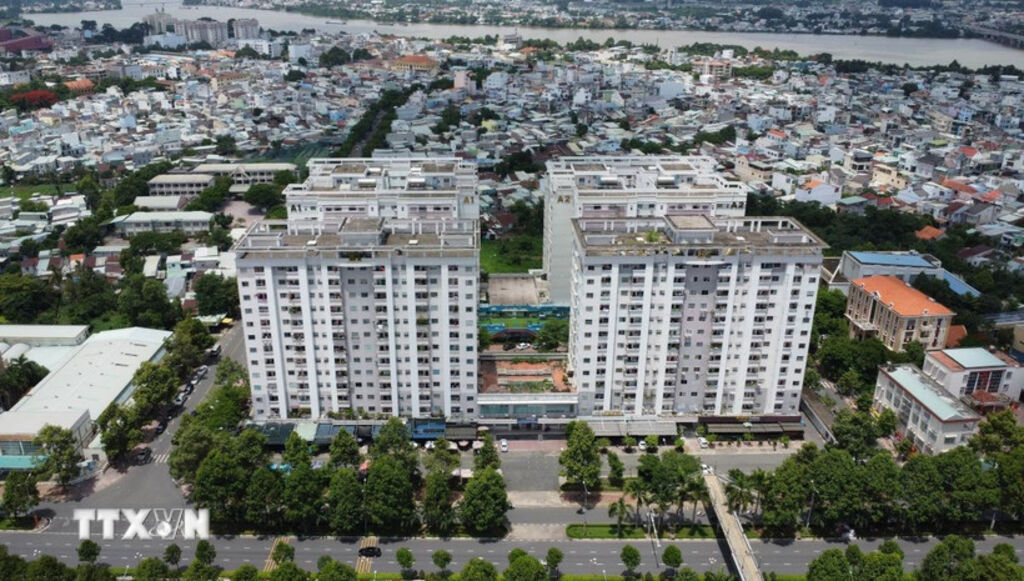
| A sociali housing project in Dong Nai province__Photo: VNA |
According to the MOC, during the first nine months of 2025, a total of 50,687 of 100,275 social housing units were completed nationwide, equivalent to 50.5 percent of the annual plan. By the end of 2025, an additional 38,600 units are expected to be delivered, bringing the total to 89,007 units, or approximately 89 percent of the yearly target.
On a cumulative basis, under the Scheme on investment in the construction of at least one million social housing units for the 2021-2030 period, 696 social housing projects are currently being implemented nationwide, with a total scale of 637,048 units, representing about 60 percent of the overall target. Of these, 165 projects have been completed, delivering 116,342 units; 151 projects have commenced construction and are under implementation, with 132,616 units; and 380 projects have received in-principle investment approval, with a planned scale of 388,090 units.
Despite these initial positive results, the MOC noted that the remaining workload in the 2026–2030 period remains substantial. To ensure that the overall targets are met, the issuance of a Government Resolution featuring special mechanisms to remove legal and procedural bottlenecks is considered both urgent and necessary.
Mechanisms to address constraints
In the draft Resolution, the MOC proposes several special mechanisms aimed at accelerating project implementation and increasing the supply of social housing.
First, regarding planning and approval of investment policy
Where an investor proposes a project on a land plot that has not yet been incorporated into, or is inconsistent with, approved urban or rural planning, or where no housing development program or plan has been issued, the provincial-level People’s Committee would assign the Department of Construction to take the lead, in coordination with relevant departments and the commune-level People’s Committee where the project is located, to review and submit its appraisal to the provincial-level People’s Committee for decision. This decision will determine land-use planning indicators and requirements for spatial organization, architecture, and landscape, serving as the basis for approving the investment policy and concurrently appointing the project investor.
Following such approval, the investor would be required to prepare and submit the 1:500 detailed plan of the project, which will serve as the basis for subsequent stages of project implementation, to the competent authority for appraisal and approval. The contents of the detailed plan must then be integrated into the relevant urban and rural planning systems, as well as local housing development programs and plans.
Second, regarding allocation of land for commercial components within projects
Project investors would be allowed to allocate up to 20 percent of the total residential land area within a social housing project that has completed technical infrastructure investment for the development of commercial housing. In such cases, land-use levies must be paid for the commercial housing portion in accordance with the local administration-issued land price table in effect at the time of land allocation, land lease, or approval of land repurposing.
If a project does not reserve a separate land area for commercial or service facilities or commercial housing, investors may allocate commercial and service floor space not exceeding 20 percent of the total residential floor area of the project. This does not include floor areas used for community activities, essential infrastructure, or parking spaces as prescribed by regulations. Such commercial floor space may be concentrated within individual buildings or in one or several independent blocks, provided the prescribed ratio is not exceeded.
Third, regarding social housing typologies
In wards, social housing projects must be developed in the form of apartment buildings. In other areas, provincial-level People’s Committees would determine, based on local conditions, whether social housing projects are to be developed as apartment buildings or detached houses, in accordance with approved detailed construction planning. Where detached houses are permitted, their design and construction must fully comply with applicable standards, technical regulations, and floor-area requirements for social housing.
Fourth, regarding subjects eligible for purchase and lease-purchase of social housing
Individuals eligible for resettlement through the purchase or lease-purchase of social housing, as well as households and individuals entitled to compensation, support, and resettlement upon land recovery by the State or through negotiated land-use rights transfer for social housing development, would be given priority to purchase or lease-purchase social housing without having to meet housing and income conditions, except where they have previously purchased or lease-purchased social housing in accordance with regulations.
Fifth, regarding procedures for the grant of construction permits
Investors may opt to apply the provisions set out in Clauses 1 and 2, Article 7 of National Assembly Resolution No. 201/2025/QH15 to obtain construction permits, or alternatively apply the provisions on exemption from construction permits under the 2014 Law on Construction, as amended and supplemented.
Criteria for selection of investors
The draft Resolution prioritizes the allocation of social housing projects to enterprises with strong financial capacity, proven experience in housing project implementation, and a clear demonstration of political commitment and social responsibility in partnering with the Government to achieve social housing and social welfare objectives.
Accordingly, selected enterprises must commit to completing projects within a period of no more than three years from the date of land allocation, land lease, or approval of land-use purpose conversion, and to ensuring construction quality, reasonable pricing, and full warranty responsibilities for social housing units.
The Ministry of Construction is currently collecting public feedback on this draft Resolution via its official web portal.- (VLLF)