 |
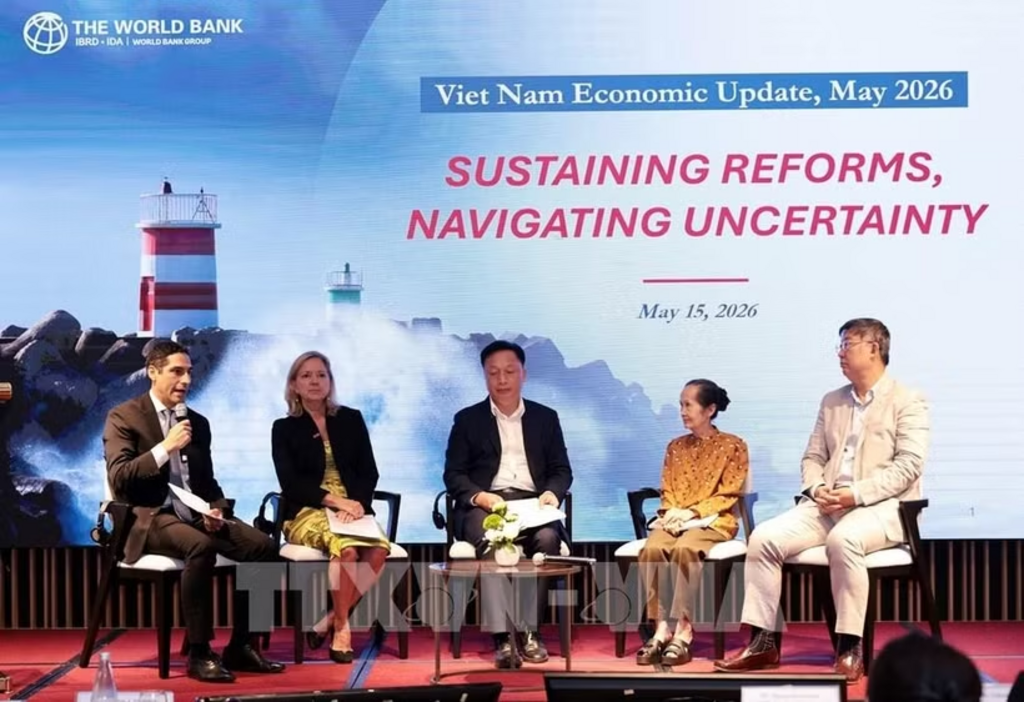
| Speakers at the press conference__Photo: VNA |
Despite mounting short-term external challenges, Vietnam’s medium-term economic outlook remains highly positive, with the country expected to continue as one of the region’s growth bright spots, according to the World Bank (WB)’s latest Vietnam Economic Update.
Speaking at a press conference to release the report on May 15, WB Division Director for Vietnam, Cambodia and Laos Mariam J. Sherman said Vietnam entered 2026 from a position of strength, outperforming other economies in the Association of Southeast Asian Nations (ASEAN).
Despite global trade headwinds, Vietnam’s gross domestic product (GDP) expanded by 8% in 2025, the highest growth rate in ASEAN, driven by strong export performance, a resilient services sector, and rising foreign direct investment (FDI) inflows and public investment. The momentum has also been supported by an ambitious reform agenda aimed at restructuring the state apparatus, described as the most far-reaching since the Doi moi (Renewal) period.
According to Tamina Khan, WB Lead Economist for Vietnam, Cambodia and Laos, Vietnam is also benefiting from the global artificial intelligence (AI) investment boom, with exports of AI-related products now accounting for nearly 30 per cent of GDP.
However, the external environment has become more challenging in 2026. Global trade uncertainty persists, while US tariffs remain higher than pre-2025 levels, putting pressure on highly open economies such as Vietnam. At the same time, conflict in the Middle East has triggered severe oil supply disruptions.
The WB said these pressures are exposing four structural weaknesses in Vietnam’s growth model.
First, the gap between domestic enterprises and FDI firms is widening. Since the announcement of US reciprocal tariffs, exports from the FDI sector have surged by 42 per cent, while exports from domestic firms have contracted due to a weaker capacity to absorb tariff shocks.
Second, despite strong trade growth, Vietnam’s foreign exchange accumulation remains limited, resulting in thinner reserves and prolonged exchange rate pressure.
Third, Vietnam’s corporate leverage ratio is among the highest in the region, while liquidity strains persist in the banking sector. Khan noted that Vietnam’s credit-to-GDP ratio reached 145 per cent in 2025, the highest in ASEAN, while Vietnamese banks maintain thinner capital buffers than regional peers.
Fourth, concerns remain over the efficiency of public investment. With a planned investment package of USD 320 billion for 2026-30, the challenge for Vietnam is not how much to spend, but how to spend effectively to generate productivity gains.
Against this backdrop, the WB projected Vietnam’s economic growth to moderate to 6.8% in 2026 before recovering in 2027–28 as oil supply shocks ease and domestic growth drivers strengthen. Average inflation in 2026 is forecast at 4.2 per cent, assuming second-round inflationary impacts remain under control.
Despite heightened short-term risks, Khan stressed that Vietnam’s medium-term outlook remains positive. She said effective implementation of reforms would help the country overcome external challenges and maintain strong growth momentum.
The WB recommended that Vietnam ensure rigorous appraisal and effective implementation of its USD-320-billion public investment portfolio, diversify long-term financing sources beyond the banking system, and improve the quality of FDI by strengthening linkages with domestic firms and promoting knowledge transfer.
Sherman noted that Vietnam is pursuing some transformative reforms, but stressed that their full impact would depend on effective implementation, making policy execution and commitment to the reform agenda crucial at this stage.- (VNA/VLLF)