 |
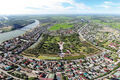
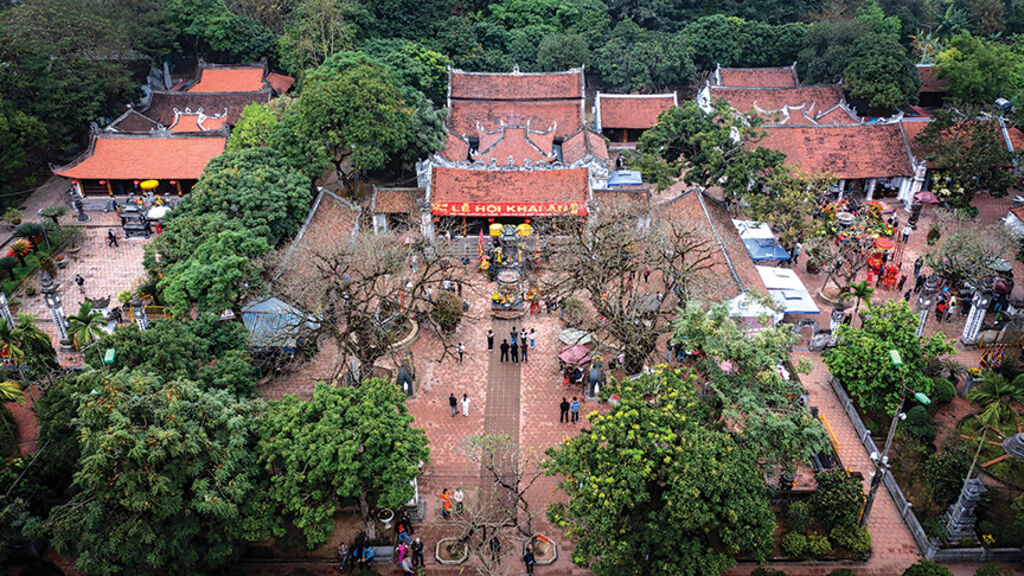
| An overview of Tran temple, with Thien Truong temple in the centre, Co Trach temple on the right, and Trung Hoa temple on the left__Photo: nhandan.vn |
The Tran temple and Pho Minh pagoda in Nam Dinh ward, Ninh Binh province, together form a typical relic complex within the system of Tran-dynasty heritage sites across the country.
Closely associated with the Tran dynasty (1225-1400), the relic complex reflects the dynasty’s enduring achievements in multiple fields, including politics, ideology, economics, culture, and military affairs. It is also a major religious centre of the Red River delta, hosting numerous traditional festivals, and featuring diverse folk cultural activities that express remembrance and reverence for the Tran dynasty. Among these, the most notable are the early-spring seal-opening festival and the August festival commemorating the death anniversary of national hero Tran Quoc Tuan, who led Dai Viet (the name of the country under the Tran dynasty) to repel three massive Mongol-Yuan invasions in the 13th century and was conferred the title Hung Dao Dai Vuong (Grand Prince Hung Dao).
To honour its exceptional historical, cultural and spiritual value, on September 27, 2012, the Prime Minister issued Decision 1419/QD-TTg, officially recognising the Tran temple and Pho Minh pagoda relic complex as the special national relic.
Historical imprints
The Tran temple was built in Thien Truong prefecture, which was once regarded as the second capital of Dai Viet, following Thang Long.
According to historical documents, in 1258, when the Yuan-Mongol army invaded the country for the first time, King Tran Thai Tong ordered the implementation of the “empty garden, vacant house” policy in the Thang Long capital and strategically withdrew to Thien Truong prefecture to mobilize the strength of the entire population.
After defeating the Mongol-Yuan army, on the 14th day of the first lunar month, at Thien Truong prefecture, King Tran Thai Tong held a banquet to reward and confer titles to officials and soldiers who had merits in fighting the enemy.
From then on, every year on that day, the Tran kings held the seal-opening ritual to worship the heaven, the earth and the ancestors, confer ranks and titles on meritorious individuals, and mark the beginning of a new working year for the Tran state apparatus.
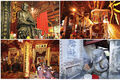
In remembrance of the Tran dynasty, on the former site of Thien Truong prefecture, local people built the Tran temple that consists of three main architectural structures, namely Thien Truong temple (also called the upper temple, worshipping 14 Tran kings), Co Trach temple (lower temple, worshipping Tran Hung Dao), and Trung Hoa temple (worshipping 14 Tran kings along with civil and military officials).
Architectural styles and spatial layout
Tran temple
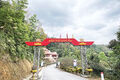
All the three temples of the Tran temple site feature traditional architectural styles and share a common entrance gate. Above the gate is a large calligraphy panel bearing the Chinese characters “Tran Mieu” (陳廟) meaning the temple of the Tran dynasty while below are three large Chinese characters “Chinh Nam Mon” (正南門)meaning the main gate facing south. For this reason, the name “Tran temple” is used to collectively refer to the three temples.
Thien Truong temple
Thien Truong temple was built on the foundations of the Imperial Ancestral temple and Trung Quang palace of the Tran dynasty, formerly the site dedicated to worshipping the ancestors of the Tran clan. Trung Quang palace once served as the residence and workplace of the Tran dynasty’s abdicated kings.
The present-day Thien Truong temple was constructed by local residents in the 15th year of the Chinh Hoa era (1695). The temple was further expanded and renovated in 1773, 1854, 1895, and 1907-08, gradually taking on its current architectural appearance.
Constructed at the centre of the relic, the temple consists of the front hall, middle hall, main sanctuary, incense-burning hall, and two side wings, comprising a total of nine buildings with 31 compartments. The structural frame was made of lim (ironwood), with tiled roofs and brick-paved floors.
Co Trach temple
Constructed in 1894, Co Trach temple is located to the east of Thien Truong temple.
According to a stele inscription preserved at the site, during the renovation of Thien Truong temple in 1868, a broken fragment of a stone stele was unearthed to the east of Thien Truong temple bearing the words “Hung Dao Than Vuong Co Trach”, meaning the former residence of Prince Tran Hung Dao.
The temple is dedicated to Tran Hung Dao and his trusted generals. The temple architecture includes the front hall, middle hall, main sanctuary, incense-burning hall, and side wings worshipping civil and military officials of the Tran dynasty.
Trung Hoa temple
Located on the western side of the complex, it was built in 2000 on the former foundation of the old Trung Hoa palace. Inside the temple sit 14 bronze statues of the 14 Tran kings placed in the middle hall and main sanctuary.
Pho Minh pagoda
Located about 300 metres west of the Tran temple, Pho Minh pagoda was originally built during the Ly dynasty. In 1262, abdicated King Tran Thai Tong expanded the pagoda into a centre of religious practice for members of the royal family, including princes, nobles, royal consorts, and princesses of the Tran dynasty.
Pho Minh pagoda features a large-scale architectural layout, with the main structure consisting of a nine-compartment front hall, a three-compartment incense-burning hall, and an upper hall, arranged in the shape of the Chinese character “Cong” (工).
The pagoda’s triple gate is made of wood with brick walls and an ancient tiled roof. On both sides of the courtyard are two stele houses. Behind the upper hall is an 11-compartment building extending in the shape of the Chinese character “Nhat” (一). This area encompasses the patriarch hall, monks’ quarters, and worshipping hall.
The most prominent highlight of the pagoda is Pho Minh tower, representative example of Buddhist architecture built in 1305 during the reign of King Tran Anh Tong to commemorate his father - King Tran Nhan Tong.
The tower is 19.51 metres high with 14 tiers, built on a square base with each side measuring 8.6 metres, sunk 0.45 meters below ground level. The tower is a construction harmoniously combining brick and stone materials. While the base and lowest tier were built entirely of fine blue stone, the upper 13 tiers were constructed of fired red bricks.
Annual festivals
Early-spring seal-opening festival
The Tran temple’s early-spring seal-opening festival is held every early spring to preserve and promote cultural values and traditional education in patriotism and resistance against foreign invaders and remember the great contributions of the Tran dynasty to the country. The seal-opening ritual, which takes place at Thien Truong temple at the midnight of the 14th day of the first lunar month, aims to pray for national peace and prosperity, favourable weather, and for all people to share in the blessings of the seal, accumulating boundless merit.
The seal is placed on a jade tray and ceremonially carried from Co Trach temple to Thien Truong temple. The seal is square in shape; its surface is embossed with four Sino-Nom characters “Tran Mieu Tu Đien” (陳廟祀典)meaning ritual records of worship at the Tran ancestral temple. Below are four engraved characters “Tich Phuc Vo Cuong” (積福無疆) conveying the educational meaning that descendants and the populace must preserve moral qualities and accumulate virtue.
After the seal-opening, the first seal impressions are offered to Tran dynasty relics, and then are distributed to people.
Over many years, the Tran temple’s seal-opening ritual has been maintained and developed by people, becoming one of the beautiful cultural practices of the Vietnamese during the early days of the new year.
August festival
This festival is organised to commemorate the death anniversary of national hero Tran Hung Dao, and is therefore also known as the traditional Tran Hung Dao festival. The festival is held from the first to the 20th day of the eighth lunar month at Tran temple and the system of relics worshipping Tran Hung Dao.
Diverse activities take place during the festival. The ritual section includes palanquin processions, incense offerings, and other rites. Meanwhile, the festive section features many traditional folk games such as wrestling, cockfighting, water puppetry, and dragon, unicorn and lion dances.
In 2014, the Tran temple festivals were inscribed by the Ministry of Culture, Sports and Tourism on the National List of Intangible Cultural Heritage.- (VLLF)