 |
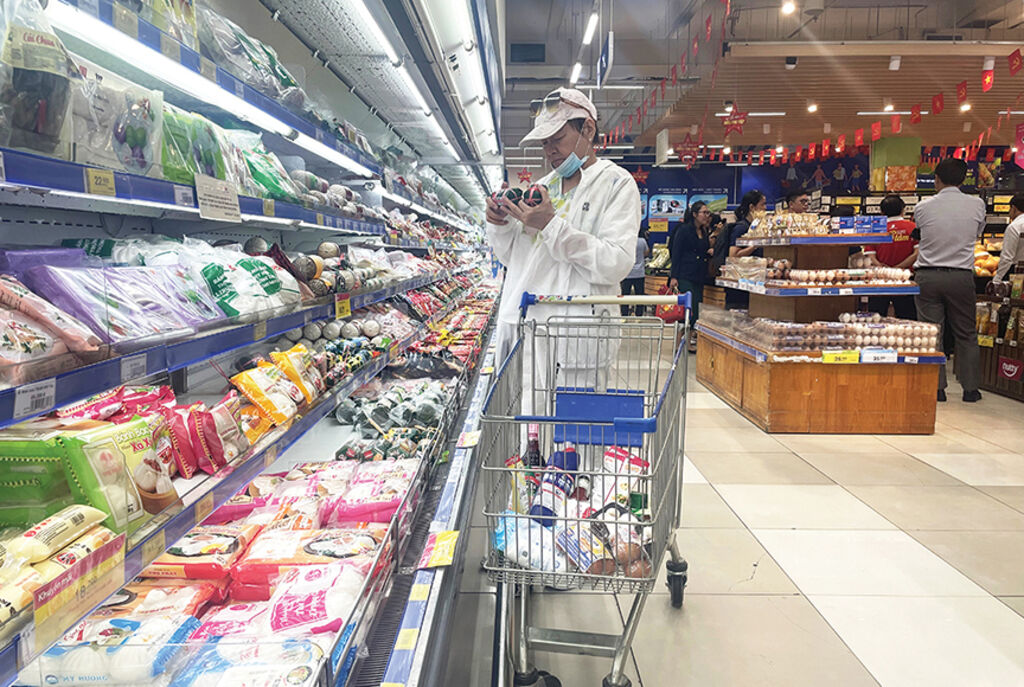
| Amid food safety scandals, consumers become the ones bearing the risk__Photo: Huong Giang/VNA |
A series of food safety scandals, ranging from canned products made from diseased pork to processed meat containing banned additives, has sounded a serious warning about the risks consumers face in their daily lives. Beyond questions of business ethics, these cases expose weaknesses in the existing legal framework and underline the urgent requirement to revise the Food Safety Law to better protect the public.
When consumers become the ones bearing risks
In early January, public concern intensified after authorities uncovered that Ha Long Canned Food Joint Stock Corporation had purchased, stored and used pork infected with African swine fever to produce a wide range of products distributed nationwide. Investigators reported the seizure of approximately 130 tonnes of diseased pork from the company’s warehouse, which had been intended for processing into more than 14,000 cans of pâté and other products.
Later the same month, law enforcement agencies in Hanoi discovered a processed meat facility in the Old Quarter that had used borax, a banned additive known to pose serious health risks, in the production of traditional pork rolls. Notably, the facility was reported to have supplied hundreds of tonnes of adulterated products to the market over several years before the violations were detected.
Although different in scale and context, both cases raise the same question: why were products posing potential risks to public health able to circulate on the market for such a long period before being discovered and addressed?
In both cases, consumers were placed in a fundamentally passive position. The products were openly sold, properly labelled and, in some instances, associated with familiar brands. As a result, consumers in fact had little ability to identify risks through ordinary observation. Trust in brand reputation and confidence in the regulatory system effectively became the sole basis for purchasing decisions.
When the violations were eventually exposed, the consequences extended beyond potential health impacts. Consumers were left with lingering anxiety, eroded confidence in processed food and growing concern about other risks that might remain undetected. In this context, the burden of self-protection, from changing consumption habits to constantly monitoring official warnings, appears increasingly to have shifted onto the public.
Taken together, these cases point to a broader and more systematic problem. When regulatory safeguards fail to operate effectively, the risks generated earlier in the production and distribution chains are ultimately transferred to consumers, who lack both the information and the tools needed to protect themselves adequately.
Shortcomings in the current legal framework
Vietnam’s Food Safety Law was adopted in 2010, more than 15 years ago. As assessed by the Ministry of Health, the law has played an important role in state management of food safety and provided a basic legal foundation for regulatory agencies to carry out their duties. At the same time, long-term implementation has revealed that a number of the law’s provisions are no longer fit for purpose, lack coherence and feasibility, and have failed to keep pace with changes in production methods, market scale and consumer behaviour. These shortcomings have, in turn, weakened the effectiveness of consumer protection.
A major weakness lies in the fragmentation of the legal framework governing food. Effective food management requires a unified legal system covering product quality, food safety and the control of counterfeit goods. In practice, however, these areas are regulated separately: product quality is governed by the Law on Product and Goods Quality; food safety by the Food Safety Law; and counterfeit control by Government Decree 98/2020/ND-CP on administrative sanctions in commercial activities and the production and trading of counterfeit and prohibited goods. This fragmentation undermines integrated management of the food supply chain from production to market circulation.
Also, the organisational structure and management model for food safety nationwide remain neither streamlined nor unified, and are not commensurate with the assigned responsibilities. Despite the continued emergence of cases involving large-scale production of counterfeit and substandard food products, mechanisms remain insufficient for state authorities to revoke previously issued certificates or to suspend the provision of public services when organisations or individuals are found to be in violation.
The current Food Safety Law further lacks provisions requiring organisations and individuals to conduct quality testing, alongside food safety testing, when registering circulation of food products, renewing product declaration registration certificates or carrying out supervision throughout the product lifecycle.
In addition, there are no clear regulations on the management, identification or traceability of food products, food materials, food additives, processing aids, and food contact utensils and materials circulating on the market through external labelling tools such as barcodes or QR codes.
Finally, though the existing law defines the rights and obligations of organisations and individuals engaged in food production and trading, it keeps silent about the rights and obligations of organisations and individuals that are named in food product declaration forms. This gap complicates inspection and supervision, as it is found unreasonable when the entity responsible for declaring a product to regulatory authorities does not bear corresponding responsibility once the product is circulating on the market.
Amending the Food Safety Law to better protect consumers
It is against this backdrop of accumulated shortcomings that amending the Food Safety Law has emerged as a systematic necessity rather than a purely technical adjustment. The objective is not only to address individual regulatory gaps, but also to strengthen the overall capacity of the legal framework to protect consumers in an increasingly complex and risk-prone food market.
The Ministry of Health is currently finalising the draft amended Food Safety Law, which focuses on addressing gaps revealed through practical implementation rather than merely refining the existing provisions. The 55-article draft covers a broad range of spheres, including general provisions; the rights and obligations of organisations and individuals in ensuring food quality and safety; conditions for ensuring food safety; requirements for food trading establishments and testing services; food safety in import and export activities; food advertising and labelling; technical requirements and food safety testing; risk analysis and management and incident response; information, education and communication on food safety; state management of food; and implementing provisions.
The draft amendment centres on five major policy groups. These include tightening oversight of establishments engaged in production and trading of high-risk food; clarifying the division of responsibilities between central authorities and provincial-level People’s Committees in food safety management; strengthening risk-based control of processed and pre-packaged food products before they are placed on the market; applying risk- and compliance history-based controls to imported food shipments; and strictly managing substances used in food production and processing that are susceptible to misuse or abuse and might pose health risks.
In particular, policies governing quality control systems, from production to circulation and distribution processes, are to be improved to facilitate testing capacity, refine procedures for assessing whether products meet quality standards, and ensure that substandard products can be recalled swiftly and effectively.
One of the most notable points of the draft amended law is the provision assigning provincial-level People’s Committees the authority and responsibility to establish a focal-point agency to take charge of food safety management at the local level. Under this approach, performance of administrative procedures would be decentralised to the maximum extent possible, enabling local authorities to fully exercise their assigned responsibilities.
Worthy of note, the draft devotes a dedicated chapter to post-market inspection. This marks a significant shift towards consolidating the rules that are currently scattered across multiple legal documents.
“Post-market surveillance plays a crucial role in food safety management and is a model adopted by many countries. At present, this model is regulated in different legal instruments. The amended Food Safety Law will consolidate these rules into a single chapter to ensure consistency, coherence and effective implementation,” Chu Quoc Thinh, Acting Director of the Vietnam Food Administration, said at a recent conference held to collect opinions on the draft law.
Recent food safety scandals illustrate that when legal frameworks and regulatory mechanisms fail to keep pace with reality, risks are ultimately transferred to consumers. Amending the Food Safety Law is therefore not merely a matter of legislative technique, but a pressing social imperative, one that seeks to restore public trust and ensure that the right to safe food is not confined to principles on paper, but realised in everyday life.- (VLLF)