 |
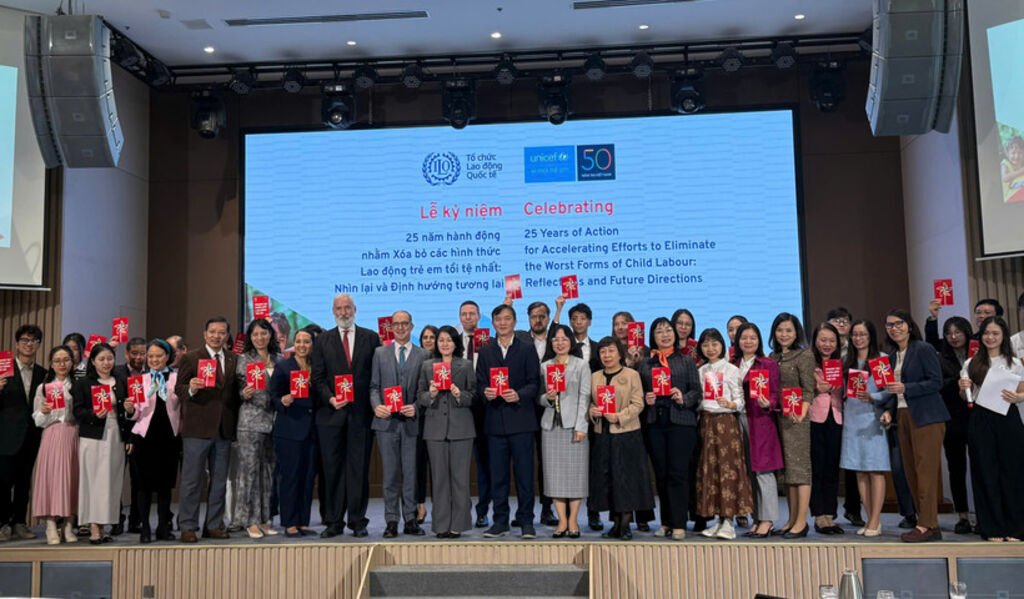
| Delegates take a photo at the event__Photo: vietnamplus.vn |
The International Labor Organization (ILO) Vietnam, in coordination with the United Nations Children’s Fund (UNICEF) Vietnam, held an event on December 17 in Hanoi to mark the 25th anniversary of Vietnam’s ratification of ILO Convention No. 182 on the Prohibition and Immediate Action for the Elimination of the Worst Forms of Child Labor.
The event marked a significant milestone, reflecting Vietnam’s long-standing commitment to protecting children in line with international labor standards and contributing to more inclusive and sustainable socio-economic development.
Speaking at the event, ILO Country Director for Vietnam Sinwon Park emphasized that ending child labor is a strategic investment in the country’s economic future. She noted that when children are in school and developing skills, and when adults have access to decent and productive jobs, the benefits extend beyond individual families to businesses and the wider economy.
Over the past 25 years, Vietnam has made substantial progress in preventing and eliminating child labor, including its worst forms. Through strengthening the legal framework, implementing national action programs, and enhancing coordination across authorities of different sectors and levels, the country has reinforced its child protection system, expanded children’s access to education, and improved monitoring of children’s participation in economic activities.
As a Pathfinder Country of Alliance 8.7, Vietnam has continued to demonstrate leadership and responsibility in global efforts to end child labor. A key driver of recent progress has been the National Program on Prevention and Reduction of Child Labor for the 2021-25 period, with a vision to 2030. The program focuses on early identification and prevention of risks, development of sustainable solutions for vulnerable children, and integration of child labor prevention into education, poverty reduction, social protection, and employment policies.
According to national surveys conducted by the General Statistics Office with support from the ILO, the proportion of children engaged in economic activities declined sharply from 9.1 percent in 2018 to 3.5 percent in 2023. Despite these gains, an estimated 94,300 children remain engaged in hazardous work, and nearly 12 percent of children in child labor are exposed to health-related risks.
A representative from the Department of Maternal and Child Health under the Ministry of Health stressed that child protection is a shared responsibility involving families, communities, state agencies, and businesses. No single actor alone can end child labor, the representative said, underscoring the need for collective action, from strengthening social protection policies for vulnerable families to enforcing laws and enhancing corporate responsibility.
In the context of rapid digital transformation, new risks such as online child exploitation are emerging alongside existing vulnerabilities. This calls for child protection systems capable of responding effectively in both online and offline environments, grounded in prevention, education, and strong law enforcement and compliance mechanisms.
To achieve these shared goals and promote high-quality economic growth, Vietnam must continue to prioritize the protection of children’s fundamental rights through integrated approaches, particularly in education and social protection.
UNICEF Representative in Vietnam Ly Phat Viet Linh reaffirmed that every child has the right to a safe childhood and opportunities to learn and develop. Preventing child labor, Linh said, begins with protecting children from harm, ensuring access to education and social services, and providing timely support to vulnerable families to help break the cycle of poverty.
At the event, the ILO, UNICEF, and the United Nations in Vietnam reaffirmed their commitment to supporting the country in implementing national programs and strengthening labor and social law enforcement.
As Vietnam prepares its National Program on the Prevention and Reduction of Child Labor for the 2026-30 period, the 25-year milestone serves as a critical opportunity to accelerate progress toward Sustainable Development Goal 8.7, which calls for the elimination of child labor in all its forms.- (VLLF)