 |
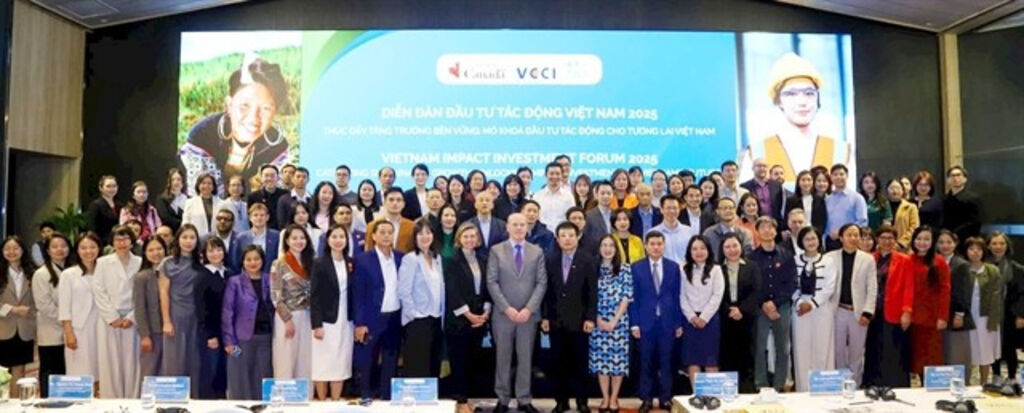
| Participants in the Vietnam Impact Investment Forum 2025, held in Hanoi on December 10__Photo: diendandoanhnghiep.vn |
Impact investment in Vietnam is experiencing strong growth thanks to important drivers like the commitment to net zero emissions by 2050, the National Green Taxonomy 2025, and the Circular Economy Plan for 2035, heard a forum on December 10.
The Vietnam Impact Investment Forum 2025, held in Hanoi, aimed to promote the country’s development into a leading impact investment hub in Southeast Asia.
The event was organized by the Vietnam Chamber of Commerce and Industry (VCCI) in collaboration with the Impact Investment Exchange (IIX) and Global Affairs Canada. It brought together more than 150 investors, impact enterprises, ecosystem support organizations, and policymakers.
At the forum, Canadian Ambassador to Vietnam Jim Nickel reaffirmed his country’s commitments to supporting impact investment in Vietnam.
Nickel said Canada has accompanied Vietnam on its journey to becoming a top impact investment center in Southeast Asia. Through development cooperation programs, Canada has shared experience in blended finance and impact investment ecosystem development while also mobilizing private sector capital to foster sustainable and inclusive growth.
Under the Impact Investment Readiness Vietnam (IIRV) project implemented by IIX, Canada has supported women-focused enterprises and businesses creating positive environmental and social impacts by improving capacity, expanding networks, and attracting large-scale private capital.
This not only contributes to Vietnam’s national priorities and the push to achieve its sustainable development goals, but also promotes inclusive and comprehensive growth, the ambassador noted.
A rising number of enterprises are offering practical solutions in key sectors, including sustainable agriculture, climate adaptation, education, health care, renewable energy, women’s economic empowerment, and financial inclusion. These enterprises generate clear social and environmental impacts while also bringing financial returns to impact investors.
IIX founder and CEO Professor Durreen Shahnaz said that through the IIRV project, nearly 250 impact enterprises have been supported, successfully mobilizing CAD 17.5 million (USD 12.6 million) in private capital.
These enterprises are creating real impact. They empower women, strengthen climate resilience, and create sustainable livelihoods, Shahnaz said.
Vietnam has tremendous potential to lead the region in impact investment. If the impact investment ecosystem receives proper support, Vietnam can unlock billions of dollars for sustainable development goals, he added.
According to the 2025 Orange Index, which measures performance in women’s empowerment and climate action, Vietnam ranks 51st globally, the highest among ASEAN countries and above the global average score of 44.
This demonstrates Vietnam’s readiness for impact investment. The country performs well in three core areas: Gender (51 points), Climate (44 points), and Community Impact (58 points).
Notably, 65 percent of assessed impact enterprises are led by women, and there is a growing number of women-owned businesses offering effective climate solutions.
VCCI Chairman Assoc. Prof. Dr Ho Sy Hung said that to maintain this momentum, enterprises need to strengthen their core capabilities and market-oriented thinking.
Meanwhile, investors should prioritize high-impact sectors and enhance cooperation with development finance institutions, and regulators need to improve the legal and business environment to encourage the development of a comprehensive impact investment ecosystem.
VCCI is committed to continuing to accompany domestic and international organizations and investors to promote impact investment, contributing to Vietnam’s sustainable and inclusive development goals.
The Vietnam Impact Investment Forum 2025 included in-depth discussions on building an enabling environment, helping impact enterprises access finance and expand their operations, and maximizing social and environmental impact.
Several enterprises shared business models that bring positive benefits to the environment and the community at the event.
One notable example is a model combining rooftop solar energy with urban ecological gardens, which helps reduce city temperatures, cut emissions, and create green jobs for women and middle-aged workers - groups often left behind during industrialization.- (VNA/VLLF)