 |
| National Assembly deputies votes on the revised Law on Planning on December 10__Photo: VNA |
Lawmakers on December 10 voted to adopt the revised Law on Planning and the revised Law on Deposit Insurance, during the ongoing 10th session of the 15th National Assembly (NA).
With 428 out of 445 deputies voting in favor, equivalent to 90.49 percent, the NA approved the revised Law on Planning, a key piece of legislation aimed at removing bottlenecks, enhancing decentralization and simplifying administrative procedures in planning activities.
Comprising six chapters and 58 articles, the revised law addresses long-standing issues of delays, overlaps and inconsistencies in planning. It clarifies the concept of “sectoral detailed planning”, which will sit alongside national-level, regional and provincial planning, as well as urban, rural and special administrative–economic unit planning.
A major change is the replacement of the term “technical and specialized planning” with “sectoral detailed planning”, reflecting the need to concretize sectoral strategies and define a clear hierarchy within the planning system. The Government has also streamlined the planning portfolio by cutting the number of planning categories from 78 to 49.
The revised law introduces significant changes to approval authority. Chairpersons of provincial People’s Committees will now approve provincial planning and provincial land-use planning, a shift from previous practice that the Prime Minister held this responsibility. The move is expected to reduce the workload of the central level and strengthen local autonomy. Regional planning will continue to be approved by the Prime Minister to ensure inter-provincial coordination, while sectoral planning will be approved according to Government regulations, with some cases possibly delegated to ministers.
To address practical obstacles in determining project conformity with existing plans, a new provision in Article 48 allows investment decisions to diverge from planning in certain circumstances, including special or urgent public investment projects or decisions by the Politburo, Secretariat, NA or Government. In such cases, plans must subsequently be updated through a simplified procedure.
The law also standardizes the planning timeline, setting a unified 10-year planning period from years ending in ‘1’ to years ending in ‘0’, and a 30-year long-term planning vision, ensuring alignment with national socio-economic development strategies.
The revised Law on Planning is set to take effect on March 1 next year. It is expected to create a more enabling legal framework and support sustainable socio-economic development.
 |
| The National Assembly endorses the revised Law on Deposit Insurance on December 10__Photo: VNA |
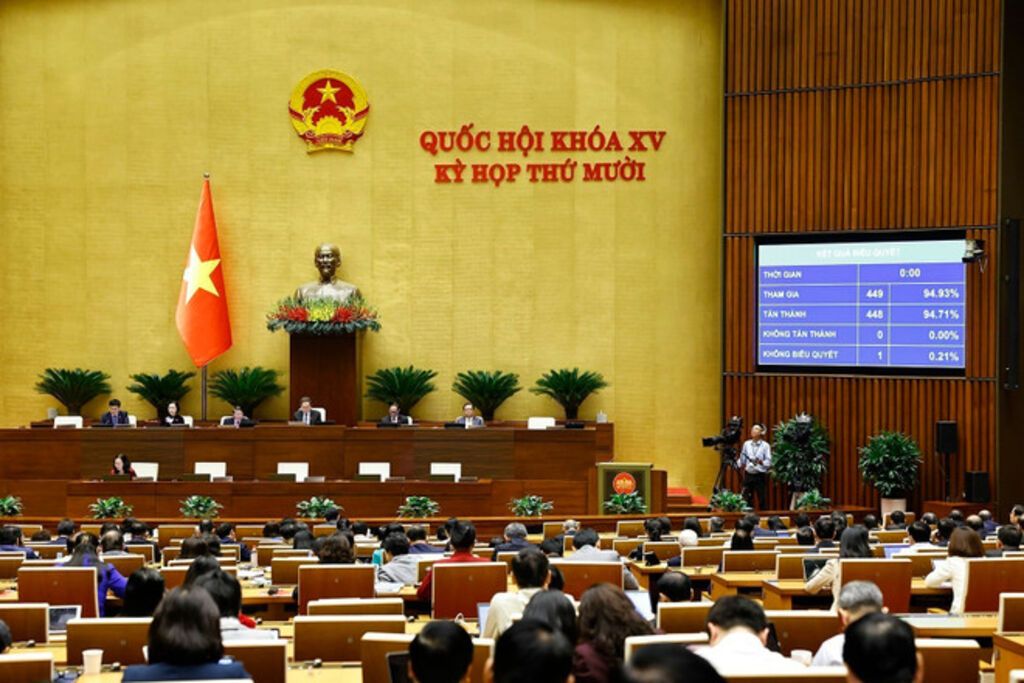
The NA also approved the revised Law on Deposit Insurance, with 448 of 449 deputies voting in favor, or 94.71 percent.
Comprising eight chapters and 41 articles, the law includes significant updates to strengthen depositor protection and reinforce the stability of the financial system. It enhances transparency by requiring deposit-insurance participants to disclose their certificates at transaction points and on their websites, as stipulated in Article 16.
The law expands the role of the deposit insurer in crisis management by detailing its involvement in early intervention, special supervision and resolution processes. New mechanisms include the provision of special loans and the purchase of long-term bonds.
The State Bank of Vietnam (SBV) is tasked with sharing data and information on insured institutions and overseeing inspection, supervision and enforcement related to deposit insurance.
Under the law, the deposit insurer must compensate depositors within 30 days from the date an insured institution stops accepting deposits or becomes unable to repay them. The Government will direct the SBV and relevant agencies to promptly issue implementing regulations to ensure effective enforcement.- (VNA/VLLF)