 |
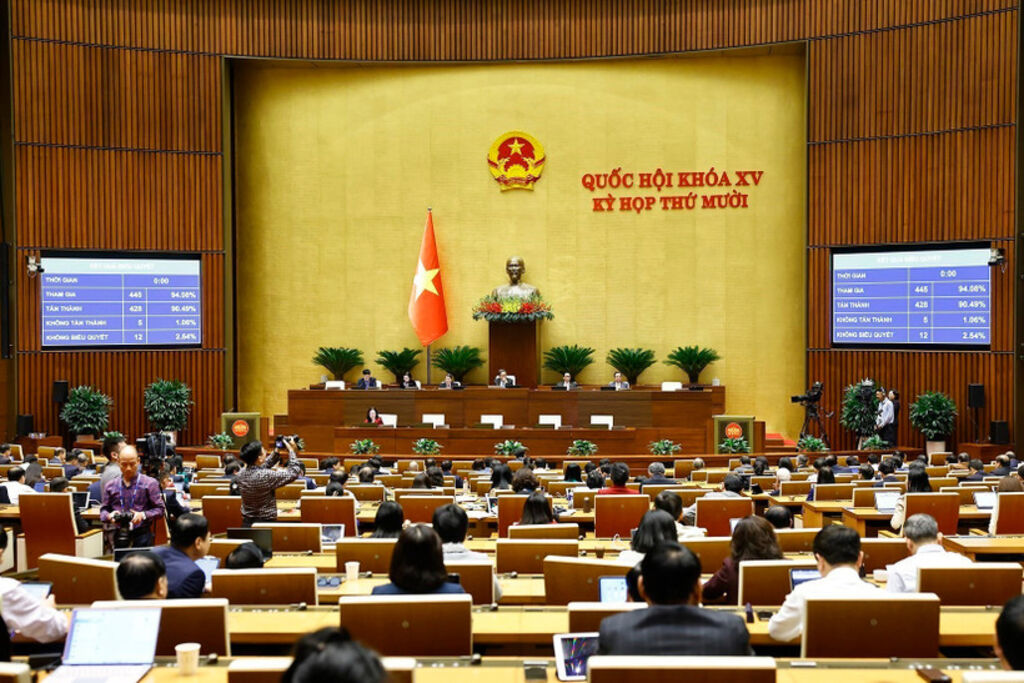
| The National Assembly votes on the Law on Thrift and Anti-Wastefulness on December 10__Photo: VNA |
With a majority of votes in favor, the National Assembly (NA) adopted the amended Law on Tax Administration, the amended Law on Personal Income Tax, and the Law on Thrift and Anti-Wastefulness on the morning of December 10.
With support from 437 out of the 448 deputies participating in the vote, accounting for 92.39% of all NA deputies, the legislature passed the amended Law on Tax Administration. The revised law comprises nine chapters with 53 articles, and will take effect from July 1, 2026.
The amended law tightens tax administration in e-commerce by requiring online platforms to pay taxes on behalf of sellers, one of the most important measures to prevent revenue loss in the digital era.
Notably, the law also changes the tax administration regime for household businesses. From January 1, 2026, instead of the previous presumptive tax regime, tax will be calculated based on actual revenue. This helps improve transparency in tax obligations and minimize risks for taxpayers.
In addition, the law broadens the scope of individual subject to exit suspension to prevent tax evasion.
With 438 of the 443 participating deputies voting in favor (92.60 percent of all deputies), the NA also approved the amended Law on Personal Income Tax, which consists of four chapters with 30 articles.
The amended law raises the family circumstance-based deduction to VND 15.5 million (about USD 588) per month (from the current VND 11 million) for each taxpayer, while the deduction for each dependent increases to VND 6.2 million per month (from VND 4.4 million).
It also raises the revenue threshold exempt from tax from the current VND 100 million (and VND 200 million proposed in earlier drafts) to VND 500 million per year. Accordingly, household businesses earning VND 500 million or less annually will not be subject to personal income tax.
The law expands tax exemptions to encourage labor and innovation, including a 100 percent tax exemption on income from night work and overtime (instead of only exempting the additional pay as previously); a five-year tax exemption on income from wages and salaries of high-quality digital technology and high-tech industry personnel; and exemptions on income from first-time transfers of carbon credits and green bonds.
The law is scheduled to take effect on July 1, 2026. However, to allow people to benefit sooner from higher deductions and lower tax rates, provisions related to income from wages, salaries, and business activities will be applied earlier, from January 1, 2026.
With 433 out of the 440 deputies present voting in favor, the NA adopted the Law on Thrift and Anti-Wastefulness. Compared with the 2013 Law on Thrift Practice and Anti-Wastefulness, the new law changes its name to the “Law on Thrift and Anti-Wastefulness”.
The law clearly distinguishes its scope of application between the public and private sectors: provisions for the public sector are mandatory while for private business and consumer activities, they are encouraged, without undue intervention in the management and use of private resources.
The law expands and clarifies the definitions of “thrift” and “wastefulness”. Thrift is not limited to using less than prescribed norms but also includes “using resources in accordance with norms, standards and regulations while achieving higher-than-targeted results”. Wastefulness includes acts that hinder socio-economic development and cause the country to miss development opportunities.
The law also institutionalizes Party regulations and specifies wasteful acts in various areas such as public finance, public investment capital, natural resources and energy, and public assets. This helps clearly identify violations for handling and avoid confusion with legislative activities.
The Law on Thrift and Anti-Wastefulness will take effect on July 1, 2026.- (VNA/VLLF)