 |
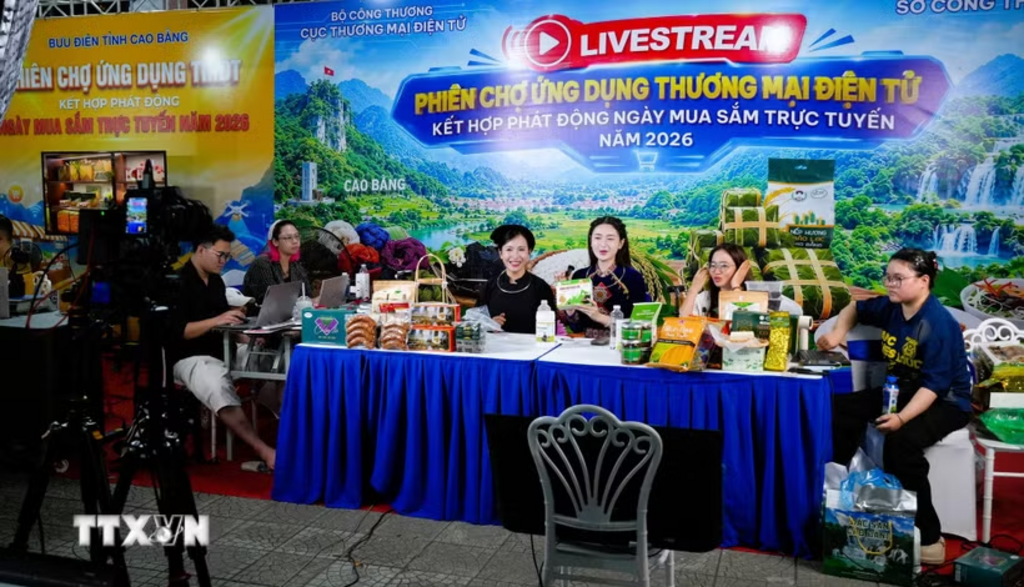
| Enterprises from Cao Bang province sell products online at an e-commerce fair__Photo: VNA |
Vietnam aims to raise total retail sales of goods and consumer service revenue to VND 13.5-14 quadrillion by 2030, with average annual growth of 14-15 per cent during the 2026-30 period, under a new programme designed to strengthen domestic brands, improve product quality and promote digital commerce.
Approved under Prime Minister Decision 2069/QD-TTg of October 29, the “Vietnamese Goods for Vietnamese People” Programme for 2026-30 also targets e-commerce sales of USD 93-97 billion by 2030, representing 18-19 per cent of the country's total retail sales of goods and consumer service revenue.
Specifically, the programme seeks to develop an ecosystem of high-quality, competitive Vietnamese products that meet the diverse needs of domestic consumers, build trusted domestic brands and contribute to the country’s goal of double-digit economic growth.
To accelerate digital trade, the programme aims to establish at least five specialised online storefronts for Vietnamese goods on major e-commerce platforms, while targeting average annual e-commerce sales growth of 23-25 per cent.
More than 70 per cent of small- and medium-sized enterprises (SMEs) manufacturing consumer goods are expected to apply e-commerce tools, while 45 per cent of SMEs operating in the trade sector are targeted to participate in major domestic and international e-commerce platforms.
A key initiative is the development of the Vietnamese Goods Digital Platform, which will connect, integrate and verify data on enterprises, products, results of assessment against relevant criteria, product traceability, distribution outlets and consumer feedback.
The platform is also intended to facilitate data sharing with relevant databases and enable consumers to access verified product information, helping them make more informed purchasing decisions.
Beyond e-commerce, the programme seeks to maintain the share of Vietnamese goods at over 80 per cent in domestic supermarkets and shopping centres and over 60 per cent in traditional retail channels. Domestic sales revenue in consumer goods manufacturing industries is expected to grow by an average of 12-15 per cent annually.
To improve product quality and consumer trust, the programme aims to develop and officially introduce a unified “Vietnamese Goods for Vietnamese People” identity system, based on national standards, national technical regulations and sector-specific requirements, while moving closer to international practices.
Under the programme, enterprises and products meeting the required criteria will be listed on the Vietnamese Goods Digital Platform, while the unified visual identity will be applied consistently across product packaging, retail outlets and online storefronts.
This approach is intended to improve product identification, strengthen transparency and make it easier for consumers to verify product information and provide feedback.
To achieve its objectives, the programme sets out seven groups of tasks and solutions covering communications, distribution network development, the Vietnamese product identification ecosystem, business capacity building, measures to stimulate consumer demand, market supervision and policy improvement.
In addition, a nationwide communications campaign under the “Vietnamese Goods for Vietnamese People” initiative will also be launched to promote domestic products, brands and businesses, while providing information on product quality, origin and points of sale.
The campaign will use newspapers, digital platforms, social media and e-commerce marketplaces, alongside promotional weeks, trade fairs, exhibitions and activities recognising outstanding Vietnamese products, brands and enterprises.
In distribution, the programme promotes specialised online storefronts for Vietnamese goods, omnichannel retail models, livestream commerce and stronger domestic supply chains. It also seeks to strengthen supply-demand linkages at national, regional and local levels, with priority given to connecting SMEs with modern distribution networks.- (VLLF)