|
| Party General Secretary To Lam delivers a speech at the ceremony commemorating the 30th anniversary of Vietnam's accession to ASEAN in Jakarta, Indonesia, in March 2025__Photo: VNA |
Vietnam’s accession to the Association of Southeast Asian Nations (ASEAN) in 1995 was a "strategic decision" for both the country and the bloc’s then six members, laying the foundation for a more united Southeast Asia, former Deputy Foreign Minister Pham Quang Vinh has said.
According to Vinh, the country’s 31-year journey has seen it transform from a newcomer into a responsible, proactive and increasingly influential member. Its growing role reflects not only deeper regional economic and foreign integration but also its emergence as a key driver of ASEAN's development, resilience and global standing.
Historic strategic decision
Vinh said that Vietnam’s decision to join ASEAN helped close a chapter of division and confrontation in Southeast Asia while opening a new era of regional cooperation.
In its early years, Vietnam focused on adapting to ASEAN’s working methods and accelerating regional integration. Despite being a newcomer, it quickly demonstrated its coordination ability by successfully hosting the 1998 ASEAN Summit in Hanoi.
The summit adopted the Hanoi Declaration, which set out key strategic goals, including narrowing the development gap between new and old members, advancing economic integration through a roadmap to reduce tariffs to near zero.
Between 2007 and 2020, Vietnam increasingly assumed a proactive role in shaping and promoting ASEAN’s development, Vinh said, stressing that the country contributed to drafting the ASEAN Charter, adopted in 2008, which established the bloc’s legal and institutional framework.
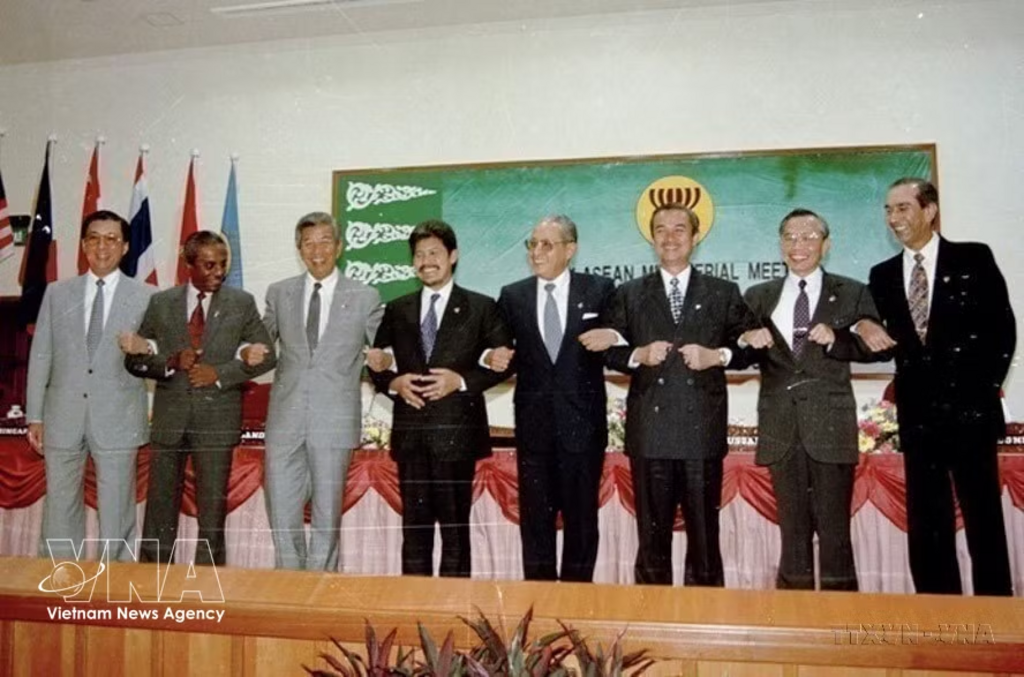 |
| Foreign Minister Nguyen Manh Cam (second from right), the ASEAN Secretary-General and ASEAN foreign ministers at the ceremony admitting Vietnam as the seventh official member of the bloc in Bandar Seri Begawan, Brunei, on July 28, 1995__Photo: VNA |
As ASEAN Chair in 2010, Vietnam oversaw the implementation of the Charter while helping secure a landmark decision to invite Russia and the US to join the East Asia Summit from 2011, reinforcing ASEAN’s central role amid growing engagement by major powers.
Vietnam’s leadership was again evident in 2020 when, as ASEAN Chair under the theme of "Cohesive and Responsive", it steered the bloc through the COVID-19 pandemic by promoting practical initiatives, including the COVID-19 ASEAN Response Fund, regional medical stockpiles and post-pandemic recovery plans.
Speaking to the Vietnam News Agency correspondents in Jakarta, Beni Sukadis, Senior Coordinator at the Indonesian Institute for Defence and Strategic Studies (LESPERSSI) Strategic Studies, said that Vietnam's most important imprint is its commitment to promoting intra-bloc solidarity and protecting ASEAN's central role in an evolving regional architecture.
He underscored Vietnam's consistent commitment to respecting sovereignty, upholding consensus, and resolving disputes in the East Sea through peaceful measures in strict accordance with international law.
From participant to rule shaper
As Vietnam enters a new stage of development, its standing within ASEAN has reached new heights. The country's foreign policy direction following the 14th National Party Congress, together with the Politburo's Resolution 06-NQ/TW issued in May 2026, has shaped a proactive and self-reliant diplomatic mindset.
Addressing a national conference on June 11, Party General Secretary and State President To Lam outlined a strategic shift in diplomacy, calling for Vietnam to move from safeguarding development space to creating national development capacity, from integrating into markets to shaping them, from participating in international rules to contributing to rule-making, and from pursuing national growth alone to advancing together with ASEAN.
That vision was reflected at the 59th ASEAN Foreign Ministers’ Meeting (AMM-59) and related meetings held in Manila, the Philippines from July 20-24.
Deputy Foreign Minister Dang Hoang Giang said the Vietnamese delegation, led by Foreign Minister Le Hoai Trung, attended the meetings not merely as a participant but as a proactive contributor of initiatives and solutions.
As coordinator for relations between ASEAN with the UK and New Zealand, Vietnam successfully led negotiations on strategic plans of action aimed at strengthening regional resilience.
Philippine Ambassador to Vietnam Francisco Noel R. Fernandez III, whose country holds the ASEAN Chairmanship in 2026, described Vietnam as a capable middle power that consistently champions ASEAN’s central role while promoting the bloc as a pillar of regional political, security and economic development.
Sharing a similar view, Collins Chong Yew Keat, a foreign affair, security and strategy analyst at the University of Malaya, said Vietnam has evolved beyond being an active ASEAN member to become a key force shaping the bloc's future, serving as both a strategic pillar and a driving force advancing the implementation of the ASEAN Community Vision 2045.
Reflecting on Vietnam’s 31-year journey in ASEAN, Ambassador Vinh said the country’s approach has been defined by three core values - solidarity, responsibility and development-oriented leadership.
Against the backdrop of growing geopolitical uncertainty and intensifying major-power competition, Vietnam’s growing role reflects a seamless combination of its own national strength and ASEAN's strategic autonomy, he stressed.