National Economics University and United Nations Development Programme
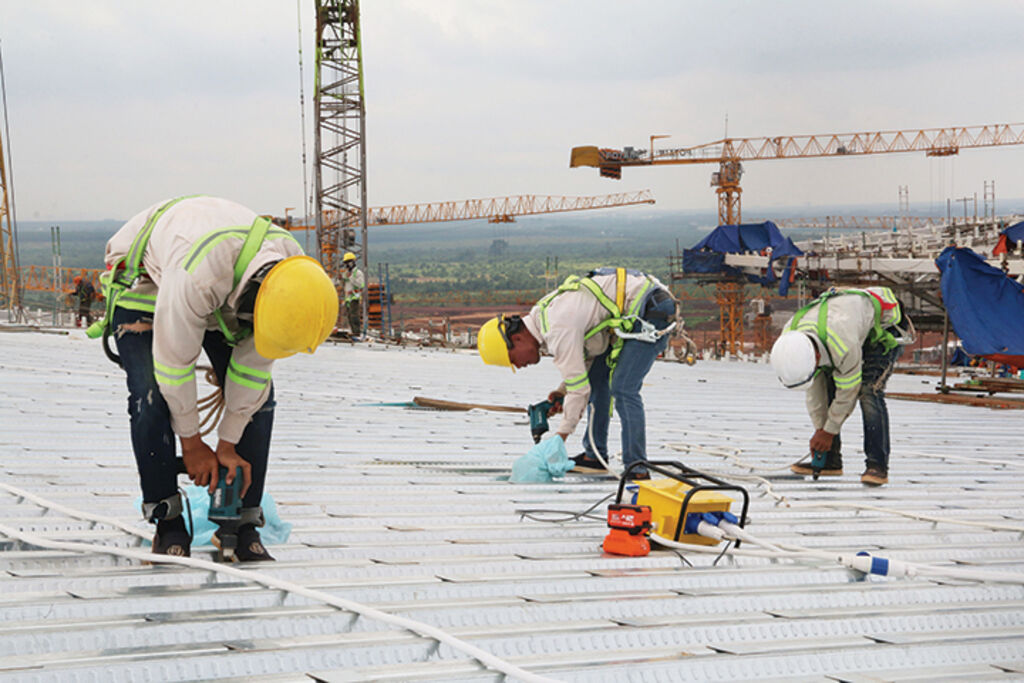 |
| Workers install the roof of the passenger terminal at Long Thanh international airport__Photo: Cong Phong/VNA |
Introduction
Extreme heat is becoming an increasingly serious occupational and livelihood risk in Vietnam’s major cities. For outdoor workers, its consequences extend beyond physical discomfort: prolonged exposure can cause health problems, reduce working hours and productivity, lower income and increase the cost of basic protective measures.
These risks are particularly significant for outdoor workers in informal employment, as they have limited access to employment-linked labour and social protection mechanisms.
A study conducted by the Institute for Sustainable Development at the National Economics University (NEU), in cooperation with the United Nations Development Programme (UNDP) Vietnam, provides evidence on the scale and distribution of these impacts. Guided by the Adaptive Social Protection framework, the research combined a review of policies and international practices with 45 in-depth interviews, 12 focus group discussions and a survey of 734 outdoor workers in Hanoi and Ho Chi Minh City. It covered construction labourers, motorbike taxi and delivery drivers, street vendors and scrap collectors.
The findings reveal a substantial mismatch between a growing climate-related risk and labour and social protection frameworks that have not yet fully adapted to either the changing climate or the evolving structure of urban employment. In one focus group discussion with construction workers, for example, it emerged that daily output could fall by roughly 30 per cent on extremely hot days - “normally we can complete 10 metres in a day, but on hot days we can only do seven”.
A risk growing faster than the response
Temperature data from 156 meteorological stations across Vietnam for the 1961-2025 period confirm an accelerating warming trend. The period from 2010 to 2020 was the warmest on record, while the frequency of days above 35 degrees Celsius doubled in many regions compared with the 1980-90 baseline.
Hanoi now experiences an average of 12 heatwave events each year. On peak days, the temperature difference between the inner city and surrounding rural areas can reach 13 degrees Celsius, reflecting the urban heat island effect associated with concrete, asphalt and waste heat from air-conditioning systems. In August 2025, Hanoi recorded 40.3 degrees Celsius, setting a new August temperature record during a month typically associated with increased rainfall and lower temperatures.
Ho Chi Minh City presents a different pattern: its tropical climate is characterised less by isolated temperature peaks than by prolonged heat accompanied by high humidity. Night-time temperatures in the urban core often remain above 28 degrees Celsius, limiting the body’s capacity for thermal recovery after daytime exposure.
Climate projections suggest that these trends will intensify. Under moderate- and high-emission scenarios, the number of days each year on which conditions in Hanoi reach a heatstroke-risk threshold is projected to rise from a historical average of 0.13 to as many as 3.87 by 2050. For people whose livelihoods depend on sustained physical activity in exposed conditions - on construction sites, on motorbikes or on the open pavement - these projections point to an increasingly hazardous working environment.
Health, income and the “dual burden” on outdoor workers
Among the 734 outdoor workers surveyed in Hanoi and Ho Chi Minh City, 94 per cent reported at least one heat-related health problem while working during heatwaves. Nearly one in five reported more than four distinct health issues. The most common were dizziness, mental fatigue, exhaustion, dehydration and sunstroke. Impacts differed between the two cities: dehydration was reported most often in Hanoi, while dizziness was the leading problem in Ho Chi Minh City. The reasons for this difference are not fully established, although survey and qualitative evidence suggest that factors such as the availability of community water stations and different patterns of heat exposure may play a role.
Heatwaves also result in lost working time: 30.3 per cent of respondents reported working fewer hours, with an average daily reduction of 2.4 hours, roughly a quarter of the typical 9.4-hour working day. Street vendors and scrap collectors were the most affected occupational group, reporting an average reduction of 2.9 hours a day. For people whose income depends on daily output, completed trips or hours worked, fewer working hours mean lower earnings.
These effects are compounded by rising costs. Overall, 46.4 per cent of respondents reported reduced income due to heatwaves, while 66.2 per cent reported increased adaptation costs, including spending on water, medication and sun-protective clothing. Age-disaggregated findings show that workers aged 40 to 59 accounted for the largest share of those reporting reduced income and increased adaptation costs, representing 53.3 per cent and 48.7 per cent of the two groups, respectively. Workers aged 60 and above accounted for 16.5 per cent of those reporting reduced income and 15.8 per cent of those reporting increased adaptation costs. This combination of falling income and rising costs constitutes a “dual burden” that is not evenly shared. Migrant workers, who tend to work more frequently and for longer hours in high temperatures, reported income loss at nearly twice the rate of local workers: 70.2 per cent compared with 35.7 per cent. Female outdoor workers also reported higher rates of income reduction than men - 55.6 per cent compared with 42.8 per cent - and greater average reductions in daily working hours. Workers aged 60 and above reported income loss at a rate of 54.4 per cent, compared with 45.1 per cent among workers under 60, while 73.8 per cent reported increased adaptation costs, compared with 64.9 per cent among workers under 60.
Figure 1. Workers reporting a decrease in income due to heatwaves (%)
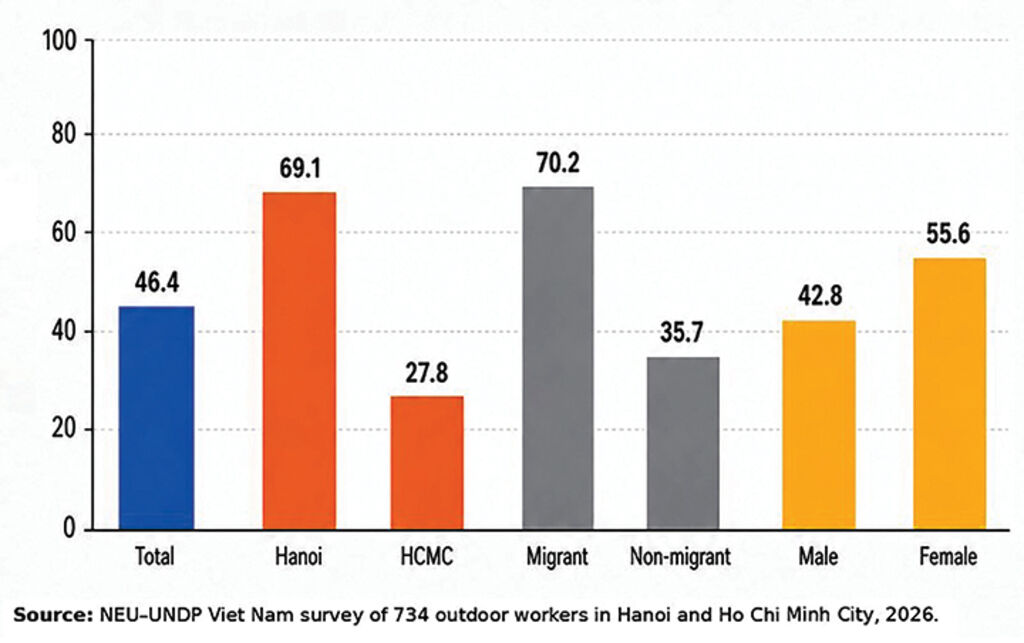 |
Figure 2. Workers reporting an increase in heatwave adaptation costs (%)
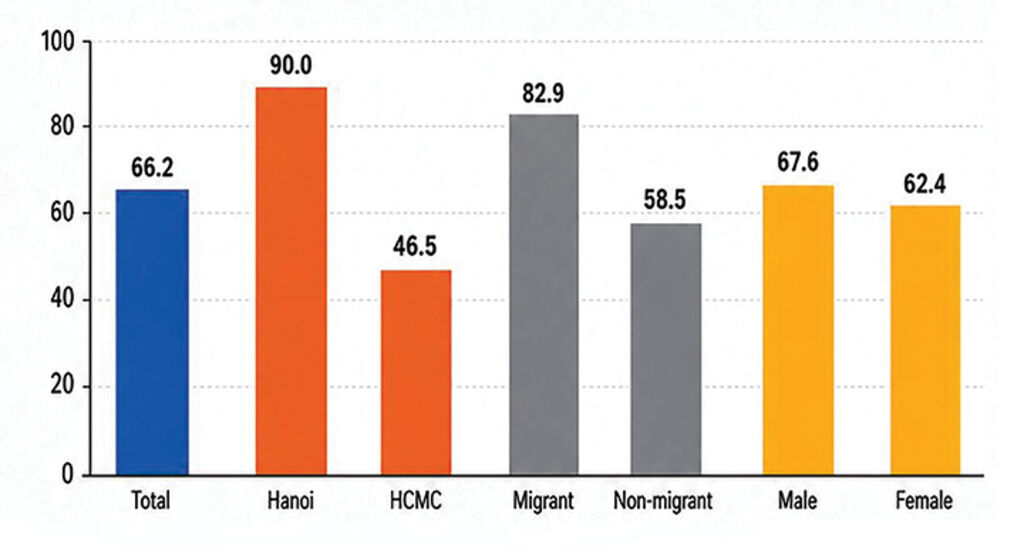 |
| Source: Survey of 734 outdoor workers in Hanoi and Ho Chi Minh City, NEU-UNDP Vietnam, 2026. |
“For workers like us, whether it is rainy or sunny, working long time, our income is still low. […] When it is 39 to 40 degrees Celsius, other people stay indoors and rest, but we still have to work. The level of endurance required is very high, but life forces us to do it.”
<Street vendor, focus group discussion>
Taken together, these cascading effects - from health problems to shorter working hours, lower income and higher costs - show why interventions focused on a single dimension are unlikely to be sufficient. They also raise a central question: why do existing labour and social protection mechanisms not yet fully reach the workers most exposed to these risks?
Where existing protections still fall short
Several reinforcing factors explain why existing mechanisms do not yet fully reach the workers most exposed to these risks. The social protection system is largely built around formal employment relationships, which many outdoor workers do not have. Extreme heat has not yet been fully recognised as a distinct occupational risk. Relevant legal provisions addressing heatwaves remain fragmented across multiple instruments, while worker awareness and local delivery capacity remain limited.
One of the main limitations lies in the close link between social insurance and formal employment. Vietnam’s compulsory social insurance system includes retirement and survivorship, sickness and maternity, and occupational accident and disease insurance. Employers contribute 21.5 per cent and employees 10.5 per cent of the monthly salary used as the contribution base. Unemployment insurance operates as a related mandatory scheme and is also tied to formal employment.
Health insurance is compulsory in principle but, unlike these schemes, it can also be accessed independently or through household-based arrangements. This broader range of access is consistent with the much higher health insurance coverage reported in the survey. Workers outside formal employment relationships generally have limited access to the employment-linked components of compulsory social insurance. Only 6.3 per cent of respondents reported social insurance coverage, compared with 77.7 per cent who reported health insurance. A further 15.8 per cent reported having no insurance of any kind.
For workers who are not covered by compulsory social insurance, voluntary social insurance provides an alternative pathway. Available under the Law on Social Insurance to Vietnamese citizens who do not participate in the compulsory scheme, it requires participants to contribute 22 per cent of a self-selected income base, while the State subsidises between 20 per cent and 50 per cent of the contribution for eligible groups. The scheme primarily provides longer-term protection, including old-age and survivorship benefits. Its role among the heat-related responses reported in the survey was nevertheless limited: only 3.3 per cent of respondents identified reported participation in voluntary insurance as a heat-related measure. This figure does not measure overall enrolment in the scheme, which the survey did not assess separately. Qualitative evidence points to broader barriers to participation, particularly unstable incomes and the priority given to immediate household needs.
The difficulties of extending social insurance beyond formal employment are particularly clear in the case of platform workers. Motorbike taxi drivers working through ride-hailing apps - the largest occupational group in the survey, representing 39.2 per cent of the sample - described their arrangements with platforms as profit-sharing rather than employment.
“I drive this motorbike without an employment contract, only a contract to open an app, not a formal employment contract. Driving is a profit-sharing arrangement.”
<Motorbike taxi driver, interview>
The digital nature of platform-based work may offer greater data traceability and therefore potential entry points for designing more inclusive contribution arrangements. Interviewed drivers described regular working patterns and income but reported that, under their contractual arrangements, they did not participate in the compulsory social insurance system. A senior official at the Vietnam Social Security offered a similar account, explaining that, under the arrangements described, commission-based earnings were not treated as wages for the purpose of compulsory social insurance contributions. The 2024 Law on Social Insurance aims to expand coverage to non-traditional workers, but its implementation for this group remains under consideration. Questions remain over contribution design, income assessment and the respective responsibilities of platforms and workers.
Extreme heat has not yet been fully addressed as a distinct occupational and social protection risk within the existing legal framework. Heatwaves are recognised in Vietnam’s disaster management legislation and in several decrees and decisions, but the relevant provisions remain spread across multiple instruments and do not form a consolidated framework addressing the occupational and livelihood dimensions of heat exposure. Under the current disaster classification system, heatwaves are typically categorised at Level 2 out of 5. This relatively low classification may be associated with more limited access to targeted resources and dedicated support than is available for higher-level hazards such as storms or floods. Although some outdoor occupations appear on the List of Arduous, Hazardous and Dangerous Occupations because of physical danger or exposure to noise and dust, heatwave or extreme heat exposure is not currently identified as a specific basis for classification.
Even where relevant provisions exist, worker awareness and local delivery capacity remain uneven. Only 11.5 per cent of respondents were aware of any government support policy relevant to their situation. Commune-level officials reported that specific guidelines on temperature-related rest periods or heat-stress standards for informal workers had not yet been issued, and noted that effective implementation depends on clear mandates and dedicated funding.
Figure 3. Health insurance coverage far exceeds other forms of insurance protection
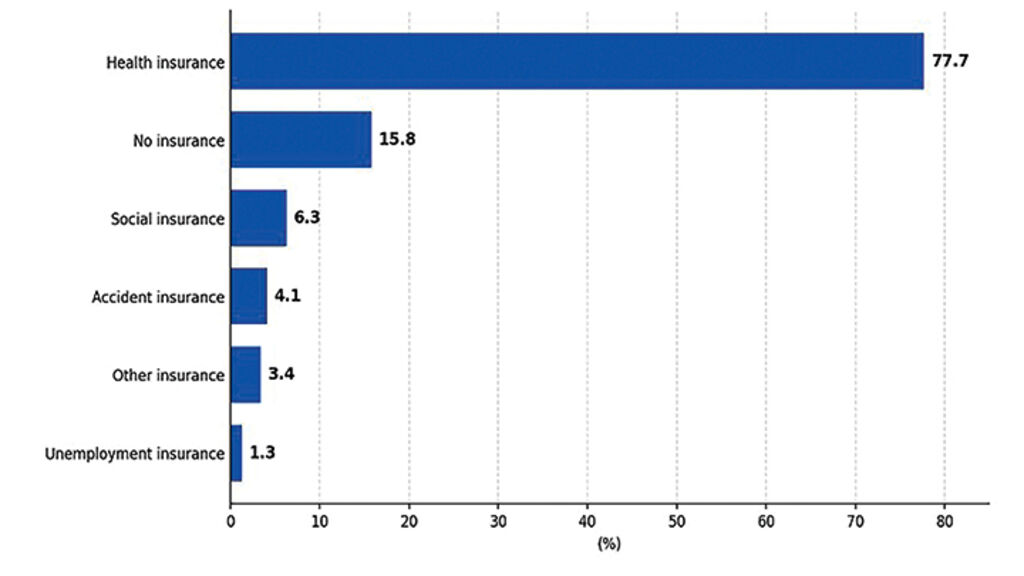 |
| Source: Survey of 734 outdoor workers in Hanoi and Ho Chi Minh City, NEU-UNDP Vietnam, 2026. |
How workers currently manage the burden
Where formal mechanisms do not yet fully reach them, outdoor workers have developed their own responses to extreme heat. These measures are practical, active and often effective in the short term, but they remain overwhelmingly individual and focused on immediate coping.
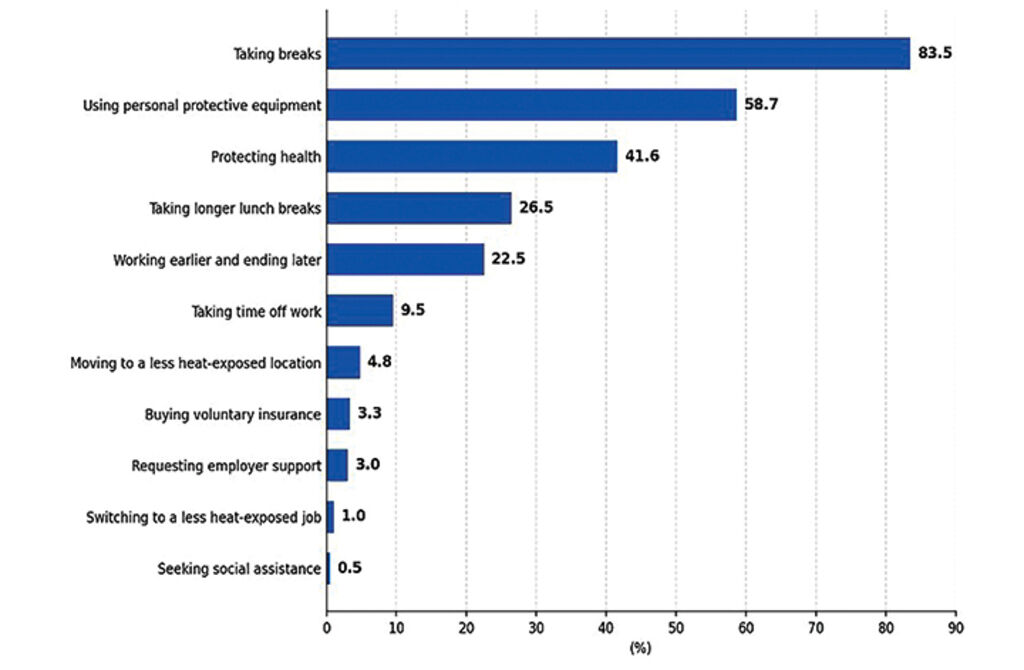
When heat-related health problems occurred, 87 per cent of respondents temporarily stopped working, moving into the shade, pulling over or sitting down until their symptoms passed. Forty-two per cent relied on basic self-administered first aid, including drinking water, taking medication they carried with them or resting until dizziness eased. Only 5 per cent went to a hospital or clinic, while fewer than 1 per cent sought any form of social assistance.
More broadly, workers took breaks to avoid peak sun (84 per cent), purchased sun-protective clothing and equipment (59 per cent), adopted health-protective measures such as carrying water or medication (42 per cent), or shifted their working hours to start earlier and finish later (23 per cent). These are not passive responses. They reflect practical knowledge developed over years of outdoor work.
“The way we cope is simply survival. We learn by ourselves; new workers watch and learn from experienced workers. Nobody formally teaches anyone.”
<Construction worker, interview>
Longer-term and institutional responses were far less common than immediate individual coping. Consistent with the limited role identified above, only 3.3 per cent reported participation in voluntary insurance as a heat-related measure, while 1 per cent had switched to a less heat-exposed job and 0.5 per cent had sought social assistance. The barriers are structural rather than attitudinal: incomes leave little room for insurance contributions, limited education can restrict occupational mobility, and institutional pathways for career transition remain limited.
The research team describes this pattern as a form of “reverse social protection”: in practice, responsibility for managing climate-related risk rests disproportionately with individual workers, especially those with the fewest resources. Migrant workers face higher rates of heat exposure and income loss, while female workers report larger reductions in working hours and earnings. Both groups therefore bear a disproportionate share of costs that a more adaptive system could distribute more broadly across public institutions, employers and insurance mechanisms.
Community-based informal support helps fill part of the gap. Workers reported receiving free drinking water from community stations, shared meals, iced tea left on the street and practical assistance from neighbours and local businesses. This support is genuine and valued, but it remains localised, depends on local initiative and is difficult to deploy at scale. It can complement formal protection, but it cannot replace it.
Figure 4. Workers rely primarily on immediate and individual coping measures
 |
| Source: Survey of 734 outdoor workers in Hanoi and Ho Chi Minh City, NEU-UNDP Vietnam, 2026. |
Building a more adaptive response
The evidence points to three interconnected opportunities to strengthen the current policy response.
Recognising and preventing heat-related occupational risk. National outdoor work standards could be developed to cover temperature thresholds, mandatory rest periods, access to drinking water, limits on work intensity and procedures for heat-related illness. These standards could be incorporated into the national technical standards system, with compliance required for enterprises employing outdoor workers. Relevant ministries could lead this process, while commune and ward authorities could translate the standards into specific guidance for workers in their areas. Government agencies and employers could also develop practical guidance on heat-related health and livelihood risks, with local authorities and enterprises adapting it to local conditions. Relevant international experience illustrates how such standards can be operationalised. France, for example, took a comparable step in 2025 by requiring employers to introduce specific preventive measures during official heat alerts.
Recognising high heat exposure within the occupational safety and health framework could further strengthen prevention and access to protection. Including relevant occupations in the List of Arduous, Hazardous and Dangerous Occupations could improve the protection available to formally employed workers, while complementary measures would still be needed for self-employed and informal workers. More broadly, further integrating heat-related risks into labour, social insurance and occupational safety legislation could establish a stronger legal foundation for rest, income protection and health support during extreme heat.
Extending effective protection beyond formal employment. Voluntary social insurance could be further developed by expanding benefits to bring them closer to compulsory coverage, reducing contribution burdens through enhanced subsidies and making the scheme better adapted to climate and heatwave-related risks. For platform-based workers, the 2024 Law on Social Insurance signals the policy direction, but implementation will require clear arrangements for contributions, income assessment and the responsibilities of platforms and workers. The data traceability and administrative capacity of digital platforms could offer a practical entry point for extending coverage to this group. Social protection programmes and policy banks could also prioritise access to preferential credit for outdoor workers seeking to invest in heat-protective equipment or transition towards less heat-exposed occupations. Resolution 42-NQ/TW, with its emphasis on a sustainable, multi-tiered and comprehensive social protection system, provides a strong foundation for these reforms.
Specific income-protection mechanisms could also be linked to heatwave forecasts. Forecast-based assistance programmes could be explored, with particular attention paid to female and migrant workers. The feasibility of heatwave leave allowances could also be assessed through dedicated funding mechanisms such as disaster prevention funds or national green funds, alongside microinsurance products consistent with existing insurance legislation and tailored to the needs of outdoor workers.
Developing preventive, forecast-based and locally deliverable mechanisms. Linking heatwave forecasts from the national meteorological agency to pre-defined assistance measures, particularly for women and migrant workers, could support a shift from post-event relief to anticipatory protection. Such measures could include the activation of local response protocols based on temperature thresholds and access to cooling facilities and drinking water. International experience also illustrates the potential of forecast-based approaches. India’s locally adapted Heat Action Plans show how such responses can be developed at scale when supported by clear mandates and adapted to local conditions, although their quality and effectiveness vary considerably.
Basic cooling infrastructure, such as public drinking-water stations and shaded rest areas, could be expanded through existing facilities and public-private cooperation. Community centres, libraries, health stations and transport facilities could serve as cooling shelters equipped with drinking water, resting areas and basic first-aid supplies. Private premises willing to provide temporary respite could complement this network, while public drinking-water stations could be prioritised in locations where outdoor workers concentrate, such as traditional markets and transport hubs.
A National Action Plan for heatwave response could consolidate provisions currently spread across disaster management, labour regulation and social assistance into a single coordinating framework. Sixty per cent of respondents identified commune or ward authorities as the main institutions that should provide support during heatwaves. This finding underscores the importance of equipping local authorities with clear guidance and adequate resources to translate national provisions into practical measures suited to local working conditions.
Conclusion
Vietnam already has an important policy foundation on which to build. Resolution 42-NQ/TW sets out the ambition of a multi-tiered, comprehensive and universal social protection system, while the 2024 Law on Social Insurance broadens the scope of coverage. The next challenge is to ensure that this reform trajectory responds more effectively to climate-related risks and reaches workers whose livelihoods depend on daily activity in exposed conditions.
Extreme heat is not only an environmental or occupational health concern. For outdoor workers, it can mean shorter working hours, lower income and higher costs for water, medication and basic protection. These pressures are most difficult to absorb for those already living with limited financial security, particularly informal, migrant and female workers.
Adapting social protection to extreme heat therefore does not require starting from scratch. It requires translating existing commitments into practical instruments: clearer occupational standards, more inclusive protection mechanisms, forecast-based support and stronger local delivery. Doing so would help ensure that the costs of a changing climate are not borne disproportionately by the workers with the least capacity to absorb them.-