 |
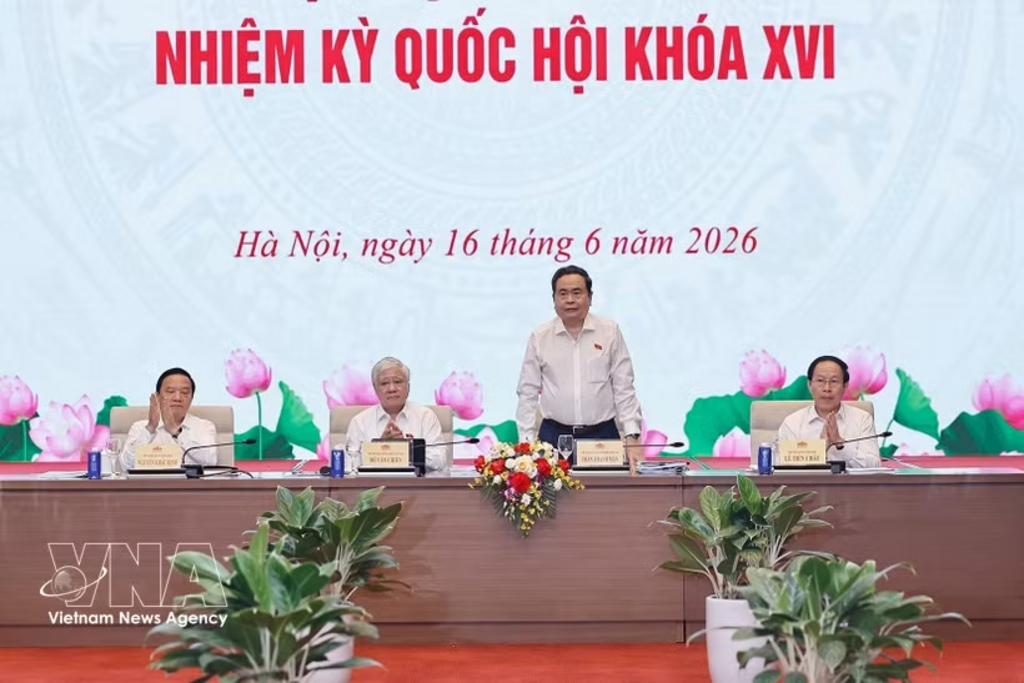
| NA Chairman Tran Thanh Man speaks at the conference__Photo: VNA |
National Assembly (NA) Chairman Tran Thanh Man chaired a conference on the implementation of legislative orientations for the 16th legislature term in Hanoi on June 16.
The gathering disseminated the Politburo’s Conclusion No.17-KL/TW and laid out the plan, core priorities, and policy tools needed to keep the lawmaking agenda on track.
Blueprint for a transparent coherent legal system
In his keynote speech, NA Vice Chairman Nguyen Khac Dinh presented the conclusion as a strategic vision for legal reform in the new development period. It spells out concrete goals, nine major orientations, six bundles of tasks and solutions, and assigns specific duties to the relevant bodies.
The ultimate goal is a legal framework comprehensive enough to deliver Vietnam’s socio-economic targets for 2026–2031, mirroring the strategic direction set at the 14th National Party Congress. By 2030, the country intends to put in place a democratic, fair, transparent, coherent, and feasible legal system that facilitates development and engages both citizens and businesses in national development.
Looking further out to 2045, Vietnam aims to develop a high-quality, advanced and modern legal system that reflects domestic realities and meets international benchmarks.
According to Dinh, the success of this legislative term will directly shape the quality of Vietnam’s institutional framework for development and heavily influence whether the country hits its strategic milestones for 2030 and 2045.
The conclusion groups nine key orientations into three main priorities. The first is to deepen the institutional framework for a socialist rule-of-law state. That means further restructuring the state apparatus, effectively operating the three-tier administrative model, pushing for greater decentralisation and delegation of authority, and reinforcing accountability and oversight of power.
The second is a revamp of development institutional framework to spur rapid, sustainable economic expansion and sharpen national competitiveness. Lawmakers will focus on refining the socialist-oriented market economy mechanism, creating a legal environment conducive for sci-tech, innovation, and digital transformation, pooling resources for growth, ensuring a stable and transparent business climate, and finetuning laws on natural resources, environmental protection, green growth, and sustainable development.
The third is to harden the legal foundation for national defence-security, diplomacy, and global integration, contributing to safeguarding sovereignty, national interests, and a peaceful, stable environment while lifting Vietnam’s standing in the global arena.
Driving fundamental change in lawmaking
Dinh highlighted the six tasks contained in the conclusion, calling for a fundamental reset of how lawmakers think. The shift is from an administrative management to a service-oriented, pro-development mindset. Lawmaking, he insisted, must become the “breakthrough of breakthroughs” in institutional reform, abandon the mentality of “ban it if it can’t be managed” and replace excessive pre-approval gatekeeping with controlled risk management.
Under this approach, laws stop being instruments of state control and start enabling business activity, trimming compliance costs, fueling innovation, and unlocking resources for development. Institutional reform must also come with strict safeguards to stamp out corruption, wastefulness, vested interests, and policy profiteering in the legislative process.
Another priority is tightening the loop between lawmaking and enforcement. Regular reviews of enforcement outcomes should use economic performance and gains in living standards as the real barometer of policy success, thus systematically identifying and clearing the institutional bottlenecks that choke off growth.
He ended with a call for the broad use of sci-tech, innovation, and artificial intelligence across the legislative process. The move is meant to modernise lawmaking, raise transparency and efficiency, and deliver a high-quality legal system capable of meeting the demands of a digitally driven economy and society.- (VNA/VLLF)