 |
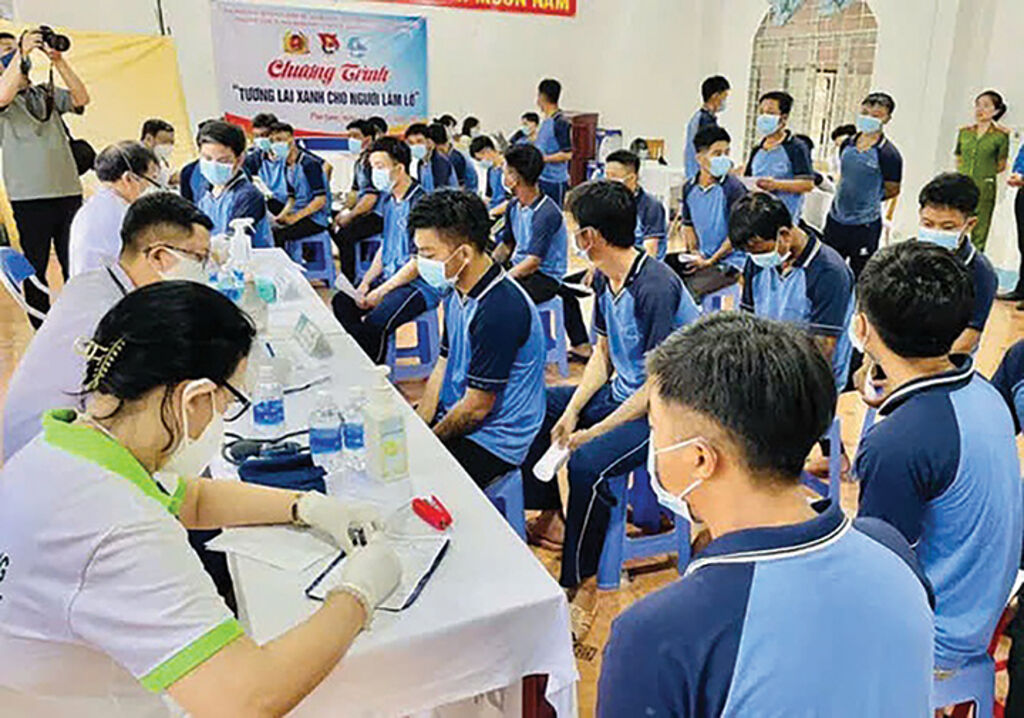
| Health check-ups for minors undergoing drug rehabilitation__Photo: tiengchuong.chinhphu.vn |
My wife and I are foreign nationals permanently residing in Vietnam with our children. I recently discovered that our 14-year-old son is addicted to drugs. Given his young age, I would prefer him to undergo rehabilitation at home rather than at a rehabilitation facility. Is this permitted under Vietnamese law?
No. Although the 2025 Law on Drug Prevention and Control (the Law) generally allows voluntary drug rehabilitation at home, in the community or at a rehabilitation facility, foreign nationals residing in Vietnam are required to undergo rehabilitation at a facility.
Under Article 40.2 of the Law, foreign nationals with drug addiction who reside in Vietnam must register for voluntary rehabilitation at a drug rehabilitation facility and pay all related expenses. Those who fail to undergo voluntary rehabilitation will be handled in accordance with law.
Your son must therefore undergo rehabilitation at a facility rather than at home.
Before registering, however, his drug addiction status must be confirmed by a competent health establishment. Under the Law, drug addiction involves dependence on narcotic substances, addictive medicines or psychotropic medicines, as determined by an authorised health establishment. The family’s own assessment is not sufficient.
To have your son’s addiction status assessed, you should contact the commune-level Public Security agency, which will arrange for an assessment at a competent health establishment. This may be an establishment licensed to provide relevant medical examination and treatment services, opioid substitution therapy or forensic psychiatric assessments.
Under Article 30 of the Law, minors aged 12 to under 18 may undergo voluntary rehabilitation at a reformatory or a public or private drug rehabilitation facility qualified to provide services to this age group.
If my son is confirmed to have a drug addiction, what procedures must I follow to register him for voluntary rehabilitation at a public facility?
Under Government Decree 163/2026/ND-CP, you must register your son for voluntary drug rehabilitation with the commune-level Public Security agency. As he is 14, the registration must be made by a parent, guardian or legal representative.
The procedure is as follows:
Step 1: Register within 24 hours
If your son has a stable place of residence, you must register him with the commune-level Public Security agency where he resides within 24 hours of receiving official confirmation and notification from a competent agency that he has a drug addiction.
If a force majeure event prevents registration within this period, the deadline will be calculated afresh from the time the event ends, as determined by a competent agency.
Step 2: Prepare the required documents
The registration dossier must include:
- A completed background information form for your son;
- An application for voluntary drug rehabilitation, including your opinion as his parent;
- A copy of the document confirming his drug addiction status, issued by a competent health establishment;
- A copy of an identity document, such as his passport or identity card, or details of his VNeID electronic identification account; and,
- A written request issued by the head of the commune-level Public Security agency for his admission to a public drug rehabilitation facility or reformatory.
The document listed in the last Item above is issued by the Public Security agency and does not have to be prepared by the family.
Step 3: Submit the dossier
You may submit the dossier either in person or online.
For in-person registration, you will submit the dossier at the designated reception point of the commune-level Public Security agency where your son resides or where his illegal drug use was detected. You must present your son’s original identity documents for verification.
For online registration, you may submit the dossier through the National Public Service Portal or the national electronic identification application. You must retain the original documents and take responsibility for the accuracy and authenticity of the information provided.
Information already available in official databases may be used instead of the corresponding documents, where permitted.
Step 4: Receive the rehabilitation decision
The receiving officer will check the dossier, verify the identity documents and record the registration. If any information or documents are missing or invalid, you will be asked to provide the missing information or make the necessary corrections.
Within 24 hours of receiving the registration, the commune-level Public Security agency must examine the dossier and issue a decision on voluntary drug rehabilitation. The decision will be sent to you, and its delivery and receipt will be formally recorded.
Under Article 38 of the Law, the competent Public Security agency will then designate the public drug rehabilitation facility or reformatory where your son will undergo rehabilitation.
How long does voluntary drug rehabilitation last, and what does the process involve?
Under Article 29 of the Law, the drug rehabilitation process is designed to address drug dependence and support recovery through medical treatment, counselling, education and preparation for reintegration into the community.
The process consists of five stages:
1. Admission and classification;
2. Detoxification and treatment of mental disorders and other medical conditions;
3. Education, counselling and behavioural rehabilitation;
4. Occupational therapy and vocational training; and,
5. Preparation for reintegration into the community.
The prescribed rehabilitation period is 24 months for first-time rehabilitation and 36 months for second-time or subsequent rehabilitation.- (VLLF)