Vu Van Anh
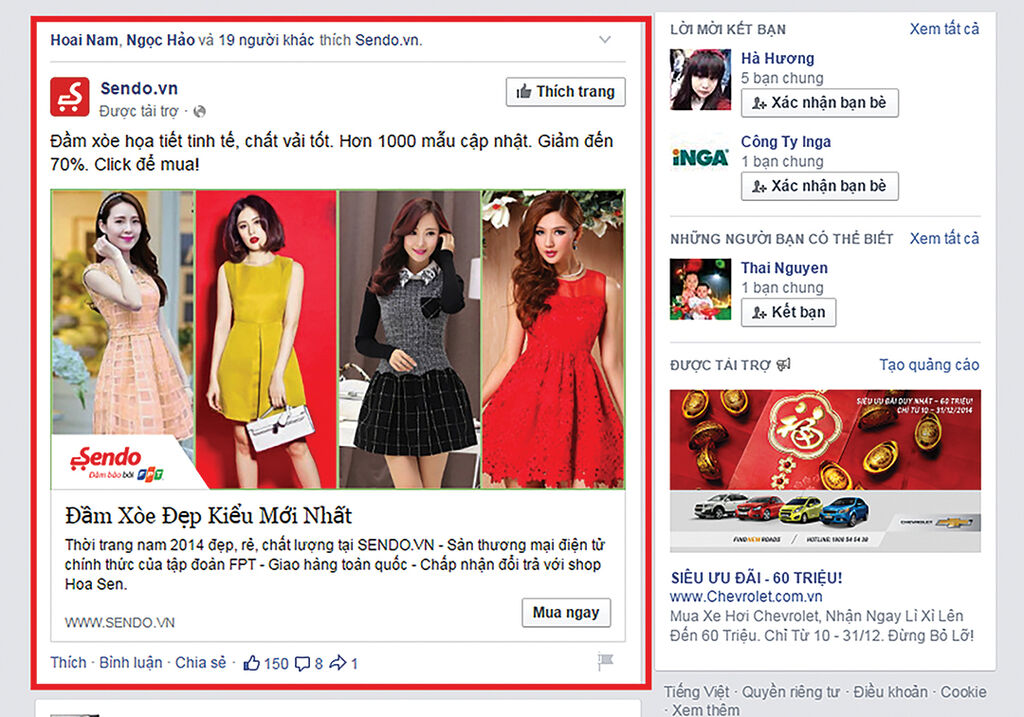 |
| An advertisement for Sendo.vn on Facebook__Photo: Internet |
The 2012 Law on Advertising has been amended and supplemented several times by Law 35/2018/QH14, Law 42/2024/QH15, Law 47/2024/QH15 and, most recently, Law 75/2025/QH15. To guide the implementation of the new rules, on December 26, 2025, the Government issued Decree 342/2025/ND-CP, detailing the implementation of the Law on Advertising. Together, these two documents introduce substantive changes that will directly affect advertisers, advertising agencies and digital platforms operating in Vietnam.
Law 75/2025/QH15 (Law 75) comes into force on January 1, 2026, and Decree 342/2025/ND-CP (Decree 342) takes effect on February 15, 2026.
Language and script used in advertising
The 2012 Law on Advertising’s provisions on this issue are quite vague. Article 18.1 only requires the advertisements to be expressed in Vietnamese, except trademarks, slogans, brand names and proper names in foreign languages that have been internationalised and cannot be replaced with Vietnamese; publications permitted to be issued in ethnic minority languages or foreign languages; and radio and television programmes broadcast in ethnic minority languages or foreign languages.
Law 75 now sets out more detailed requirements regarding language and script in advertising as follows: “Vietnamese wording in advertisements must preserve the purity of the Vietnamese language, be clear and easy to understand, and accurately convey the intended content.”
This amendment aims to address and rectify the use of inappropriate wording in advertisements that may mislead consumers.
Requirements on advertising content
Although this matter has been previously provided in Article 19 of the 2012 Law on Advertising, these provisions are considered not specific and explicit enough, leading to inconsistent interpretation and application in practice. Accordingly, Article 1.12 of Law 75 revises the requirements on advertisements in a more detailed and clearly classified manner.
Specifically, advertisements must be truthful, accurate and clear and must not mislead consumers about features, quality, utilities or effects of products, goods or services.
In case an advertisement is required to include notes, recommendations or warnings, such information must be fully presented, clear and easily accessible; the text must contrast with the background colour and must not be smaller than the main text of the advertisement; for an audio or audio-visual advertisement, notes, recommendations or warnings must be read clearly, at a speed and volume equivalent to the reading of other content in the same advertisement.
The law clearly states that advertising content does not include: documents, information or images describing products, goods or services provided by organisations or individuals for promotional purposes, display or introduction of goods and services, trade fairs and exhibitions, except health supplements and foods for special dietary uses in accordance with food safety regulations.
Mandatory information required to be displayed on labels and packaging under product labelling regulations, except for health supplements and foods for special dietary uses; information that must be publicly disclosed and provided to customers and consumers; information and warnings about prevention of harmful effects of goods; and other information obligations required under relevant regulations are also excluded from advertising content.
With respect to advertisements for special products, goods and services, Decree 342 specifies detailed requirements for 11 groups of products and services, including cosmetics, food, milk, chemicals, medical instruments, medical examination and treatment services, veterinary medicines, fertilisers, plant varieties, pharmaceuticals, and alcoholic beverages (below 15 degrees and beer).
Online advertising
Online advertising has become a preferred channel for advertisers due to its advantages over print media. As a result, further refinement of the legal framework governing online advertising has become necessary.
Compared to Article 23 of the 2012 Law on Advertising, Article 1.16 of Law 75 contains more comprehensive and specific provisions.
Under these new provisions, online advertisements include advertisements on online newspapers, websites, social media platforms, online applications and digital platforms connected to the Internet and must comply with several regulations.
Firstly, online advertisements must be clearly identifiable through numbers, text, symbols, images or sounds to distinguish them from non-advertising content.
Secondly, for advertisements not displayed at fixed positions, there must be clear and recognisable features or icons enabling users to turn off the advertisement, report violating advertising content to the service provider, or refuse to view inappropriate advertising content.
To guide the implementation of Law 75, Article 17 of Decree 342 clearly defines non-fixed advertisements as advertisements displayed at non-fixed positions or times on online service interfaces, covering the whole or part of the main content and interrupting users’ access to information.
The decree requires that the feature or icon to turn off an advertisement must allow the advertisement to be closed with a single interaction. Fake or misleading close icons are prohibited. There must be no waiting time to close static image advertisements. For animated image sequences or video advertisements, the maximum waiting time for users to skip them is five seconds.
This represents a significant change, as previously the majority of platforms required users to view advertisements for 15 to 30 seconds or longer before being able to skip them.
In addition, entities engaged in advertising activities must also provide icons and guidance enabling users to report violating advertising content and choose to refuse, turn off or stop viewing inappropriate advertisements. Reports must be received and handled promptly, and handling results must be notified to users in accordance with law.
Thirdly, where advertisements contain links to other content, the linked content must comply with legal requirements, and advertising service providers and publishers are obliged to monitor and supervise such content.
Fourthly, social media service providers must offer features enabling users to distinguish advertising content from other content.
Lastly, social media service users engaged in advertising activities must clearly distinguish sponsored or advertising content from other content they provide.
Clearer legal responsibilities for online advertising platforms
Under Articles 12, 13, 14 and 15a of Law 75, advertisers, advertising service providers, advertising publishers and product endorsers participating in online advertising must:
- Comply with the laws on advertising, cybersecurity, personal data protection, consumer protection, child protection, and management, provision and use of Internet services and online information; and must declare and pay taxes on advertising service revenues in accordance with tax laws;
- Refrain from placing advertisements within, adjacent to, before or after violating content; and from advertising on unlawful websites, social media platforms, online applications and digital platforms;
- Refrain from cooperating in advertising with organisations, individuals, websites, social media platforms, online applications, digital platforms, accounts, content channels or fan pages or groups publicly identified by competent authorities as unlawful;
- Prevent and remove violating information at the request of competent authorities and provide relevant information upon requests; and,
- Abide by administrative sanctions and other measures imposed for violations of the advertising law.
In addition to complying with the above provisions, when entering into contracts with online advertising service providers, advertisers, publishers and product endorsers may ask for technical solutions that enable them to monitor and remove violating advertisements from the service system.
Online advertising service providers must:
- Notify their contact information to state authorities;
- Verify advertisers’ identities and require advertisers to provide their business registration certificates or other valid legal documents;
- Retain advertisement-related information and records for three years and provide them upon request;
- Take technical measures to control and remove violating advertisements;
- Retain information on advertising distribution rules and algorithms;
- Establish mechanisms to receive and settle complaints;
- Ensure transparency when establishing and operating intermediary digital platforms; and,
- Submit annual and ad hoc reports upon request.
Organisations and individuals engaged in online advertising must remove violating advertisements within 24 hours of receiving a written or electronic request from the Ministry of Culture, Sports and Tourism or other competent authorities; otherwise, state agencies will apply technical blocking measures and impose sanctions in accordance with law. Telecommunications and Internet service providers will have to block violating advertisements when so requested.
Management of cross-border advertising into Vietnam
Foreign advertisers wishing to conduct cross-border advertising in Vietnam must comply with Article 39 of Law 75.
Accordingly, foreign organisations and individuals operating in Vietnam may advertise their products, goods, services and activities in Vietnam. Those not operating in Vietnam may hire a Vietnamese advertising service provider to carry out advertising activities.
Article 19.1 of Decree 342 further specifies that domestic and foreign enterprises providing online advertising services in Vietnam are required to notify their contact information to the Ministry of Culture, Sports and Tourism before commencing business operations.
Notifications may be submitted in person, by post, online or via the National Public Service Portal. Online submissions must bear a digital signature in accordance with the law on electronic transactions. Within four working days of receiving a valid notification, the Ministry will issue a confirmation. Any changes to contact information require a renewed notification.
The decree also requires foreign organisations and individuals providing cross-border advertising services to comply with Vietnam’s law and cooperate with authorities in handling violations.
These provisions are regarded as a significant step forward, particularly as many violating advertisements currently originate from platforms with servers located overseas, posing enforcement challenges.
Overall, Law 75 and Decree 342 introduce more detailed and clearly structured requirements on advertising content and activities, enhancing the state management, especially in cyberspace and for products directly affecting public wellbeing.-