 |
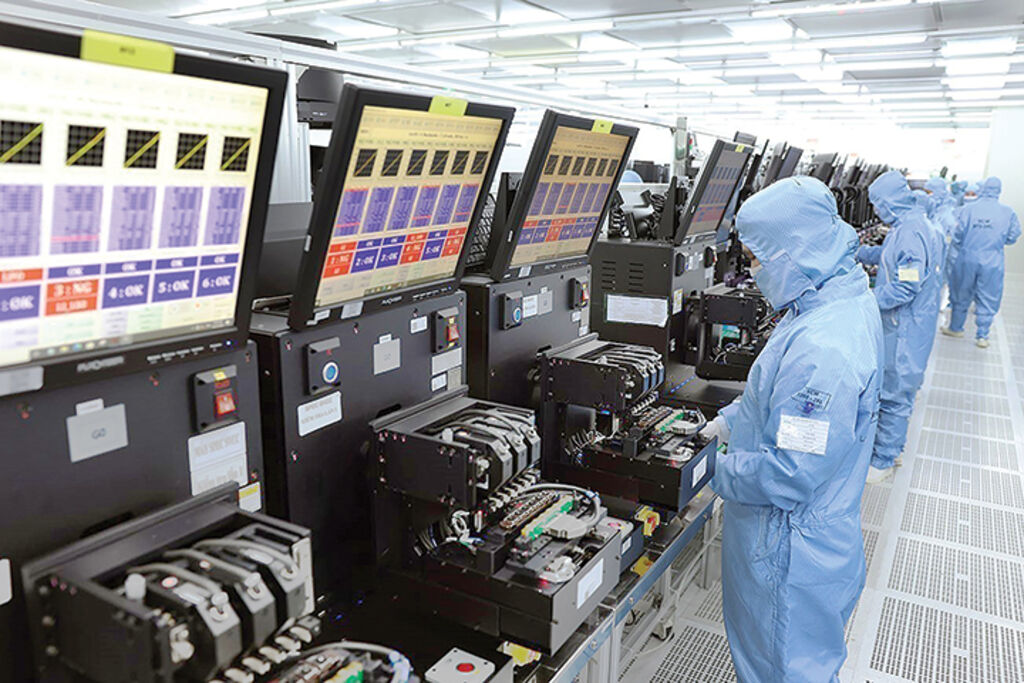
| A line manufacturing camera modules and electronic components for export at the plant of RoK-invested MCNEX VINA Co., Ltd. in Phuc Son Industrial Park, Ninh Binh province__Photo: Vu Sinh/VNA |
The Government has recently issued Decree 320/2025/ND-CP detailing a number of articles of, and measures for implementing, the Law on Corporate Income Tax (the Decree).
Taking effect on December 15 and applying to the 2025 corporate income tax period, the decree aims to further improve the provisions on corporate income tax (CIT) so as to fully and promptly institutionalize the guidelines and directions of the Party and the State regarding reform of the tax policy system in general and CIT policies in particular. This aims to promote administrative reform, improve the business environment, and attract more investment in the priority sectors and regions. Notably, the decree provides specific and clear definitions of CIT payers and CIT incentive beneficiaries, as well as preferential CIT rates and CIT exemption or reduction policies.
Changes in taxpayer definitions
Under Article 2.1.b of the 2025 CIT Law, enterprises established under foreign laws (known as foreign enterprises) with or without a permanent establishment in Vietnam are CIT payers.
To make it clearer, Article 2.1.b of the decree provides detailed definitions of foreign enterprises, including:
(i) Foreign enterprises with permanent establishments in Vietnam that have to pay tax on taxable incomes arising in Vietnam and taxable incomes arising outside Vietnam that are related to operations of the permanent establishments;
(ii) Foreign enterprises with permanent establishments in Vietnam that have to pay tax on taxable incomes arising in Vietnam that are not related to operations of the permanent establishments;
(iii) Foreign enterprises with permanent establishments in Vietnam (other than those mentioned at Items (i) and (ii) above) that provide goods or services in Vietnam through forms of e-commerce or digital platform-based business and have to pay tax on taxable incomes arising in Vietnam; and,
(iv) Foreign enterprises without a permanent establishment in Vietnam that have to pay tax on taxable incomes arising in Vietnam.
The decree also expands the category of tax payment agents as stated in Article 2.2. They include:
· Organizations established and operating (or registered for operation) under Vietnam’s law, including also organizations managing e-commerce floors and those managing digital platforms: These organizations may act as CIT payment agents for Vietnamese partners conducting e-commerce or digital platform-based business activities, or acquiring capital contributions under contracts with foreign enterprises; and,
· Securities investment fund management companies: These companies will pay CIT on behalf of investors when a securities investment fund divides profits to investors and act as CIT payers for incomes from transfer and lease of real estate by real estate investment funds. In case the transferee of capital from a foreign enterprise is a foreign organization or individual, the CIT payer is the enterprise established under Vietnam’s law in the locality where the foreign organizations invest capital.
CIT-liable incomes
Regarding the determination of taxed income, the decree stipulates that income amounts liable to CIT include income amounts generated from goods production and trading and service provision activities and other income amounts.
Specifically, other income amounts include, but are not limited to, income from capital and securities transfer; income from transfer of real estate and investment projects; income from asset ownership and use rights; income from asset lease; income from transfer or liquidation of assets other than real estate; interests on deposits and loans; exchange rate differences; bad debts that were written off but now can be recovered; gifts, presents, and other income amounts as prescribed. Enterprises should properly classify these income amounts for making adequate declarations upon the determination of CIT-liable incomes.
In addition to taxable incomes, the decree also specifies CIT-exempt income amounts, including: income from fishing; income from the production of agricultural, forest or aquatic products, especially for enterprises operating in areas with difficult socio-economic conditions; income from the provision of technical services directly serving agriculture; income from the performance of scientific research, technological development, innovation and digital transformation contracts (eligible for three-year CIT exemption); income from production and business operations of enterprises employing people with disabilities, post-rehabilitation persons, or people with HIV/AIDS.
Sectors, trades and fields eligible for CIT incentives
As per Article 18.2 of the decree, the range of sectors and trades eligible for CIT incentives is broader to cover such key fields of the economy as application of high technologies and strategic technologies; manufacture of software and digital technology products; cyberinformation security; research, designing, manufacture and testing of semiconductor chips; and building of artificial intelligence data centers.
Additionally, projects on manufacture of supporting industry products prioritized for development, particularly products serving high technologies, textiles and garments, leather and footwear, electronics, mechanical engineering, and automobile manufacturing and assembly are also eligible for incentives.
The decree also provides incentive policies to promote renewable energy, clean energy, environmental protection, new materials, national defense-security industry, and key chemicals and mechanical engineering.
Furthermore, the list of sectors eligible for CIT incentives now covers also important infrastructure projects such as power plants, water plants, transport systems, airports, seaports, aerodromes, terminals; hi-tech enterprises, and science and technology enterprises; projects capitalized at VND 12 trillion or more; agriculture, forestry and fisheries; agricultural cooperatives; education, healthcare and culture using mobilized social resources; social housing; and publishing and press activities.
Preferential CIT rates and incentive application periods
Article 19 of the decree provides various preferential CIT rates based on industry, location and project scale. Specifically, a CIT rate of 10 percent for 15 years applies to new investment projects in the fields of high technology, digital technology, clean energy, important infrastructure, hi-tech enterprises, and science and technology enterprises, as well as projects with large investment amounts or eligible for special incentives.
Worthy of note, the CIT rate of 10 percent throughout the operation duration applies to projects in the fields of agriculture, forestry, fisheries, salt making, education, healthcare with mobilized social resources, publishing; journalism, and agricultural cooperatives.
A CIT rate of 17 percent for 10 years applies to new investment projects in the manufacture of high-grade steel, energy-efficient products, machinery and equipment for use in agro-forestry-fisheries, animal feed, automobile assembly, and digital industry, and projects implemented in economic zones or geographical areas eligible for incentives. Particularly, this preferential tax rate will apply throughout the operation period of people’s credit funds, microfinance institutions and cooperative banks.
The decree empowers the Prime Minister to decide to extend the application period of preferential CIT rates to no more than 15 years for particularly important projects with large investment amounts and socio-economic spillover effects; or to apply lower CIT rates to projects eligible for special investment incentives and support.
Alongside the preferential CIT rates, the decree maintains CIT exemption and reduction policies. Specifically, Article 20 says that CIT exemption for the first four years of operation (counting from the first year of generation of taxable income) and 50-percent CIT reduction for nine subsequent years will be granted for incomes eligible for high incentives. Meanwhile, CIT exemption for the first two years of operation and 50-percent CIT reduction for four subsequent years will be applied to projects generating income subject to the 17-percent tax rate. In case no income is generated in the first three years of operation, the CIT incentive application period will be counted from the fourth year of operation.
For projects requiring certificates of entitlement to incentives in the fields of high technology, science and technology, supporting industries, etc., the CIT exemption or reduction period is calculated from the year of issuance of the certificates or the first year of income generation, whichever comes first.
For investment projects eligible for special investment incentives and support, the Prime Minister may decide to extend the tax exemption or reduction period which, however, must not exceed the projects’ operation duration.
It can be said that the decree has helped build a comprehensive framework of CIT incentives, aiming to promote investment in hi-tech fields, strategic infrastructure, the green economy, and social welfare. This is expected to serve as an important driving force to promote growth and enhance the competitiveness of enterprises and the entire economy in the coming period.-