 |
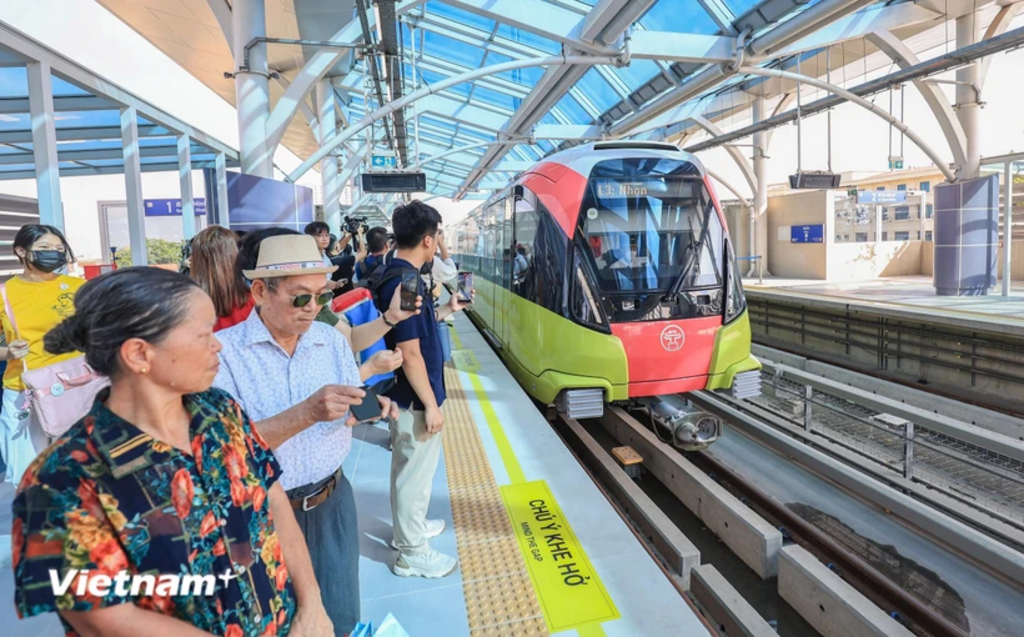
| The Hanoi’s Nhon-Hanoi Railway Station urban railway line__Photo: vietnamplus.vn |
All cities nationwide will develop and implement smart city development schemes by 2030, gradually integrating digital and green transformation into urban development.
The target is set out in Prime Ministerial Decision 2116/QD-TTg dated November 5, approving the National Smart City Development Orientation for 202-30, with a vision towards 2035.
Under the Decision, urban governance and development will undergo a fundamental shift from reactive management and fragmented technology applications towards a results-oriented approach.
This approach is intended to strengthen capacities for analysis, forecasting and coordination, with effectiveness measured in terms of outcomes, impacts, the ability to address urban challenges, service quality, and satisfaction among residents and businesses.
All cities will be required to establish shared urban databases, prioritising the standardisation and cleansing of geographical, land, population, planning and infrastructure data to facilitate data connectivity and sharing.
Geographic information system (GIS)-based databases covering urban planning, infrastructure and spatial development will also be developed and updated in accordance with locally approved implementation schemes. Digital twins will be piloted to address specific urban challenges, while provinces may select urban areas for pilot implementation based on local needs.
By 2035, data-driven urban governance and development models will have been established in major cities and urban centres, with interconnected and shared data serving as a key resource for urban planning, investment, construction and operation.
Urban management decisions will increasingly be supported by data analysis, forecasting, simulation and advanced digital technologies.
The orientation also seeks to establish a secure, interconnected urban data ecosystem that facilitates effective data sharing and utilisation, while strengthening capacities for forecasting and early warning, cross-sectoral coordination, policy responses, operational continuity during disruptions and rapid recovery.
It further aims to improve the quality of life, resilience and competitiveness of Vietnamese cities and strengthen their participation in regional and international innovation and smart city networks.
Smart city development will be tailored to the functions, characteristics and readiness of individual urban areas. Major cities and regional urban centres will take the lead, while other urban areas will identify priorities according to their specific needs and available resources.
Development approaches will also take account of local geographical conditions and urban functions, including those of industrial, logistics, tourism, coastal and riverine cities.
In newly developed urban areas, smart solutions will be incorporated from the planning and design stages, while existing urban areas will prioritise tackling pressing challenges and infrastructure bottlenecks.
Priority will be given to data interconnectivity and the application of advanced technologies, including GIS, building information modelling (BIM), city information modelling (CIM), artificial intelligence (AI), the Internet of Things (IoT) and digital twins. Technology adoption will be guided by practical needs and data readiness rather than reliance on any single technology.
The Decision identifies nine groups of key tasks and solutions, including improving institutional frameworks, standards and governance models; developing urban databases and shared digital platforms; and strengthening smart urban planning and management.
Other priorities include developing digital and smart technical infrastructure, establishing regulatory sandboxes, expanding smart urban areas and services, and modernising urban governance.
The remaining tasks focus on addressing major urban challenges, promoting innovation and mobilising resources; monitoring, evaluating and scaling up successful models; and strengthening human resource development and international cooperation.
Implementation will be carried out in three phases.
During 2026-27, responsible authorities will finalise technical guidelines, reference architectures and evaluation indicators, launch the national smart city information portal, and identify local priorities and resources.
The 2028-29 phase will focus on standardising, connecting and sharing urban data; implementing and evaluating pilot projects; upgrading urban management platforms where conditions permit; and scaling up successful models.
In 2030, authorities will assess the maturity of smart city development across urban areas, evaluate progress towards the targets, review successful models and propose priorities for the subsequent development period towards 2035.- (VLLF)