|
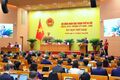
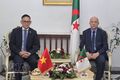
| Prime Minister Le Minh Hung addresses a working session with the Lao Cai provincial Party Committee's Standing Board in Yen Bai ward on July 14, 2026__Photo: VNA |
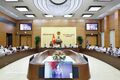
Prime Minister Le Minh Hung called on the northern border province of Lao Cai to turn challenges into opportunities, transform its border location into strategic advantages and leveraging its unique strengths and potential as drivers of growth, while chairing a working session with the provincial Party Committee's Standing Board in Yen Bai ward, on July 14.
The PM acknowledged the province’s socio-economic achievements in the first half of 2026, with economic growth of 9.01 per cent, above the national average, ranking fourth in its region and 15th in the nation.
Budget revenue exceeded VND 11.3 trillion (USD 430.31 million), reaching 64 per cent of the annual target and rising 21.3 per cent year-on-year, while public investment disbursement reached 47.2 per cent, the fifth highest nationwide and well above the national average of 35.5 per cent.
Border trade, industry and tourism continued to expand, with newly approved investment projects increasing 31 per cent and total registered capital rising 3.4-fold from a year earlier.
Administrative reform and infrastructure development also advanced, with the province completing 64per cent of its land database, ranking third nationwide. Lao Cai was among the country's leading localities in implementing Resolution 57 on science, technology, innovation and digital transformation, and became the first province to introduce criteria and pilot "digital village" and "smart village" models, according to the provincial Party Committee’s report.
However, the Government leader pointed to a number of challenges, including its still modest economic scale, slower-than-planned GRDP growth, limited economic restructuring, and a digital economy accounting for only 9.46 per cent of GRDP.
He also noted weak FDI attraction, incomplete transport and digital infrastructure, and delays in major projects due to site clearance and unresolved legacy projects.
For the second half of 2026 and beyond, PM Hung urged Lao Cai to effectively implement the resolutions of the 14th National Party Congress, conclusions of the Party Central Committee, Politburo and Secretariat, and key Government resolutions.
He stressed that achieving double-digit growth will require innovative thinking, greater initiative and creativity, turning border advantages and local strengths into development resources while acting decisively to meet growth targets.
 |
| Prime Minister Le Minh Hung offers flowers and incense at the provincial Martyrs' Cemetery in tribute to fallen soldiers on July 14, 2026__Photo: VNA |
Alongside traditional growth drivers, Lao Cai should renew its growth model through digital transformation, technology adoption, productivity improvements, business climate reforms and high-quality human resources. It should identify new growth engines, particularly border-gate economy, deep processing industries, mining, ecological agriculture, forestry and tourism.
The PM asked for stronger economic restructuring towards green, high-value and high-tech industries, renewable energy development, and the expansion of border trade to make Lao Cai a modern smart logistics hub. He also urged the province to develop tourism into a key economic sector and promote green, circular agriculture linked with value chains, OCOP products and tourism.
He instructed Lao Cai to maintain public investment disbursement momentum and strive for a 100per cent disbursement rate by year-end through monthly and quarterly KPI monitoring and capital reallocation from slow-moving projects.
He urged close coordination with ministries to remove institutional bottlenecks, effectively implement provincial planning, and develop key growth corridors based on international and inter-regional connectivity.
Priority should be given to transport infrastructure, border economic zones, cross-border cooperation areas and digital infrastructure, while accelerating strategic projects including Sa Pa international airport, the smart border gate project, the Lao Cai–Hanoi–Hai Phong railway, expansion of the Yen Bai–Lao Cai section of the Noi Bai–Lao Cai Expressway, and regional transport links in northern mountainous areas.
PM Hung also instructed the province to implement national policies on social housing and affordable rental housing, particularly for workers, while accelerating plans for public housing through 2030.
Regarding the two-tier local government model, he stressed the need for continued streamlining of the administrative apparatus, stronger decentralisation where appropriate, improved personnel arrangements and faster handling of surplus public assets.
On implementing Resolution 57, he urged Lao Cai to prioritise eliminating telecommunications "dead zones", addressing electricity shortages and carrying out the Government's 100-day action plan to remove digital transformation bottlenecks.
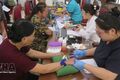
He also stressed the importance of ensuring social welfare, education, healthcare, ethnic and religious policies, preparing for the 2026–2027 school year, completing the first phase of four ethnic boarding schools and launching construction of five more.
The province was instructed to effectively implement national target programmes, carry out the nationwide 500-day campaign to locate, recover and identify the remains of fallen soldiers.
Earlier the same day, PM Hung offered flowers and incense at the provincial Martyrs' Cemetery in tribute to fallen soldiers, and visited the family of Tran Thi Vinh, 92, the mother of a martyr and wife of a veteran revolutionary, in Yen Bai ward.- (VNA/VLLF)