 |
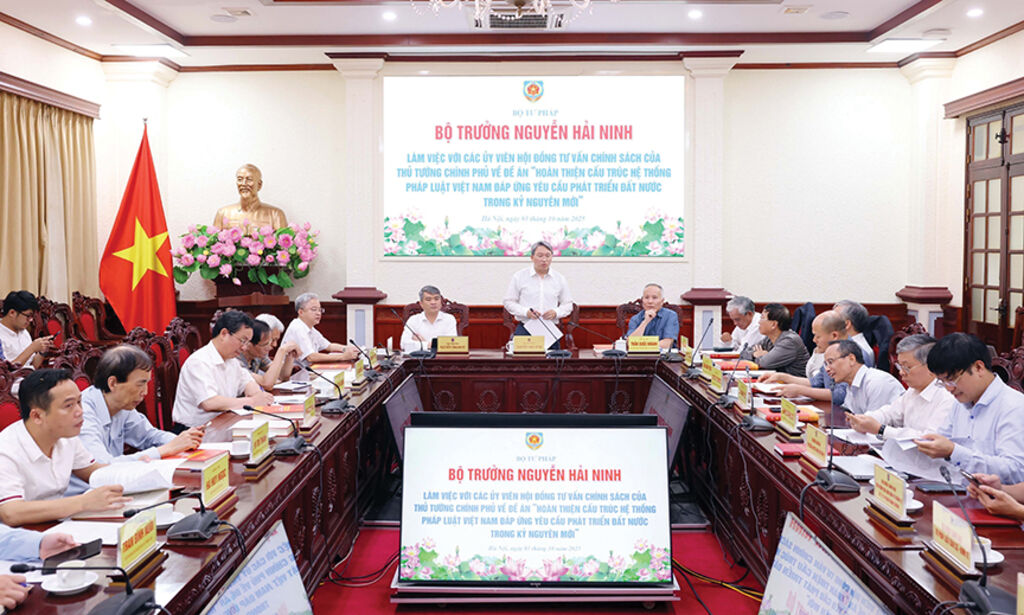
| A working session on the Scheme “Improving the structure of Vietnam’s legal system to meet national development requirements in the new era”__Photo: Pham Kien/VNA |
Nearly one year after the Politburo issued Resolution 66-NQ/TW, Vietnam’s sweeping push to innovate lawmaking and law enforcement work has delivered significant results but there still exist challenges that must be addressed to turn institutions into a lasting source of national competitive advantage. In the interview granted to the press, Minister of Justice Nguyen Hai Ninh reflects on the resolution’s breakthrough achievements, candidly identifies the remaining bottlenecks, and outlines key priorities for 2026.
Could you outline some of the most notable results of implementing Resolution 66-NQ/TW in 2025? In your view, have these outcomes amounted to a genuinely breakthrough institutional reform?
Immediately after Resolution 66-NQ/TW was adopted, on May 18, 2025, the Party Central Committee’s Politburo and Secretariat convened a conference to disseminate and internalise its contents, attracting more than 1.5 million cadres and Party members through both in-person and online participation at 37,000 connection points nationwide.
Earlier, on May 16, 2025, the National Assembly’s Party Committee issued Plan 28-KH/DUQH to guide the implementation of the Resolution. One day later, on May 17, 2025, the Government promulgated Resolution 140/NQ-CP approving its Action Programme for implementing Resolution 66-NQ/TW, identifying 49 tasks with clearly specified roadmaps and timelines. All 22 ministries, ministerial-level agencies and government-attached agencies, and all 34 provinces and centrally run cities have issued their programmes or plans to implement the Resolution; several ministries, sectors and localities have also established steering committees for this purpose.
Closely following the Party’s leadership and the orientations set out in Resolution 66-NQ/TW, the National Assembly, the Government, the Supreme People’s Court, the Supreme People’s Procuracy and other relevant agencies have demonstrated strong determination and a high sense of responsibility in changing legislative thinking and strengthening coordination to promptly institutionalise the Party’s guidelines and the Politburo’s strategic resolutions. This has helped establish a comprehensive legal framework to meet the requirements of streamlining the organisational apparatus of the political system, building and operating the two-tier local government model, promoting decentralisation and delegation of authority, reforming administrative procedures, swiftly removing obstacles, and unlocking resources for national development.
Resolution 66-NQ/TW has provided an important political ground for competent authorities to issue a series of strategic policy decisions - many unprecedented in the field of lawmaking, abolishing the mindset that “what cannot be managed should be prohibited”, and transforming institutions from “a bottleneck of bottlenecks” into a national competitive advantage that paves the way for development facilitation. Notably, the target of “basically removing legal bottlenecks by 2025” set out in the Resolution has been achieved.
The National Assembly, the Government, ministries, sectors and localities have proactively and flexibly renewed their modes of operation, demonstrated creativity in performing their functions and tasks, and adapted to practical conditions to complete an exceptionally large legislative workload during the term. In 2025 alone, the Government submitted to the National Assembly the Resolution amending and supplementing a number of articles of the 2013 Constitution, together with 99 laws and legal normative resolutions - a record number in legislative work. The Government promulgated 377 decrees and legal normative resolutions, while ministries and sectors drafted, submitted for issuance, or issued within their competence 1,404 legal documents - the highest figure of the entire term. Local authorities issued some 13,000 legal documents.
Law enforcement has also received due attention in line with Resolution 66-NQ/TW, with a focus on reviewing and removing legal bottlenecks and reforming administrative procedures, particularly in the spheres directly affecting people’s lives such as land, the environment, healthcare, education, science and technology, and social security. The inspection, review, consolidation and systematisation of legal documents have increasingly become more orderly and seen fundamental improvements. Mechanisms for dialogue and for receiving and handling feedback and petitions from citizens and businesses have been properly implemented by ministries and sectors with notable results. Long-standing obstacles related to financial mechanisms for lawmaking work have also been addressed.
It can be affirmed that Resolution 66-NQ/TW marks a strategic breakthrough in renewing lawmaking and law enforcement activities, truly serving as a “call to action” for profound institutional reform. This contributes to the further completion of a modern, effective and efficient socialist law-ruled state that places citizens and businesses at its centre. The implementation of the Resolution has exerted comprehensive and powerful impacts on institutional and legal reform across the entire political system, from central to local levels, and has garnered broad consensus and support from agencies and organisations within the political system, the public, the community of jurists and lawyers, and the business circle.
The achievements you have outlined are obviously significant. In your opinion, however, what limitations should be noted to ensure that the breakthrough guidelines of Resolution 66-NQ/TW are translated into practice and that institutions truly become a sustainable source of national competitive advantage?
Alongside the achievements mentioned above, progress in formulating action programmes and plans to implement Politburo Resolution 66-NQ/TW and Government Resolution 140/NQ-CP has, at certain ministries, sectors and localities, been slower than expected. Due attention has not been paid to legislative development and improvement here and there. There remains a situation where implementing regulations for laws and ordinances are issued behind schedule.
At present, the legal system still lacks an overall and coherent design capable of meeting the requirements in the new context, particularly those arising from socio-economic development, digital transformation, international integration and the renewal of the national governance model.
In addition, law enforcement continues to be a weak point. In some agencies and units, law dissemination and education as well as policy communication remain largely formalistic, lacking flexibility and failing to closely follow issues of public concern or those requiring public opinion orientation. Investment in digital transformation in certain bodies has yet to be made in a comprehensive and synchronous manner; technological infrastructure and legal databases in some units remain incomplete, making it difficult to access and process information effectively.
2026 is the first year of implementing the Resolution of the 14th National Party Congress and also a pivotal year for the continued implementation of Resolution 66-NQ/TW. What, from your standpoint, are the key priority areas for 2026?
The year 2026 carries special significance in translating the Party’s resolutions into reality. The foremost priority is to focus the leadership and direction on promptly reviewing and institutionalising the major orientations set out in the documents of the 14th National Party Congress and the nine strategic resolutions of the Politburo, closely aligned with the 2026 work programme of the Central Steering Committee for Institutional and Legal Reform.
Firstly, priority should be given to formulating the Strategy for improving the legal system in the new era, with the aim of building a legal system that is rational in structure, comprehensive, democratic, equitable, coherent, unified, open, transparent, feasible and stable. This strategy will serve as a basis for guiding legislative orientations for the term and annual legislative programmes, ensuring proactivity, flexibility, and responsiveness to the practical demands of the new era. In addition, efforts should be concentrated on revising legal documents relating to the organisation of the two-tier local government model, as well as handling documents adjusted under resolutions of the Government and the National Assembly Standing Committee according to the special mechanism to resolve legal difficulties and obstacles. These tasks must be completed before March 1, 2027, in accordance with National Assembly Resolution 206/2025/QH15 and the 2025 Law on Organisation of Local Administration.
Secondly, attention should be paid to legislative and drafting techniques, with a view to making them more professional, scientific, feasible and effective. This includes focusing on the compilation and refinement of the National Legislative Drafting Handbook, sets of standards, and technical guidelines for legislative drafting, and the formulation of related schemes to support training, capacity building and professional development for officials engaged in lawmaking work. The goal is to standardise processes while enhancing professional competence, occupational responsibility and professionalism of legislative advisory staff.
Thirdly, institutional frameworks governing the consolidation of legal documents should be improved to ensure its effectiveness. Consolidated texts should serve as the official basis for legal citation and application, and be submitted to competent authorities simultaneously with amending or supplementing documents. It is also necessary to adopt simplified consolidation techniques, provide the consolidation of legal documents issued by local state agencies, and expand the category of documents eligible for consolidation.
Finally, continued efforts are required to improve the national database of legal documents, develop a big data project in the field of law, and promote comprehensive digital transformation in law dissemination and education, including the application of artificial intelligence in legal guidance and consultation. It is also a need to further develop and effectively operate the National Law Portal as a platform for policy and legal information, a digital interaction channel between the State and citizens and businesses, and a mechanism for receiving and processing feedback and recommendations on legal documents, while creating a digital forum for proposing initiatives on institutional improvement.-