Vo Hung Dat
Faculty of International Law
Ho Chi Minh City University of Law
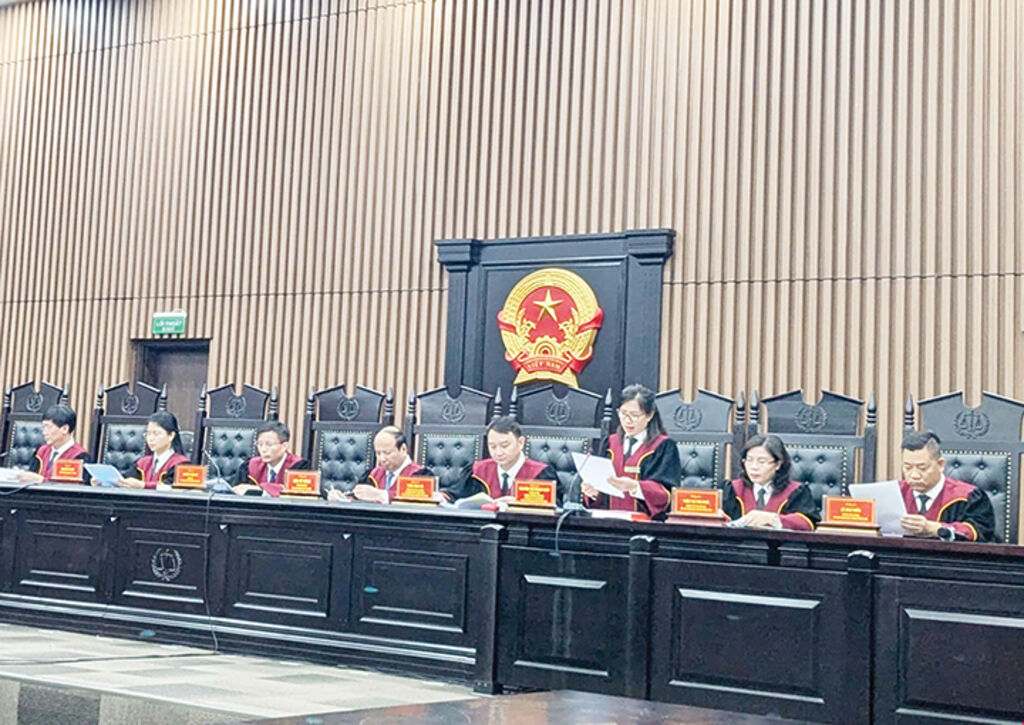 |
| A court hearing at the People’s Court of Hanoi__Photo: Kim Anh/VNA |
Introduction
The recognition and enforcement of foreign arbitral awards constitute a cornerstone of the Vietnamese State’s policies on international cooperation in the judicial sector, particularly regarding commercial dispute resolution. Since 1995, as a Contracting State to the 1958 United Nations Convention on the Recognition and Enforcement of Foreign Arbitral Awards (the Convention), Vietnam has been obliged to issue specific regulations on recognition and enforcement of foreign arbitral awards. This is especially pertinent for disputes falling under the exclusive jurisdiction of domestic courts as specified in Article 470 of the 2015 Civil Procedure Code (the Code).
Legal viewpoints on possibility of recognition and enforcement of foreign arbitral awards
Instances where recognition and enforcement are precluded
Based on the principle of respecting for national jurisdiction and sovereignty, it is understood that a subject matter determined to fall under Vietnam’s exclusive jurisdiction is not capable of settlement by foreign authorities. In practice, Vietnam’s law is explicit about this viewpoint regarding foreign judgements and rulings. Specifically, if a civil matter involving foreign elements falls under Vietnam’s exclusive jurisdiction but is settled by a foreign court, such court’s judgement and ruling will not be recognised in Vietnam[2]. Similarly, a foreign arbitral award may be refused to be recognised in Vietnam if it addresses a dispute falling under the exclusive jurisdiction of Vietnamese courts.
This understanding is consolidated by Article 472 of the Code which clarifies that a dispute falling under the exclusive jurisdiction of Vietnamese courts should be settled by Vietnamese courts, even if the disputing parties have reached an arbitration agreement. In this context, it can be argued that the exclusive jurisdiction of Vietnamese courts is prioritised over arbitrability.
Possibility of recognition and enforcement
Conversely, Article 6 of the 2010 Law on Commercial Arbitration requires a court to refuse a matter if the parties have reached an arbitration agreement, regardless of whether such matter falls under the exclusive jurisdiction of Vietnamese courts. If an arbitral tribunal has commenced procedures for dispute resolution, the court that is requested by the disputing parties to resolve such dispute must reject the dispute-related lawsuit even though it finds the dispute non-arbitrable and there is no prior arbitration agreement. If the court has accepted the lawsuit, it must terminate the proceedings unless it took the dispute for resolution first[3].
Furthermore, neither Article V of the Convention nor Article 459 of the Code explicitly cites the arbitral resolution of matters falling under the exclusive jurisdiction of Vietnamese courts as grounds for refusal of the recognition of foreign arbitral awards. To facilitate the recognition or enforcement of foreign arbitral awards, Article III of the Convention states that “There shall not be imposed substantially more onerous conditions or higher fees, or charges on the recognition or enforcement of arbitral awards to which this Convention applies than are imposed on the recognition or enforcement of domestic arbitral awards.”
Proposed solutions
Theoretically, the key question is: Should the national jurisdiction prevail over party autonomy to commercial disputes to refer their disputes to arbitration? Or, in other words, is it necessary to weigh the importance of the exclusive jurisdiction of the court against the benefits from promoting cross-border commercial trade through recognising arbitration as a dispute resolution mechanism?
In the author’s opinion, the national jurisdiction should be prioritised. However, the exclusive jurisdiction should be established in relationship between Vietnamese courts and foreign courts, rather than between courts and arbitrations. In this regard, the Code has properly settled the issue through affirming that Vietnam would refuse to recognise and enforce judgements and rulings of foreign courts regarding matters falling under the exclusive jurisdiction of Vietnamese courts.
Arbitration, as a dispute resolution mechanism, is largely based on party autonomy with the advantage of information confidentiality. So, parties’ arbitration agreement means their seeking a non-court dispute resolution mechanism, which does not necessarily negate Vietnam’s jurisdiction.
Regarding the applicability of current regulations, as analysed above, both the Convention and Vietnam’s law permit a Contracting State to refuse to recognise foreign arbitral awards addressing matters that are not capable of settlement by arbitration (i.e., non-arbitrable matters) or in case the recognition of the awards is contrary to Vietnam’s public policy. This is the legal ground for most countries to refuse recognition of foreign arbitral awards addressing disputes falling under their exclusive jurisdiction.
As a Contracting State to the Convention, Vietnam may apply the provisions of Articles V.2.a. and V.2.b. of the Convention to refuse, on a case-by-case basis, to recognise foreign arbitral awards addressing disputes falling under its exclusive jurisdiction.
As per Article 470.1 of the Code, there are three types of disputes falling under the exclusive jurisdiction of Vietnamese courts, including disputes relating to the rights to immovable property, disputes relating to divorce, and disputes in which the parties have reached agreement to have their disputes resolved by Vietnamese courts.
Firstly, for disputes relating to the rights to immovable property located in Vietnam, the country currently permits Vietnamese arbitrations to resolve land-related commercial disputes in conformity with the international practices. So, there might be cases in which foreign arbitrations resolve disputes over immovable property located in Vietnam even though the recognition of foreign arbitral awards for these matters has usually been refused for the reason that immovable property-related matters are closely tied to the national sovereignty. In practice, the resolution of immovable property-related disputes by foreign arbitrations aimed at dodging the jurisdiction of Vietnamese courts may be regarded as infringing upon the country’s interests and therefore lead to refusal of recognition for violation of the fundamental principles of Vietnam’s laws as per Article V.2.b of the Convention and Article 459.2.b of the Code. This also follows the guidance in Resolution 01/2014/NQ-HDTP[4], regarding abolition of arbitral awards for violation of the fundamental principles of Vietnam’s law and those seriously harming the State’s interests, and the lawful rights and interests of the disputing parties and third parties[5].
Secondly, Vietnam, like most countries around the world, imposes limitations on arbitrability of matrimonial matters, especially divorce cases. Consequently, the settlement by foreign arbitrations of divorce cases, which fall under the exclusive jurisdiction of Vietnamese courts, is rare. Should such foreign arbitral awards for divorce cases involving Vietnamese citizens exist, they would not be refused of recognition by Vietnam for the reason that these cases are categorised as subject matters not capable of settlement by arbitration under Article V.2.a of the Convention and Article 459.2.a of the Code.
Thirdly, regarding disputes in which the parties have agreed to have their disputes resolved by Vietnamese courts, the parties have to reach dual agreements, namely an arbitration agreement (and actually have had their disputes resolved by arbitration) and an agreement to have their disputes resolved by Vietnamese courts. Vietnam’s laws, like most jurisdictions, remain “arbitration-friendly”. In practice, if the disputing parties proceed to arbitration without renewing their agreement or reaching a new agreement for dispute resolution, the courts that have accepted the disputes would return lawsuit petitions or terminate lawsuit proceedings[6]. In these cases, the exclusive jurisdiction of courts, in the author’s opinion, is based on the initial free will of disputing parties, and therefore, it is reasonable to prioritise the subsequent choice of arbitration over court for dispute solution. As a result, foreign arbitral awards for disputes in which the parties have agreed to choose Vietnamese courts for resolving their disputes should be permitted for recognition and enforcement in the country in order to uphold the principle of party autonomy in commercial activities.
Conclusion
Arguments about the possibility of recognition and enforcement of foreign arbitral awards addressing matters falling under the exclusive jurisdiction of domestic courts remains a significant theoretical challenge. This is the competition between the national jurisdiction and party autonomy in choosing a mechanism for commercial dispute resolution. From the perspective of practical legal landscape, to resolve these inconsistencies, the competent authorities of Vietnam should issue detailed guiding texts.
Regarding disputes over the rights to immovable property located in Vietnam which have been resolved by foreign arbitrations, domestic courts may justify their refusal for the reason that the recognition and enforcement would be contrary to the public policy in accordance with Article V.2.b of the Convention and Article 459.2.b of the Code.
As for divorce cases settled by foreign arbitrations (if any), domestic courts may justify their refusal based on the fact that these cases are not capable of settlement by arbitration (i.e., non-arbitrability) in accordance with Article V.2.a of the Convention and Article 459.2.a of the Code.
Lastly, it is proposed to permit recognition and enforcement of foreign arbitral awards addressing disputes in which the disputing parties have reached agreement to choose Vietnamese courts but later have them resolved by foreign arbitrations.-
[1] The full text of the Vietnamese version of this article is published on the Vietnamese Journal of Legal Sciences, issue No. 09(193)/2025.
[2] Articles 439.4 and 440 of the Code.
[3] Article 2.2.c of Resolution 01/2014/NQ-HDTP of the Council of Justices of the Supreme People’s Court, guiding the implementation of a number of provisions of the Law on Commercial Arbitration.
[4] Resolution 01/2014/NQ-HDTP.
[5] In practice, Vietnamese courts have refused to recognise foreign arbitral awards for violation of the fundamental principles of Vietnam’s law stemming from the failure to comply with the contract form requirement or similar reasons.
[6] Articles 2.2 and 2.4 of Resolution 01/2014/NQ-HDTP.