 |
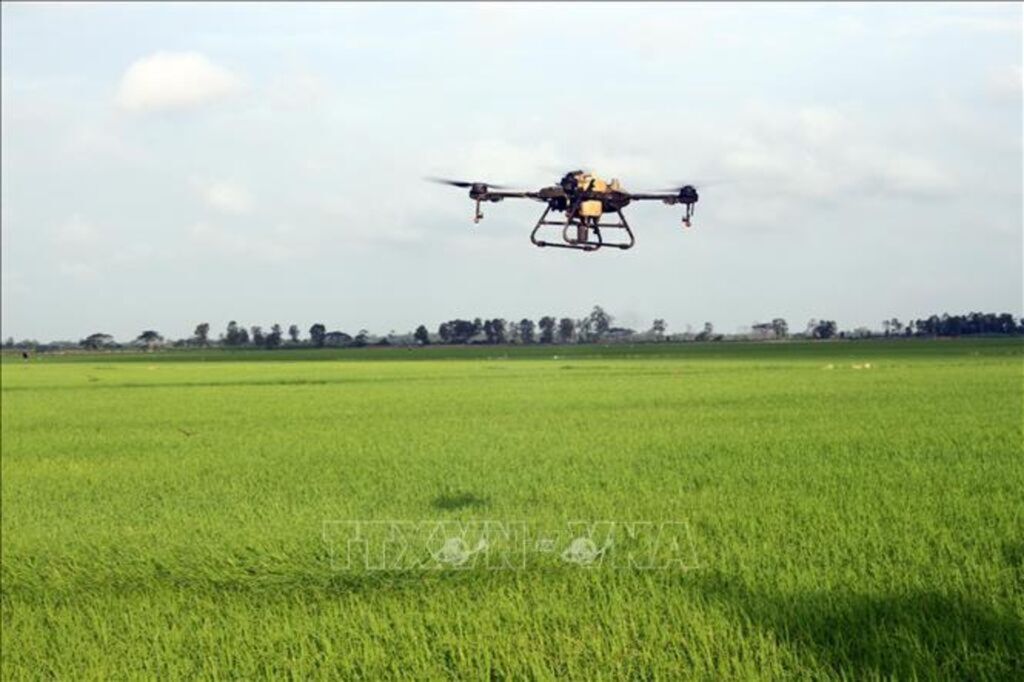
| UAVs spraying crop protection chemicals over rice fields in Can Tho city__Photo: VNA |
In an official letter sent on March 22, the Ministry of Science and Technology (MOST) requested related authorities to review, adjust, supplement, and register their lists of strategic technologies and products. The list of authorities to be consulted on these challenges includes ministries, ministerial-level agencies, local authorities, research institutes, universities, and professional organisations.
The distinguishing feature of this review is a fresh approach that does not begin with technology itself, but rather with the “major challenges” of each sector or field. Under MOST’s guidance, consulted units should not merely list technologies or research topics, but have to identify issues that are inclusive and pressing, and capable of being translated into specific programmes of action.
Based on these challenges, proposing authorities will identify stages within value chains that may generate the greatest impacts, thereby selecting strategic products and technologies. This new approach aims to concentrate resources on vital links and avoid thinned-up investment.
Each proposal must be accompanied by specific impact indicators, such as increased productivity, reduced costs, higher localisation rates, or market expansion. Furthermore, proposing authorities need to clarify target markets, international competitiveness, and the potential for import substitution and export promotion.
MOST also requested a roadmap that clearly identify authorities participating in the implementation, including in-charge units, coordinating units, leading enterprises, institutions and academies. Factors regarding infrastructure for testing/experimentation, data, standards, and intellectual property should also be considered from the outset.
Technologies on the list of strategic technologies are divided into two groups. The first group consists of technologies that already have application markets that can create direct short-term impacts on such sectors as agriculture, processing, construction, and energy. The second group comprises technologies that can generate new growth engines or serve as foundational pillars linked to long-term autonomy goals, such as quantum technology, high-speed railways, small modular nuclear reactors, and low-altitude space technology including UAVs and satellites.
Proposals on strategic technologies must be based on the needs of the economy, the advantages of the domestic industries, and the possibility of forming markets for technological products. This aims to improve productivity and competitiveness, found new industries, and ensure the technological autonomy in key sectors.
This challenge-based approach indicates a shift in the policy making. Last week, Hanoi also announced 30 problems requiring technological solutions, focusing on bottlenecks such as transport, environmental protection, and urban infrastructure. Regarding urban transportation, the city administration has set a requirement to build a real-time intelligent traffic management system whilst utilising data to regulate the mass transit demand. Additionally, challenges such as pavement occupancy and waste management, and flood forecasting have been raised, requiring integrated solutions rather than isolated technologies.
Previously, in June 2025, the Prime Minister issued a list of 11 strategic technology groups, including AI, cloud computing and big data, blockchain, 5G/6G mobile networks, robotics and automation, semiconductor chips, advanced biomedicine, energy and advanced materials, rare earth-ocean-underground technology, cybersecurity, and aerospace technology.
Earlier this year, MOST continued to collect opinions on a new list to update and replace the previous one. Compared to the previous list, the draft retains the 11 strategic technology groups. However, the products within each technology group have been further specified.- (VLLF)