 |
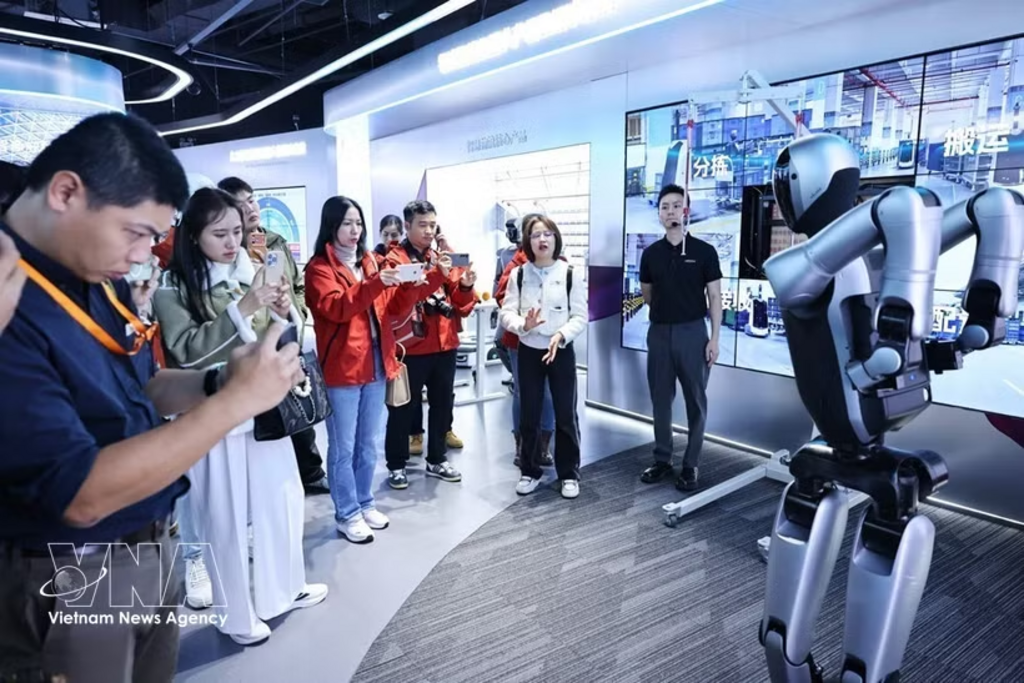
| Visitors to UBTECH, a company major in the research and development of humanoid robots __Photo: VNA |
Over the past years, global integration has opened Vietnam’s doors to new markets, capital, technology, and resources essential for its growth. Step by step, that same integration has become the engine quietly stockpiling the country’s strength through decades of reform.
Speaking at the recent 33rd Diplomatic Conference, Party General Secretary and President To Lam drew a stark new battle line: science and technology are now transforming production, governance, and the balance of power. Artificial intelligence, semiconductors, biotech, digital infrastructure, and new energy are delivering both opportunities and new risks. Nations that command technology, data, and a quality workforce will pull ahead while those that hesitate will be left further behind.
Against that backdrop, he assigned the diplomatic sector a hard new mission: sci-tech diplomacy must become a regular task. That means building networks of technology partners, linking research institutes, universities, enterprises, and experts, and scanning the horizon for new trends, standards, and policies, all to channel the right knowledge and technologies back into Vietnam. Diplomacy is no longer just about chasing capital; it must hunt knowledge, talents, and world-class best practices.
Institutional framework to unlock knowledge and technology
The directive by General Secretary and President Lam reflects a shift in Vietnam’s development mindset, in line with the Politburo’s Resolution 57-NQ/TW dated December 22, 2024 on breakthroughs in sci-tech, innovation and national digital transformation. For the first time, sci-tech has been placed at the very centre as a driver of growth model.
Resolution 57-NQ/TW identifies global cooperation in sci-tech, innovation and digital transformation as one of seven major groups of solutions, standing shoulder to shoulder with institutional reform, infrastructure, and workforce development. It demands deeper collaboration in research, acquisition, transfer and mastery of advanced technologies in priority areas, while setting a target of attracting at least three of the world’s leading tech corporations to set up headquarters in Vietnam by 2030. The resolution also ties technology mastery directly to workforce training, aiming to lift Vietnamese enterprises and lock domestic firms more deeply into global value chains.
On January 24, 2025, the Politburo’s Resolution 59-NQ/TW on global integration in the new situation sharpened the edge even further: for the first time, global integration in science, technology and innovation was carved out as an independent solution group, treated on equal footing with economic and political-defence-security integration. Then, on May 19, 2026, the Politburo’s Resolution 06-NQ/TW on the foreign policy orientations set by the 14th National Party Congress cemented the breakthrough role of “sci-tech diplomacy” in powering the transformation of the growth model, digital overhaul and green transition.
Expanding access to knowledge and technology
Building on these broad orientations, the current task is to expand cooperation while turning foreign affairs into concrete outcomes in terms of knowledge, technology, resources and domestic development muscle. This is the exact approach the Ministry of Science and Technology (MOST) is pursuing in sci-tech diplomacy.
Minister of Science and Technology Vu Hai Quan called sci-tech diplomacy a pioneering tool to sharpen the economy’s internal capacity and competitiveness. Under Resolutions 57 and 06, integration and diplomacy, including sci-tech diplomacy, now stand alone as strategic breakthroughs, treated on an equal footing with economic and political-security integration.
Recent numbers show that high-level diplomacy is producing concrete results. Vietnam maintained its 44th position among 139 economies in the Global Innovation Index, while information and communications technology (ICT) exports rocketed to USD 174.2 billion. At the same time, heavyweights like Qualcomm, Samsung, Marvell, and Synopsys are aggressively scaling up inside Vietnam. The minister pointed straight at this as hard evidence that deeper global cooperation in sci-tech and innovation works.
Drawing on that track record, Quan said mastering strategic technologies requires a shift from merely accessing technology to actively shaping it. The ministry has proposed tight coordination with the Ministry of Foreign Affairs (MOFA), leveraging the entire network of Vietnamese representative agencies abroad, with a focus on five core tasks.
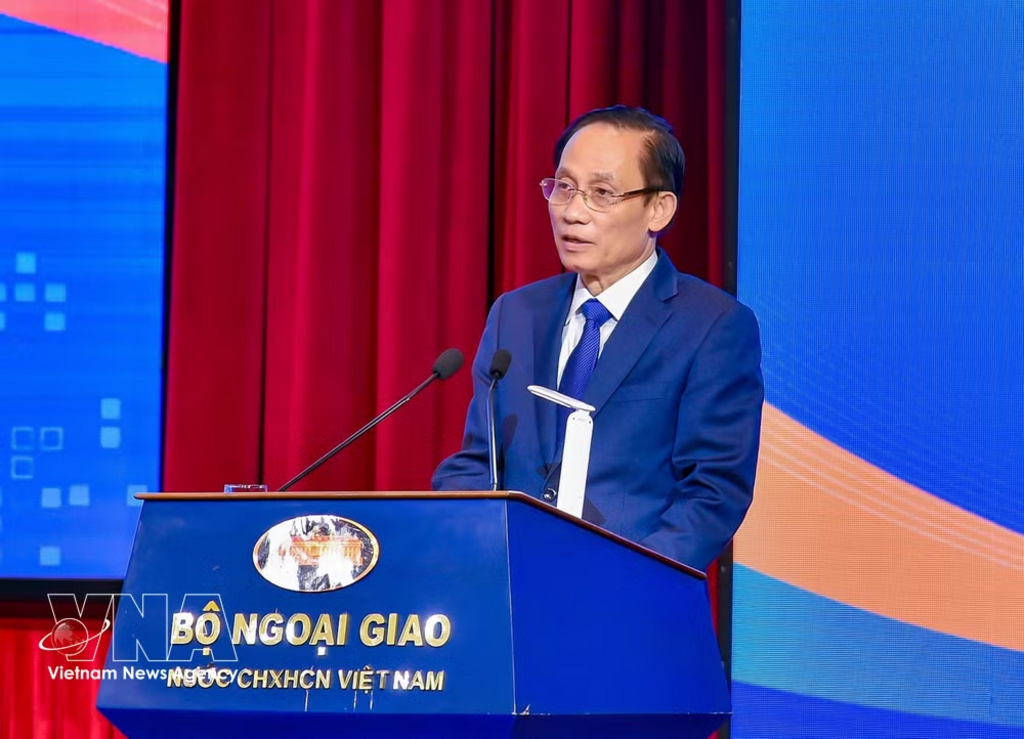 |
| Minister of Foreign Affairs Le Hoai Trung addresses a session on sci-tech diplomacy at the 33rd Diplomatic Conference on August 5 __Photo: VNA |
First, Vietnam should aggressively harvest international experience for sci-tech, innovation, and digital transformation policymaking. While building policies on strategic technologies, the ministry studied the playbooks of the US, China, and other advanced economies. To set financial norms for strategic tech, for example, it benchmarked Singapore’s practices and built pay packages that rival what Singapore offers to scientists, creating a magnet for top talent. At the same time, sci-tech task management has been overhauled, rewarding final outputs over paperwork. Hard milestones now track the progress and results of technology tasks.
The minister also made clear that the MOST intends to lock arms with the MOFA to keep identifying technology partners, especially deep-tech players hunting for investment opportunities inside Vietnam.
On the pull for global technology capital and talent, Quan stressed the need to unlock cash from international investment funds. The focus is approaching and encourging tech investment funds to plant their operations in Vietnam. International capital will act as a critical lever for incubating startups in tough technology fields like biotechnology, new materials, and other advanced technologies, he said.
He singled out the global hunt for sci-tech talents as a top mission demanding tight coordination with the MOFA. That means ditching the old administrative approach to attracting overseas experts, intellectuals, and scientists. Under the new playbook, the State won’t do the recruiting. Instead, it will build the enabling mechanisms, handing research institutes, universities, and business networks far greater power to pull in and deploy talents on their own terms.
At the same time, Vietnam needs to blow up siloed mindset and the central-local divide that hampers talent recruitment and use. The goal is a wide-open, flexible innovation ecosystem designed to lure leading chief engineers, scientists, and overseas Vietnamese intellectuals home to drive major national projects. The MOST is already assembling a global network of Vietnamese AI experts, putting experts and scientists at the controls of designing and operating large-scale systems.
“Sci-tech diplomacy can’t stop at handshakes and connections. Its bottom line must be the technological capabilities actually transferred, new markets cracked open, and the country’s self-reliance hardened”, Quan affirmed.- (VNA/VLLF)