 |
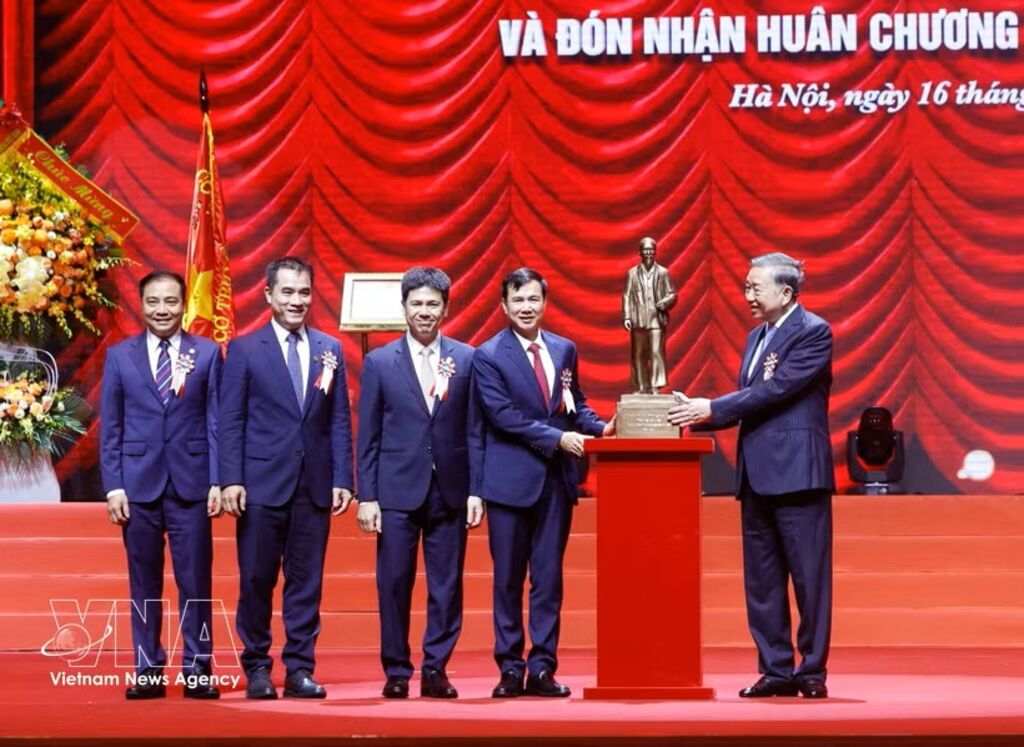
| Party General Secretary and State President To Lam presents a statute of President Ho Chi Minh to VNU-Hanoi __Photo: VNA |
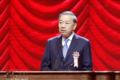
Following Party General Secretary and President To Lam’s keynote address at a ceremony marking the 120th anniversary of Vietnam National University - Hanoi (VNU-Hanoi) on May 16, scientists and intellectuals are optimistic about the view that “scientists must play a central role in connecting knowledge and serving national development in the new era”.
Assoc. Prof. Dr Truong Ngoc Kiem, Director of VNU-Hanoi’s Technology and Innovation Park, said the ceremony also saw the university awarded the First-Class Labour Order.
At the ceremony, General Secretary and President Lam assigned several strategic tasks to the university, including its transformation into an elite institution and a national frontrunner in sci-tech, innovation, and digital transformation, all in direct support of Vietnam’s push for double-digit economic growth. This mission is not only a strategic orientation for VNU- Hanoi but also an inspiration for Vietnam’s entire higher education system, Kiem said.
As the country enters a new era, the Party and State have designated sci-tech and and innovation as central priorities, he said, adding that VNU-Hanoi, alongside other higher education establishments, must not only produce high-caliber talents but also function as a hub for knowledge transfer and groundbreaking innovation.
Universities should act as bridges connecting the academia, State, and businesses, ensuring that sci-tech achievements are translated into practical applications for national development, Kiem elaborated.
According to Kiem, as the focal point for innovation activities within the park, VNU-Hanoi has locked onto two immediate priorities. First, it will review its scientific and innovation portfolio to accelerate partnerships and rapidly transfer research outcomes to local authorities and enterprises. Second, as a coordinating unit, it will link domestic and international sci-tech activities with localities and companies so that products developed by its faculty and scientists translate straight into national value.
Even with limited state resources, targeted investments in top research groups and standout scientists are a must. Such policies, he said, would attract leading overseas Vietnamese and foreign researchers, build up homegrown research muscle, and unlock the full intellectual power of scholars and lecturers, turning sci-tech and innovation into primary growth accelerants.
Prof. Doctor of Science Vu Minh Giang, VNU-Hanoi’s former Vice President and former Chairman of its Science and Training Council, expressed his appreciation for special attention shown by General Secretary and President Lam and senior Party and State leaders toward higher education development in Vietnam.
He pointed back to November 15, 1945 when President Ho Chi Minh himself attended the university’s very first ceremony, even as the newly independent nation faced enormous pressures. Such move made a clear statement that the revolutionary State puts intellectuals and talent first, Giang stressed.
To fulfill the tasks assigned by the top Vietnamese leader, he said VNU-Hanoi must clearly define its strategic direction, resources, and human capital, noting that the emphasis on special mechanisms could unlock a phase of rapid and breakthrough development for the university.
He cited financial reform as a critical example, arguing that salaries for scientists and lecturers need to match what top global universities offer if Vietnam wants to attract and keep world-class talents.
On the leader’s stark warning about the risk of falling behind in the global tech race, Director of VNU-Hanoi’s Science and Innovation Department Prof. Tran Thi Thanh Tu called the caution both timely and invaluable, especially for the intellectual and scientific community tasked with shaping the country’s tech future.
Prof. Dr Nguyen Ngoc Minh, a recipient of the 2016 Ta Quang Buu Award from VNU-Hanoi’s University of Science, also stressed that the university’s scientific community is fully aware of its responsibilities in the current era.
The mission of intellectuals today goes far beyond publishing papers or lecturing. It’s about solving the country’s biggest challenges, sharpening its competitiveness, protecting Vietnam’s cultural and human values, and giving the next generation the tools to navigate the decades ahead, he added.- (VNA/VLLF)