 |
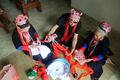
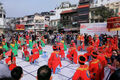
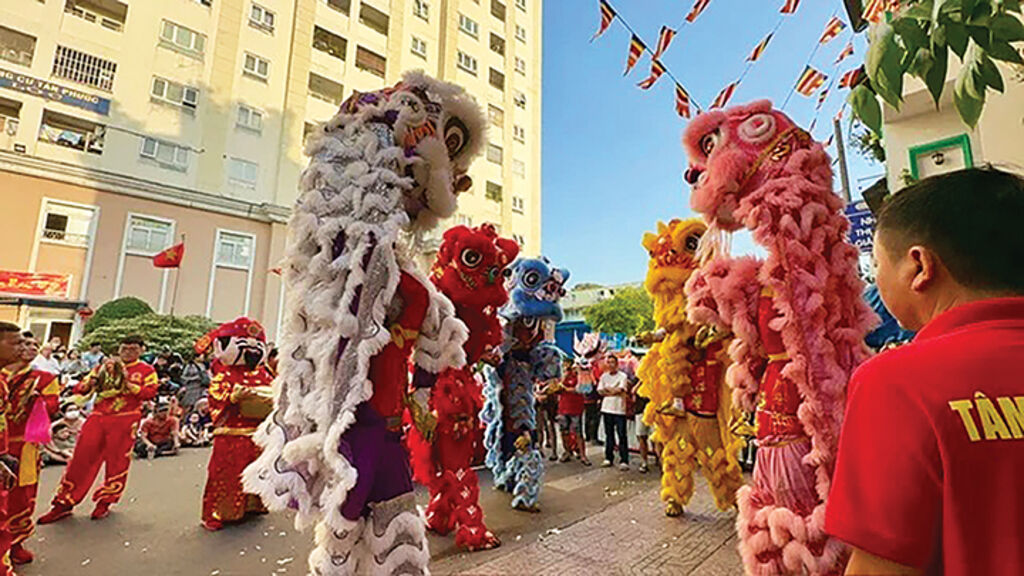
| Kylin dancing combines vibrant colours, music, performance and martial arts, symbolising prosperity and good fortune__Photo: https://www.thanhnien.vn |
In the cultural and spiritual life of the Hoa-ethnic community, kylin, lion and dragon dances are closely associated with festivals and important occasions, symbolising good fortune, prosperity and peace. As a familiar saying goes, “Wherever there are Hoa people, there are kylin, lion and dragon dances”.
In Ho Chi Minh City, Cho Lon, home to generations of Hoa residents, has long been a centre of the tradition. Kylin dance forms part of the broader dance tradition and is commonly performed during the Lunar New Year, the Mid-Autumn Festival, shop openings, groundbreaking ceremonies and other festive occasions.
Behind these lively performances, set to the powerful rhythms of drums and cymbals, is another tradition: the painstaking craft of making kylin heads.
A kylin head must be visually striking and expressive, yet light enough for performers to manoeuvre and sturdy enough to withstand demanding routines. These requirements have helped shape a distinctive craft practised in Cho Lon for more than a century.
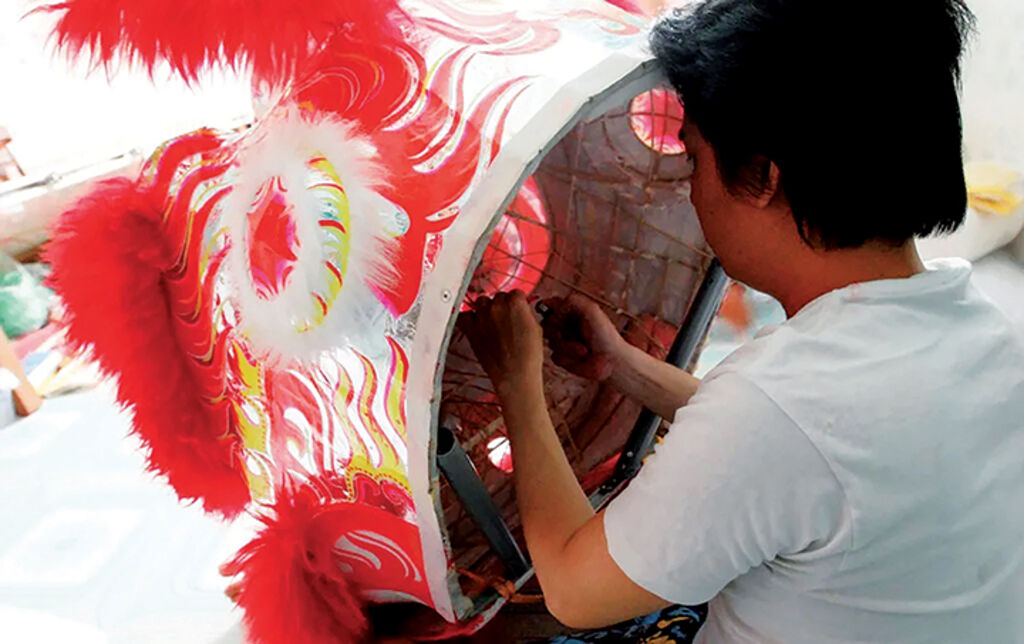 |
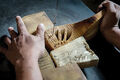
| The kylin head’s frame is the most difficult part to make, comprising more than 100 pairs of components with different shapes and structures__Photo: https://www.elledecoration.vn |
Closely associated with the history of the Hoa-ethnic community in the area, kylin-head making has been passed down through generations, often within families. What began as a means of earning a living has gradually become a traditional craft deeply embedded in the community’s cultural life.
Today, around 100 workshops in Cho Lon, particularly along Hai Thuong Lan Ong and Trieu Quang Phuc streets, continue the craft. Before major competitions and public performances, dance troupes often turn to experienced artisans to commission custom-made heads.
Among them is Truong Quoc Ton, a third-generation craftsman from the Hong Hanh Hien workshop at 109 Trieu Quang Phuc street. His workshop, like other long-established businesses in the area, produces kylin heads for customers in Vietnam and overseas and welcomes visitors interested in learning about the craft.
Making a kylin head
A traditional bamboo-framed kylin head is made entirely by hand in a series of painstaking stages, from building the frame and covering it with paper or fabric to painting, decorating and assembling the moving parts.
The first and most important stage is building the frame, which determines the shape, balance and durability of the finished head.
Artisans traditionally work with bamboo, rattan and zinc wire. The bamboo and rattan are sun-dried, split into thin strips and smoothed before being bent into the required curves. Depending on the complexity of the design and the artisan’s experience, making a single frame can take up to a week.
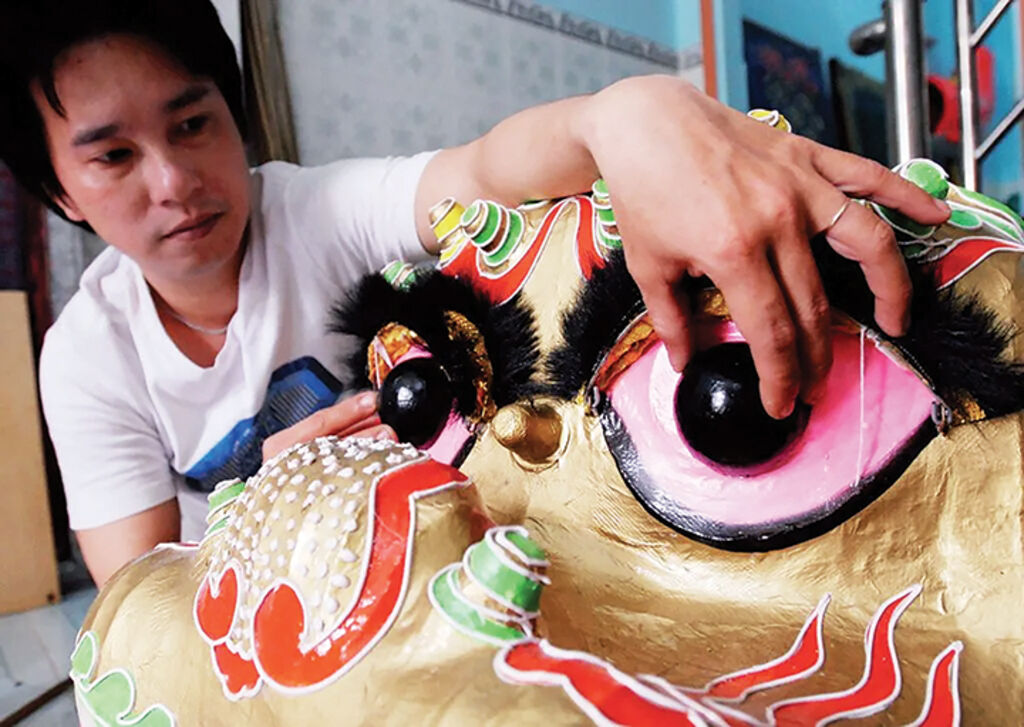 |
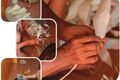
| Artisan Truong Quoc Ton puts the finishing touches to the eyes of a kylin head, one of its most intricate parts__Photo: https://www.elledecoration.vn |
One of the most difficult tasks is forming and joining the structural pieces. A traditional head may contain more than 100 pairs of joints, each shaped differently according to its position in the frame. This calls for considerable precision to keep the head symmetrical, balanced and sturdy.
Because the frame is made by hand rather than from a standard mould, no two heads are entirely identical. Small differences in proportion and structure give each one its own character.
Once the frame is complete, it is covered with mesh fabric or a type of traditional paper, fixed with cassava starch paste. A layer of white glue is then applied before the head is left to dry in the sun for several hours or, in some cases, a full day. The horns are also covered with layers of paper before being attached to the frame.
Then comes the painting, when the kylin begins to take on its distinctive character. Artisans use vivid colours such as red, blue and yellow to paint traditional motifs directly onto the prepared surface. The eyes are among the most important features, as they largely determine the expression of the finished head, from playful and cheerful to imposing and fierce.
Less experienced craftsmen may first sketch the patterns in pencil, while master artisans often paint freehand. As a result, even heads made to the same design can vary subtly in colour, expression and detail. Depending on the complexity of the patterns and the customer’s requirements, painting and decoration can take from several days to several weeks.
While preserving traditional techniques, artisans also adapt their designs to changing tastes. Conventional horn forms may, for example, be replaced or embellished with phoenixes, peacocks and other decorative motifs. Such variations give individual pieces a distinctive appearance without departing from the basic form and visual language of the traditional kylin head.
After the paint has dried, fur is attached to give the head greater movement and vitality during a performance. Plastic eyes may be fitted with lights, while strings and small internal mechanisms can be installed to make them blink as the dancer moves.
The finished head must meet several practical requirements. It should be light enough to wear and manipulate, yet strong enough to endure vigorous movements and occasional impacts during a performance. Its features must also be bold and expressive enough to remain clearly visible to spectators.
Kylin heads are generally made in small, medium and large sizes. Perhaps counter-intuitively, smaller heads can be more difficult to make, as the confined space inside the frame gives artisans less room to attach and adjust the internal components.
The final step is to attach the head to a tail, usually about 2.5 metres long and made from brightly coloured fabric decorated with sequins and tinsel that complement the colours of the head.
Keeping the craft alive
For generations, kylin-head making has remained closely connected with the festivals and community life of Cho Lon. The workshops are especially busy in the weeks leading up to the Mid-Autumn Festival and the Lunar New Year, when demand from performance troupes rises sharply and artisans work long hours to complete their orders.
The craft has also evolved over time. In addition to supplying local troupes, workshops now make kylin heads for customers overseas and welcome visitors interested in learning about the production process.
Yet despite changes in materials, decoration and market demand, much of the work continues to depend on skills acquired through years of practice: knowing how far a bamboo strip can bend, how to balance the frame, how to give the face the right expression and how to create a head that comes to life in performance.
From strips of bamboo and layers of paper to the final brushstrokes, each kylin head embodies both craftsmanship and cultural memory. When it comes to life amid the drums and cymbals of a festival performance, it also carries forward a tradition that generations of Hoa artisans in Ho Chi Minh City have preserved and passed down.- (VLLF)