Nguyen Tat Vien[2]
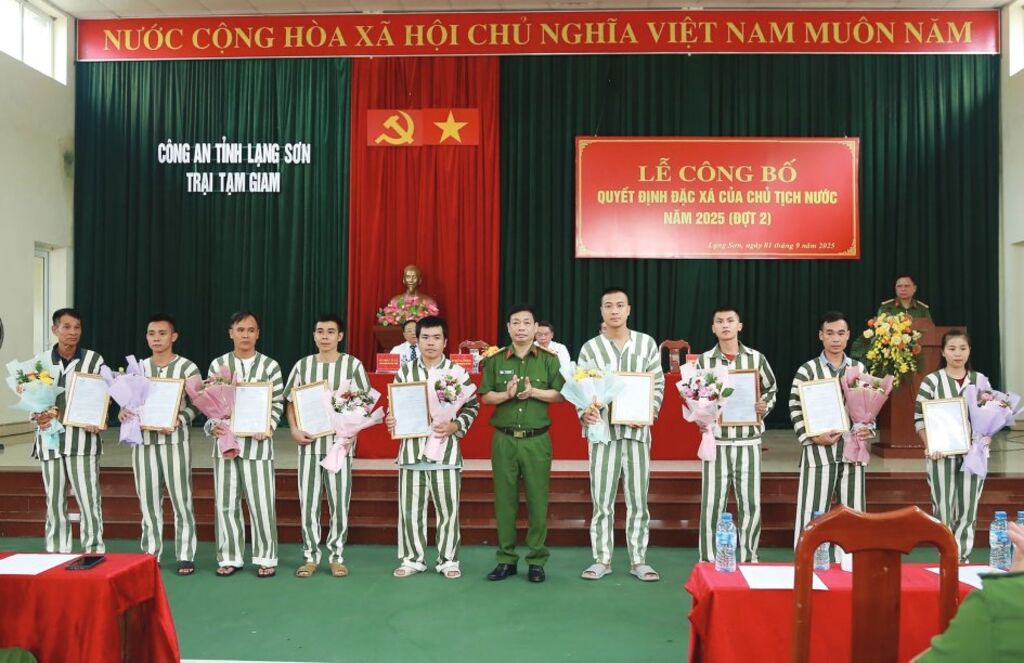 |
| On September 1, 2025, eligible inmates at the detention facility of the Lang Son province’s Department of Public Security receive the President’s 2025 amnesty decisions (second phase)__Photo: Anh Tuan/VNA |
Conditional early release (parole) is a new measure introduced in the 2015 Penal Code (as revised in 2017, 2024 and 2025) and the result of institutionalising the Communist Party of Vietnam’s guideline to “emphasise the effectiveness of prevention and rehabilitation in handling offenders” as outlined in Politburo Resolution 49-NQ/TW on the Strategy for Judicial Reform through 2020. This new mechanism allows sentenced persons to undergo rehabilitation and education in a normal social environment. In practice, parole has proven to be responsive to requirements of crime prevention and combat, as well as offender rehabilitation and education. However, certain enforcement challenges remain, requiring uniform guidance from competent agencies.
Significance of regulations on conditional early release
In the most general sense, criminal policy, particularly crime prevention and combat policy, is a component of legal policy, manifested in the formulation, enforcement and application of law. In practice, this is considered a policy of employing criminal law measures and providing orientations for all law enforcement activities of investigating, prosecuting, adjudicating and judgement enforcement agencies. In a broader sense, criminal policy is understood a component of social policy directing crime prevention and combat, with humanity and social justice values expressed through the provisions on exemption from penalties, reduction of sentence term, and early release.
Resolution 08-NQ/HNTW dated January 23, 1995, of the eighth plenum of the seventh Party Central Committee, clearly states: “Regarding offenders sentenced to imprisonment, humane treatment is required. There must be vocational training programmes for inmates and job placements for them after release to help them quickly reintegrate into the social community.”
To meet the requirements of renewal of the judicial work, the Politburo issued Directive 53-CT/TW on March 21, 2000, requiring “effective implementation of management and assistance measures for released prisoners to continue educating them to become honest citizens, integrate into community life and minimise recidivism.” Later in 2002, the Politburo adopted Resolution 08-NQ/TW on a number of major tasks of the judicial work, stating that judicial work must help effectively prevent and promptly and strictly handle criminal offences, maintain order and discipline, and guarantee and respect democratic rights as well as lawful rights and interests of organisations and citizens. Most importantly, Politburo Resolution 49-NQ/TW dated June 2, 2005, on the Strategy for Judicial Reform through 2020, emphasises the need to attach greater importance to improvement of criminal policies and judicial proceedings, heighten prevention effectiveness and encourage prosocial behaviours in the handling of offenders; and to reduce imprisonment sentences, and expand the application of monetary fines and non-custodial reform for certain crimes.
Institutionalising the Party’s guidelines and viewpoints, the 2013 Constitution, as well as legislation on judicial proceedings and criminal judgement enforcement, have added many new provisions aimed at upholding the State’s responsibility in respecting and protecting human rights and citizens’ rights. More specifically, as per the criminal procedure law, the State must apply all lawful measures to discover the objective truth of criminal cases and strictly punish offenders, while bearing the responsibility to guarantee the lawful rights and interests of related individuals and organisations, especially those participating in criminal proceedings as arrestees, detainees, suspects, defendants, and persons liable to serve sentences who belong to disadvantaged or vulnerable groups.
In the field of criminal judgement enforcement, guaranteeing socialist leniency and humanitarian policies is a key principle throughout all judgement enforcement activities. Accordingly, criminal judgement enforcement is not intended to punish offenders but to create conditions for them to rectify their mistakes, realise the gravity of their crimes, and facilitate their labour, study and reform so as to become honest and useful citizens. This principle is closely linked to the principle of combining education and persuasion with coercion, bringing higher efficiency to the reform of sentenced persons. This principle is set out in the provisions on parole of the 2015 Penal Code, as revised in 2017, 2024 and 2025, (the Code). This new mechanism also stems from the requirements of international legal and judicial integration.
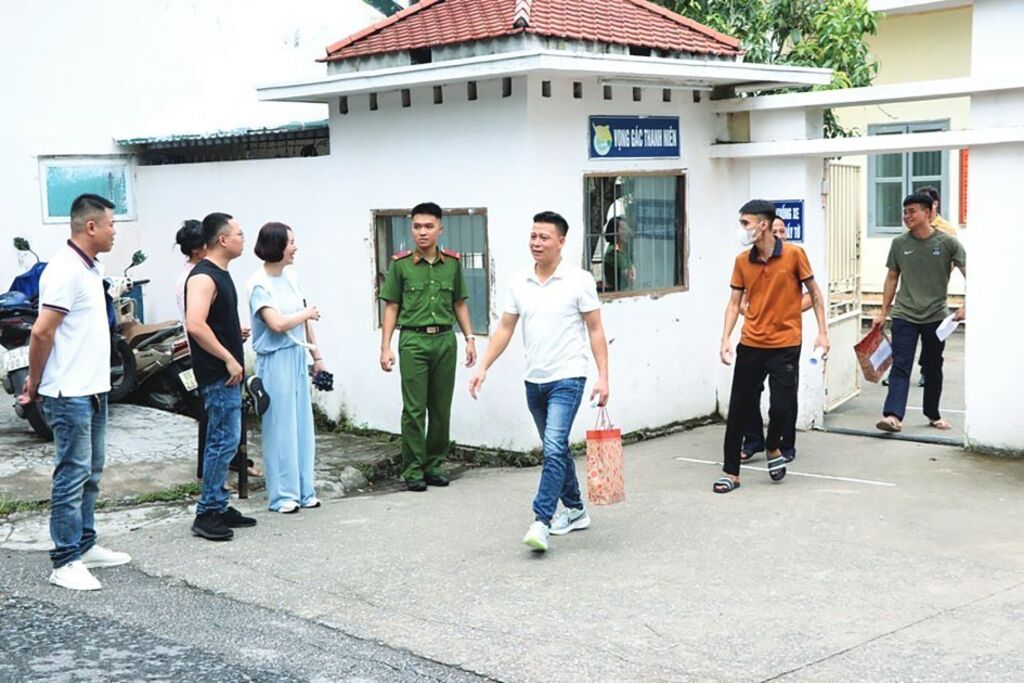 |
| Amnestied inmates are released from Detention Camp No. 2 in Hai Phong on September 1, 2025__Photo: Manh Minh/VNA |
Provisions on parole in criminal law
Parole is one of the measures for exemption from or reduction of sentence term - a new mechanism allowing sentenced persons to be reformed and educated in a normal social environment.
In essence, parole is a measure applied by the court, allowing offenders who are serving sentences in detention facilities to continue serving their sentences in the community under certain conditions. In reality, a parolee is obliged to continue to serve his sentence, but in a normal social environment rather than in a detention facility. Also, he has to perform his obligations during the probation period and submit to supervision by local authorities and the criminal judgement enforcement agency.
As defined in Resolution 01/2018/NQ-HDTP dated April 24, 2018, of the Council of Justices of the Supreme People’s Court, guiding the application of Articles 66 and 106 of the Code regarding parole: “Parole is a measure applied by the court to sentenced persons when they meet all conditions specified by the Penal Code, and it is deemed unnecessary to compel them to continue serving their sentences in detention facilities.”
The Code stipulates that persons serving sentences for serious, very serious or particularly serious crimes who have received a sentence reduction, or persons serving sentences for less serious crimes, may be granted parole when they satisfy the following conditions: (i) being a first-time offender; (ii) having shown improvement and a good sense of reform; (iii) having a clear place of residence; (iv) having completely served additional penalties such as fine, compensation for damage, and payment of legal cost; (v) having served at least half of the sentence term, or at least 15 years for those sentenced to life imprisonment but later entitled to commutation termed imprisonment.
In case the offender is a person with meritorious services to the revolution, a relative of a person with meritorious services to the revolution, a person aged 70 years or older, a person with severe or particularly severe disabilities, or a woman nursing a child aged under 36 months, he/she must have served at least one-third of the sentence term, or at least 12 years, if sentenced to life imprisonment but later entitled to commutation to termed imprisonment.
Parole is not applicable to persons convicted of crimes against national security, crimes against peace, crimes against humanity, war crimes, or terrorism; persons sentenced to imprisonment of 10 years or more for intentional crimes against life, health, dignity or honour; persons sentenced to imprisonment of seven years or more for plundering property, kidnapping in order to appropriate property, illegally producing narcotics, illegally trading in narcotics or appropriating narcotics; and persons whose death sentences were commuted or who fall into the case specified in Article 40.3 of the Code.
The probation period for a parolee is equal to the remainder of his sentence. During this period, the parolee has to fulfil the law-specified obligations. If he intentionally breaches such obligations twice or more, or is administratively sanctioned twice or more, the court may revoke the parole decision and compel him to serve the remainder of the sentence. If he commits a new crime during the probation period, the court will compel him to serve the new sentence combined with the unserved period of the previous sentence.
Parolees have the opportunity to be released early and have to serve their sentences at their places of residence, with the obligation to strictly comply with commitments to abiding by law, performing civic duties, and implementing regulations of the places where they reside, work or study. They are obliged to report as required, remain under the management of commune-level People’s Committees or military units assigned to manage them, show themselves at the request of the commune-level People’s Committees or military units, and monthly send written reports on their compliance to the managing authorities.
In addition to the above binding conditions, the court may consider shortening the probation period when the parolee has served at least half of such period, shown significant progress, strictly complied with law, performed his obligations, actively worked and studied, recorded merits in labour and production activities or protection of national security, and been commended by provincial- or higher-level authorities.
An offender aged under 18 years who does not fall into any of the cases specified in Article 66.2 of the Code, may be granted parole if he satisfies the following conditions: (i) being a first-time offender; (ii) showing significant progress and a good sense of reform; (iii) having served at least one-third of the sentence; and (iv) having a clear place of residence.
Implementation of parole regulations
Issuance of guiding texts of the Code
After the Code took effect, central justice agencies promptly issued documents guiding the application of the parole measure. The first to mention is Resolution 01/2018/NQ-HDTP of the Council of Justices of the Supreme People’s Court, guiding the application of Articles 66 and 106 of the Penal Code. Subsequently, the Government issued Decree 133/2020/ND-CP detailing a number of articles of the Law on Enforcement of Criminal Judgements, and Decree 49/2020/ND-CP detailing the provisions of the Law on Enforcement of Criminal Judgements regarding community reintegration.
The Ministry of Public Security, the Ministry of National Defence, the Supreme People’s Court and the Supreme People’s Procuracy issued several joint documents, such as Joint Circular 04/2018/TTLT on coordination in the implementation of the 2015 Criminal Procedure Code regarding parole, and Joint Circular 03/2021/TTLT on coordination in the implementation of the order and procedures for shortening the probation period for persons entitled to parole or suspended sentences. Individually, the Ministry of Public Security issued Circular 12/2018/TT-BCA on parole applied in the People’s Public Security forces; and Circular 64/2019/TT-BCA on handling of cases in which persons entitled to parole, postponement of the serving of sentences, suspended sentences or non-custodial reform have their places of residence changed. The Ministry of National Defence issued Circular 181/2019/TT-BQP on settlement of cases similar to those mentioned above who are managed by the army and whose places of residence or workplaces are changed. When obstacles arose in practice, these agencies issued more specific instructions.
Obstacles to be resolved
During the application of regulations on parole, judicial agencies have encountered several obstacles that require specific guidance.
First, there is a lack of specific criteria for identifying the criterion of having “no impact on security and social order and safety” when considering parole. Resolution 01/2018/NQ-HDTP stipulates that parole must be considered carefully to ensure it does not affect security and social order and safety, especially for drug-related, corruption or organised crimes. Due to the lack of specific criteria, local authorities have interpreted this requirement differently, and the responsibility to verify the satisfaction of this requirement is assigned to commune-level Public Security agencies or criminal judgement enforcement agencies of district-level Public Security Divisions or of provincial-level Departments of Public Security.
Second, there appear problems in implementing provisions on the timing of announcement of parole decisions. It is not consistent when a parole decision is announced and when the inmate is actually released. While some documents suggest release “immediately” upon the receipt of the parole decision, others imply the decision only becomes effective 15 days after the date of their signing. This leads to discrepancies where some detention facilities or reformatories release inmates immediately while others wait 15 days to avoid possible problems if the decision is appealed or protested against.
Third, inconsistency exists in determining the probation period for parolees. While Article 66.3 of the Code states that the probation period equals the remainder of the sentence (the probation period is counted from the date of announcement of the court’s parole decision and release of the inmate), some guiding texts imply that the probation period starts only when the parole decision becomes legally effective, leading to inconsistent application.
Fourth, conditions for shortening the probation period are, to some extent, impractical. The condition of “showing significant progress” to be evidenced by commendation of a provincial- or higher-level authority is considered impractical. Under the current Law on Emulation and Commendation, the standards for such commendation are very high, making it almost impossible for a parolee to qualify.
Fifth, eligible subjects remain narrow. The current scope of inmates eligible for parole does not cover those who have committed multiple “less serious” crimes. Even if these inmates reform well and have stable places of residence, they remain ineligible because they are not regarded as first-time offenders.
Recommendations
The Supreme People’s Court should take charge of and coordinate with the Supreme People’s Procuracy, the Ministry of Public Security and the Ministry of National Defence in reviewing parole practices and harmonising the guiding documents of the Code, the Criminal Procedure Code and the Law on Enforcement of Criminal Judgements.
Criteria for the criterion of having “no impact on security and social order” should be specified, preferably delegating clear powers to commune-level Public Security agencies to verify the satisfaction of this criterion to ensure the preparation of accurate dossiers for parole consideration.
It is necessary to enhance coordination between responsible agencies, particularly Public Security agencies, People’s Procuracies and People’s Courts, in reviewing and preparing dossiers of request for parole for eligible inmates. At the same time, regulations on coordination among judicial agencies to discuss and resolve parole dossiers should be issued, thus guaranteeing the rights of eligible inmates.
It is also required to carry out public communication about the significance and impact of parole more intensely in the mass media and law education channels to promote the community participation in the process of inmate reform.
Finally, authorities should proceed with carefully reviewing the implementation of Article 66 of the Code regarding parole in order to expand eligible subjects to include those who have served half of their sentences, have clear places of residence, have fulfilled their civil obligations, have shown good progress, and no longer pose a danger to society, even if they are not first-time offenders.-
[1] The Vietnamese version of this article is published on the Vietnamese Journal of Legal Sciences (No. 08(192)/2025)
[2] Faculty of Business & Law, Saigon International University, former Permanent Member of the Central Steering Committee for Judicial Reform.