 |
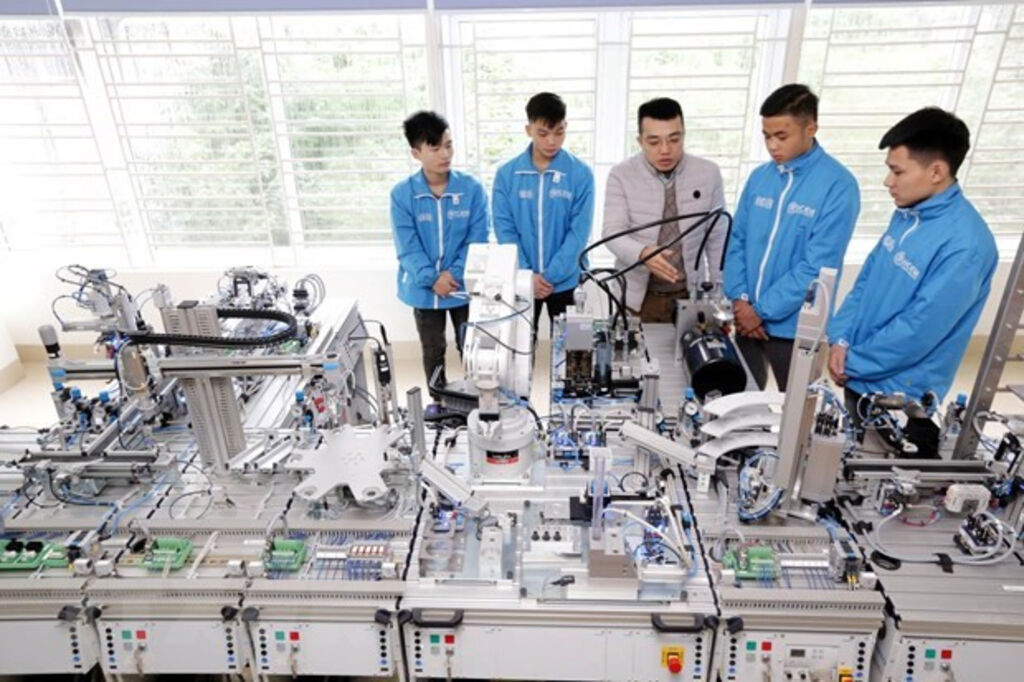
| Vocational education institutions would be granted autonomy to decide on the form and content of cooperation__Photo: VNA |
The Ministry of Education and Training (MOET) is seeking public opinions on a draft decree detailing and guiding a number of articles of the Law on Vocational Education.
The draft, which is available for public comment on the MOET’s Portal, is expected to establish a synchronous and uniform legal framework facilitating the development of vocational education. This framework aims to meet the needs of learners and the labor market, as well as requirements for occupational qualifications and skills within ASEAN and in the globe.
With respect to the naming and renaming of colleges and professional secondary schools, the draft decree would allow agencies and organizations that establish such colleges or schools to decide on the names of these education institutions, provided that such names do neither exaggerate the institutions’ quality, titles or rankings nor cause confusion with the names of other foreign education institutions.
For vocational secondary schools, in order to avoid confusion with other models of general education institutions, the draft decree says that the term “pho thong” (general education) or “co so” (institution) would not be allowed to be used in their names.
In addition, the draft sets out conditions, competence, and mechanisms for inspection and supervision of cooperation and joint training activities with foreign partners.
Specifically, vocational education institutions would be granted autonomy to decide on the form and content of cooperation, while ensuring compliance with current regulations and the requirements of management authorities.
The draft also introduces provisions on inspection and supervision in international cooperation to ensure the harmony between the autonomy and accountability of vocational education institutions and the management objectives of management agencies. This is expected to guarantee a favorable legal environment for enhancing the quality of vocational education.
Moreover, the draft decree specifies conditions for joint training with foreign partners, while prohibiting cooperation and joint training in the sectors of national defense and security and religion.
Noticeably, the draft gives provisions on simplification of administrative procedures related to joint training activities in order to save social costs, improve productivity and efficiency, and clearly assign responsibilities to both task performers and heads of relevant units.
Particularly, the draft decree clearly provides the decentralization and delegation of powers to local administrations as directed by the Party and the State. Accordingly, local state-management agencies in charge of education and training may license joint training with foreign partners in localities. Meanwhile, the central-level state management agency in charge of education and training would license joint training activities for colleges and higher education institutions permitted to provide college-level vocational training.- (VLLF)