 |
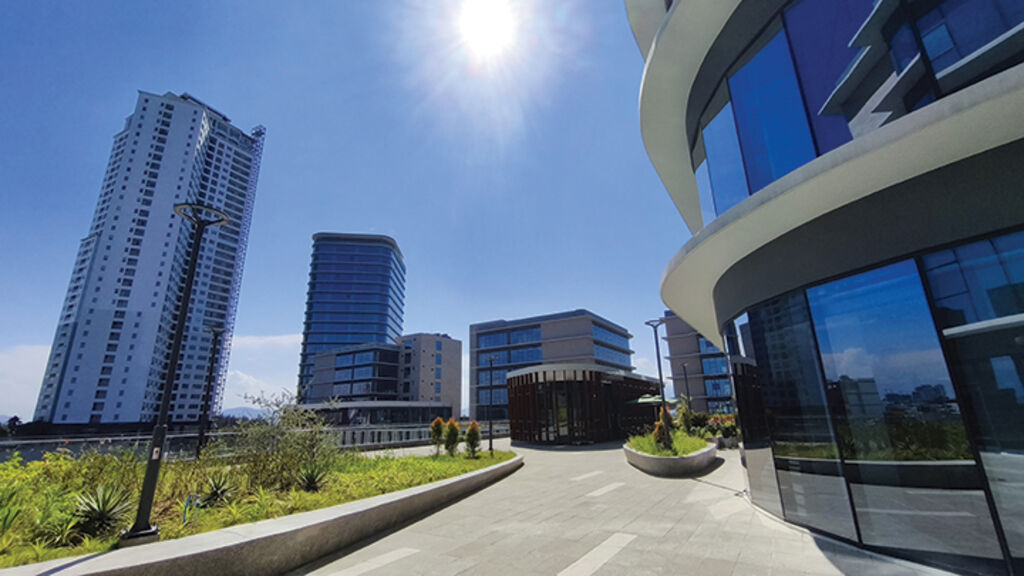
| Da Nang Software Park No. 2, where the initial headquarters of the IFC in Da Nang city will be located__Photo: Quoc Dung/VNA |
The Government issued a package of eight decrees to implement the National Assembly’s Resolution 222/NQ-QH, on the International Financial Center (IFC) in Vietnam. With specific provisions on the IFC’s organizational model and operation mechanism, from December 18, their effective date, these decrees are expected to lay a comprehensive legal basis for the IFC’s effective operation.
Decree 323/ND-CP
This Decree, governing the establishment of the IFC, provides that the IFC is a unified legal entity operating in two locations, Ho Chi Minh City and Da Nang city. Its operating regulations will be approved by its Executive Council and are valid and applied uniformly in both locations. All standards, regulations, procedures, rules, professional templates and licensing criteria within the IFC are issued in a unified manner and applied simultaneously in both locations.
The IFC in Ho Chi Minh City is planned to become an international financial center with a comprehensive and diverse financial ecosystem, providing both traditional and specialized financial services and utilizing the synergistic and complementary effects of financial services. Meanwhile, the Da Nang city-based IFC will operate as a modern international financial center closely integrated with innovation, digital technology and sustainable finance ecosystems, creating a regulatory sandbox for new financial models and pioneering the extensive provision of digital asset products, digital payment services, and specialized trading platforms and exchanges.
The IFC consists of functional zones for financial transactions, banking services, securities and commodity exchange, offices, arbitration center, court, among others as administered by the Executive Authorities of the Center in the two cities.
Decree 324/2025/ND-CP
This Decree stipulates financial policies exclusively applicable to the IFC, with a focus on corporate income tax (CIT) and personal income tax (PIT).
With respect to CIT, the decree provides two different incentive levels, depending on the nature of industries or sectors of investment projects newly arising within the IFC.
Specifically, projects in priority sectors within the IFC will be subject to a CIT rate of 10 percent for a period of 30 years, and a CIT exemption period of up to four years and a 50-percent CIT reduction period of subsequent nine years at most.
Meanwhile, for projects that are not on the priority list, the preferential tax rate is 15 percent for 15 years, with a CIT exemption of up to two years and a 50-percent CIT reduction period of up to the subsequent four years.
As for PIT, the decree provides PIT exemption until the end of 2030 for income from salaries and wages of managers, experts, scientists, and highly qualified staffs at the IFC, regardless of whether they are Vietnamese or foreigners.
Decree 325/2025/ND-CP
This Decree introduces unprecedentedly open regulations on labor management.
Accordingly, the decree authorizes organizations and enterprises operating within the IFC to proactively recruit foreign workers based on their actual job requirements, without being subject to caps on the proportion of foreign personnel, provided they ensure the national security.
In addition, the procedures for granting work permits are utterly simplified, with the application processing time limit reduced to three working days. The decree also stipulates that the validity of a work permit or a certificate of work permit exemption may be extended up to 10 years.
Notably, the Executive Authorities of the IFC in Ho Chi Minh City and Da Nang city will be decentralized by the Government to perform the management, grant and revocation of the relevant permits and documents.
Decree 326/2025/ND-CP
This Decree details the regulations on land and environmental management within the IFC, which are applicable to IFC members, investors, and agencies, organizations and individuals involved in investment and business activities within the IFC in the two localities.
The chairpersons of the People’s Committees of Ho Chi Minh City and Da Nang city will be empowered to decide on land allocation, land lease, permission for land repurposing, extension or adjustment of land use periods for investment projects of IFC members. The land administration authorities of the two cities will issue first-time certificates of land use rights and ownership of land-attached assets to the IFC members.
In addition to land-related regulations, the decree also requires investment projects within the IFC to make the environmental registration before discharging waste into the environment, except cases exempted from environmental registration specified by the law on environmental protection.
Decree 327/2025/ND-CP
This Decree provides policies on entry, exit and residence of foreigners at the IFC.
Foreign nationals who are key investors, experts, managers or highly qualified workers employed by agencies and organizations headquartered at the IFC and meet law-specified criteria will be granted a visa or a temporary residence card bearing the symbol “UĐ1” with a validity of up to 10 years, upon the recommendation of the Executive Authorities.
Foreigners who are spouses or children under 18 years of age of such persons may be granted visas or temporary residence cards bearing the symbol “UĐ2”, with a validity duration equal to that of the “UĐ1” visas or temporary residence cards.
Regarding permanent residence, foreigners being key investors, experts, scientists, individuals with special talents, or senior managers working for a long term at agencies and organizations headquartered at the IFC may be considered for permission for permanent residence in Vietnam if they have documents proving their long-term employment and have worked continuously for at least three years at such agencies or organizations, and are recommended by heads of relevant competent agencies.
Decree 328/2025/ND-CP
This Decree provides the establishment and operation of the International Arbitration Center (IAC) under the IFC.
The IAC will be licensed for establishment by the Minister of Justice upon an application for establishment submitted by at least five founders who meet the standards specified in this Decree.
The IAC is located within the IFC in Ho Chi Minh City and possesses the legal person status, its own seal, and a bank account. It operates independently in terms of organization and finance. The establishment, operation registration, and announcement of the establishment of the IAC must comply with the Law on Commercial Arbitration and this Decree.
Under the decree, the application of foreign laws by the IAC must comply with the National Assembly’s Resolution 222/2025/QH15 and the Law on Commercial Arbitration.
One of the noteworthy points of the decree is that in case the parties agree to resolve a dispute at the IAC, the disputing parties have the right to mutually agree to waive their right to request a court to rule out the recognition of the parties’ settlement or an arbitral award of the Arbitral Tribunal of the IAC that has taken legal effect. Once the parties have executed a written agreement waiving such right, the court would refuse to accept or adjudicate any request for ruling out the arbitral award of the Arbitral Tribunal.
Decree 329/2025/ND-CP
This Decree provides the licensing of establishment and operation of banks, foreign exchange management, anti-money laundering, counter-terrorist financing, and prevention of financing the proliferation of weapons of mass destruction at the IFC.
Notably, the decree’s significant provisions on foreign exchange management require each of the IFC’s member enterprises to open a foreign-currency payment account at the center’s member bank for its financial transactions, including borrowing funds from individuals or organizations residing outside Vietnam’s territory, lending to overseas entities or domestic borrowers, making outbound investments from the IFC in overseas markets, and making inbound investments from the IFC in other fields in Vietnam.
Foreign investors are required to open foreign-currency payment accounts at a member bank to carry out foreign investment transactions in the IFC.
Meanwhile, overseas organizations and individuals are permitted to use foreign-currency payment accounts at member banks under the Governor of the State Bank of Vietnam’s regulations.
Decree 330/2025/ND-CP
This Decree provides the establishment and operation of the commodity exchanges within the IFC.
Accordingly, the executive authorities in the two cities will examine and verify the conditions and dossiers of application for the establishment of the commodity exchanges.
The decree sets out conditions for an enterprise to establish a commodity exchange within the IFC. An eligible enterprise must either be a member of the IFC or be owned or controlled by one of IFC members with a minimum ownership threshold of 49 percent. In case foreign investment is involved, the foreign ownership must not exceed 49 percent.
In addition, the enterprise must have a minimum charter capital of VND 1,500 trillion, an organizational and operational model and functions of a commodity exchange, a draft charter, and a robust and secure information technology system to ensure stable, safe and reliable operation of the commodity exchange.- (VLLF)