As children grow up in a digital world, the Constitution and law should not only recognise their rights but also protect them from emerging and complex risks. Tracing the development of children’s rights through Vietnam’s Constitutions from 1946 to 2013, this article looks at how far the legal framework has come, where gaps remain, and what reforms are needed to better safeguard children in the new era.
Nguyen Van Cong[2] and To Van Hoa[3]
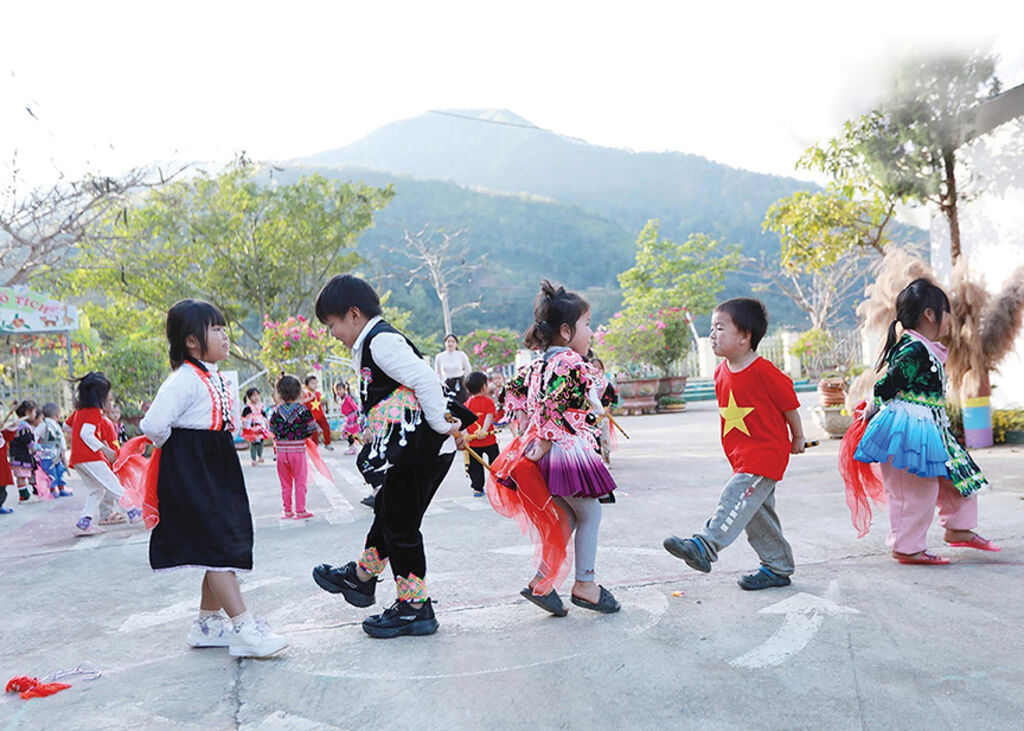 |
| Children at Trung Chai Kindergarten in Pa Tan commune, Lai Chau province, take part in outdoor activities__Photo: Quy Trung/VNA |
Introduction
In the context of globalisation and international integration, the assurance and protection of human rights have become an important measure of a country’s development. Children’s rights, as an integral part of human rights, require special priority and remain a major concern of both the international community and Vietnam. Studying the protection of children’s rights through Vietnam’s Constitutions is therefore important from theoretical, legal and practical perspectives.
From a theoretical perspective, children are not only subjects in need of protection and care but also holders of rights, including the rights to life and to comprehensive development. This approach has been widely recognised, particularly under the 1989 United Nations Convention on the Rights of the Child (CRC), which Vietnam was among the first countries to ratify[4]. The theory of children’s rights requires both the assurance of rights, through the creation of necessary political, economic, social and legal conditions, and the protection of rights, through legal measures and mechanisms to restore infringed rights and handle violations.
From a legal perspective, the Constitution, as the fundamental law with the highest legal validity, plays a foundational role in recognising and enforcing children’s rights. Vietnam’s constitutional history has seen positive developments in this field, from scattered provisions in the Constitutions of 1946, 1959, 1980 and 1992 to a separate article, Article 37, of the 2013 Constitution. However, gaps remain, including the absence of a clear constitutional recognition of the principle of “the best interests of the child” and of emerging rights in the digital era, such as protection in cyberspace and privacy over personal data.
From a practical perspective, rapid technological development has posed new risks for children, from online violence and abuse to the unlawful collection and exploitation of personal data. Although Vietnam’s legal framework has made considerable progress, enforcement remains limited and the gap between legal provisions and practice is still wide. This requires continued review and improvement of the constitutional framework to better protect children in the new era.
Development of Vietnam’s constitutional provisions on children’s rights
Vietnam’s constitutional thinking on children’s rights, as reflected in the Constitutions from 1946 to 2013, has made significant progress. It has evolved from viewing children as objects of the State’s protection to recognising the shared responsibility of the State, family and society in protecting children, and finally to affirming children as independent rights holders with the right to participate in child-related matters[5].
The 1946 Constitution, adopted soon after national independence, laid the foundation for Vietnam’s legal system on human rights and children’s rights. Although it did not use the term “children’s rights” in the modern sense, the 1946 Constitution reflected the humanitarian and deeply progressive thinking. Article 6 affirmed the right to equality and non-discrimination for all citizens, including children; Article 14 provided that children should receive care in education and upbringing; and Article 15 established compulsory and free primary education, recognising the right to education as a fundamental right of all children, regardless of economic conditions, ethnicity or background, and elevating education from a social policy to the highest responsibility of the newly established State.
The 1959 Constitution marked further progress by directly providing the protection of mothers and children for the first time. Article 24 stipulated: “The State protects the interests of mothers and children and ensures the development of maternity homes, nurseries and kindergartens.” With this provision, the scope of children’s rights was expanded from protection and education to healthcare, welfare and social security. However, the approach remained welfare-oriented, with children still viewed mainly as beneficiaries of the State’s assistance rather than rights holders in the full sense.
The 1980 Constitution reflected a significant change. Moving beyond the model of “the State’s protection”, it established a mechanism of shared responsibility among multiple actors, namely the State, society and family. Articles 64 and 65 affirmed the role of the family, the obligation of parents to raise and educate their children without discrimination, and the responsibility of the State and society to protect, care for and educate adolescents and children. Together with the 1979 Ordinance on Child Protection, Care and Education, these provisions created the first comprehensive legal framework for child protection, moving from a centralised model to one based on social coordination.
The 1992 Constitution, adopted after Vietnam ratified the CRC in 1990, reflected a clearer shift in the approach from “welfare” to “rights”[6]. It recognised education as both a right and an obligation of citizens, defined the responsibilities of multiple actors, expanded protection for vulnerable children and children in disadvantaged areas, and laid the legal foundation for internalising the CRC. This was followed by important laws, including the 1991 Law on Child Protection, Care and Education, the 1995 Civil Code, the 1994 Labour Code, the 1998 Education Law, and the 1999 Penal Code.
The 2013 Constitution marked a breakthrough in the constitutionalisation of children’s rights. Article 37.1 provides that children shall be protected, cared for and educated by the State, family and society; may participate in child-related issues; and shall be protected against harassment, persecution, maltreatment, abandonment, abuse, labour exploitation and other infringements of their rights. Compared with previous versions, the 2013 Constitution recognises children as rights holders, increases protection against harm, clarifies the responsibilities of the State, family and society, affirms children’s right to participation, and prohibits acts that infringe upon children’s rights.
Article 37 has provided important momentum for improving Vietnam’s legal framework on child protection, most notably through the 2016 Law on Children[7], which replaced the 2004 Law on Child Protection, Care and Education. Its principles have also been concretised in many legal documents, including the Penal Code, the Criminal Procedure Code, the Civil Code, the Labour Code, the Law on Marriage and Family, the Law on Drug Prevention and Control, the Law Against Human Trafficking, the Law on Handling of Administrative Violations, the Law on Medical Examination and Treatment, and the Law on Child Adoption.
However, the 2013 Constitution still has limitations. There remain no specific provisions on children’s important rights such as the right to protection in cyberspace, the right to privacy in the digital environment, and the rights of children with disabilities and ethnic minority children. The principle of “the best interests of the child” has not been established as a clear constitutional principle, and mechanisms for enforcement and monitoring remain absent. Further constitutional improvement is thus needed, especially in the digital era and amid current global challenges.
Challenges in protection of children’s rights in the new era
Challenges from cyberspace are among the most pressing issues in the protection of children’s rights. Today, children are exposed to the Internet and social media from an early age and face growing risks of online violence, harassment and cyberbullying. A reseach by the Education University, Vietnam National University, Hanoi, in 2019 showed that nearly 31 per cent of Vietnamese lower and upper secondary school students had been victims of cyberbullying, with serious effects on their psychological well-being, physical health and development. This reality requires adoption of specific legal provisions and strict sanctions to prevent and handle online harassment against children.
The protection of children’s privacy and personal data in cyberspace is also a serious concern, as children generate large amounts of digital data while studying and playing online. The popularity of IoT devices and smart toys further increases the risk of privacy infringements, including unauthorised audio or video recording without appropriate safeguards.
Risks from AI and new technologies are also becoming a worry in the protection of children’s rights. While AI, virtual reality (VR) and augmented reality (AR) create new opportunities, they also pose unprecedented legal risks. AI may be misused to monitor, influence or manipulate children’s behaviour through recommendation algorithms and targeted advertising, while algorithms may increase children’s exposure to harmful content.
VR and AR can also blur the boundary between the real and virtual worlds, posing risks of violence or sexual harassment in virtual spaces that the law has yet to clearly define. As current regulations barely address child protection in the context of AI, VR and AR, it is necessary to clarify the responsibilities of technology developers and service providers, ensuring that new systems are designed and operated in the best interests of children.
The growing practice of “sharenting” on social media platforms also raises serious concerns for children’s privacy. By sharing excessive information and images of their children online, parents may unintentionally create a “digital footprint” that children cannot control, exposing them to risks such as identity theft or misuse of sensitive images later in life.
In Vietnam, sharenting has not yet been regulated by law. This gap requires further study, including whether children’s rights over personal information shared by their parents should be recognised and what responsibilities parents should bear when posting images of their children online. Raising public awareness, especially among parents, is therefore essential to better protect children’s privacy in cyberspace.
Vietnam’s lack of an independent constitutional protection mechanism also creates a gap in the guarantee of constitutional rights, including children’s rights. The current mechanism, under which the National Assembly and its bodies exercise supreme oversight, has revealed shortcomings. As the Constitution has the highest legal validity, assigning the legislature to monitor the constitutionality of the laws it promulgates creates an inherent contradiction and undermines objectivity[8]. This results in the lack of a supreme legal protection mechanism for constitutional rights, including children’s rights, when they are infringed upon by legal documents themselves.
Finally, child protection measures must be balanced against children’s different rights. Excessive protection measures might restrict children’s right to freedom of expression, right to access to information and right to participation[9]. Measures such as online content control may be necessary to reduce internet-related risks, but they can also limit children’s freedom to seek and receive information and express their views. Hence, clear mechanisms are necessary to resolve such conflicts and ensure that children can participate in making decision concerning their own protection.
Proposals for improving constitutional provisions on protection of children’s rights
The key solution is to constitutionalise the principle of “the best interests of the child”, elevating it from a statutory principle to a supreme constitutional guideline. As one of the pillars of the CRC and a legal standard recognised in many countries, the incorporation of this principle in the Constitution would have important legal effects.
First, it would help concretise the Party’s guideline on “placing children at the centre of all development policies”, as set out in Politburo Directive 28-CT/TW dated December 25, 2023, on strengthening child care, education and protection to meet the requirements of developing a prosperous and happy country. Once the principle of “the best interests of the child” is constitutionalised, legislative, executive and judicial bodies would be required to give top priority to children’s interests when issuing and implementing policies.
Second, it would serve as a supreme interpretative principle, guiding courts and state agencies to interpret and apply the law in the manner most beneficial to children, especially in cases of conflicting interests.
Third, the inclusion of this principle in the Constitution would affirm Vietnam’s strong political and legal commitment to the international community, turning the protection of children’s rights from a social moral responsibility into a mandatory constitutional obligation.
Another necessary step is to expand the scope of children’s rights recognised by the Constitution to reflect the realities of the digital era. Although the 2013 Constitution marked clear progress, it mainly refers to traditional rights, such as protection, care and education. This is deemed insufficient as children interact more deeply with the digital environment. Constitutionalising children’s digital rights would help safeguard their fundamental rights online at the highest level. Rights that should be taken into account include equal, safe and non-discriminatory access to digital technology; protection in cyberspace, including from emerging forms of harassment involving digital technology and AI; and protection of personal data security.
To realise these orientations, Article 37 of the 2013 Constitution should be revised to set out the foundational principles for specialised laws to further concretise. The proposed amendments are listed below.
“1. Children shall be protected, cared for and educated by the State, family and society, and shall be guaranteed for participation in children-related matters. All decisions concerning children must place the best interests of the child first.
2. The State shall guarantee children’s equal, safe and non-discriminatory access to digital technology. All acts of infringement, torture, maltreatment, abandonment, abuse, exploitation; violation of privacy, personal secrets, family secrets and data security of children are prohibited.”
Building a constitutional mechanism to secure the enforcement of children’s rights is also essential. Resolution 27-NQ/TW dated November 9, 2022, of the Party Central Committee, on continuing to build and improve the socialist law-ruled State of Vietnam in the new period frankly identified one of the core limitations of the current political system: “State power has not been effectively controlled, and the power control mechanism remains incomplete.”
The resolution also sets the overall objective of “upholding the Constitution and law, and respecting, ensuring and effectively protecting human rights and citizens’ rights”. These strategic orientations create an urgent requirement and a firm political basis for studying the establishment of an independent and specialised constitutional body to protect the Constitution. Such a body would be a prerequisite for ensuring that constitutionalised rights, including children’s rights, are effectively guaranteed and protected in practice.
International experience shows that independent constitutional review is a key feature of modern law-ruled states, helping control public power and protect fundamental human rights. Four basic models may be identified: the specialised-body model, or European-style constitutional review; the judicial empowerment model, or American-style constitutional review; the decentralised model, common in socialist countries; and the mixed European-American model[10]. For Vietnam, however, most of these models appear unsuitable or reveal significant limitations.
The American-style model, which empowers the entire court system, would be difficult to apply in Vietnam. Its success is closely linked to the common law tradition and the principle of stare decisis, while Vietnam follows the civil law tradition, where precedents have just been recognised since 2015 and remain mainly supplementary. Granting such power to thousands of judges could therefore lead to inconsistency in constitutional interpretation and instability in the legal system[11].
The French-style Constitutional Council model is not optimal either, as its main function is preventive: reviewing the constitutionality of draft laws before promulgation. It does not adequately address constitutional violations that have occurred, while Vietnam needs a mechanism capable of handling violations in legislation, administration and adjudication[12].
Nor would the socialist-style decentralised model, currently applied in Vietnam through oversight by legislative bodies, resolve existing shortcomings. Continuing with this model would neither overcome the contradiction of “being the judge in one’s own case” nor create an independent and objective mechanism for controlling power, as required in the process of building a law-ruled state.
Given the limitations of the above models, a centralised constitutional adjudication model, in the form of a European-style constitutional court, appears to be the most suitable option for Vietnam. This model has proven effective in many civil-law countries and has become a common trend among new democracies[13]. The independence of such a court would not mean a complete separation, but rather a position, authority and operational mechanism sufficient for it to perform its control function within the overall framework of assignment, coordination and control of unified state power. On that basis, improving Vietnam’s Constitution towards the establishment of a constitutional court is necessary.
For this reason, the Constitution should add an article, or a separate section, defining the position of the constitutional court as the supreme constitutional adjudication body; the principle of its independence when exercising constitutional authority; and its jurisdiction, including the power to rule on the constitutionality of legal documents and to interpret the Constitution.
Conclusion
Vietnam’s Constitutions have progressively strengthened the recognition and protection of children’s rights, moving from a protection-oriented approach to the affirmation of children as rights holders. However, the digital era has posed emerging risks that current constitutional provisions do not yet fully address. Further reform is consequently needed to constitutionalise the principle of “the best interests of the child”, expand the scope of children’s rights in the digital environment and establish more effective protection mechanisms, so that children’s rights are not only recognised in law but also protected in practice.-
[1] The Vietnamese version of this article was published on the Vietnamese Journal of Legal Studies, No. 2/2026
[2] Doctoral candidate, Cohort 28, Hanoi Law University, email: congnv.it@mod.gov.vn
[3] Associate Professor, Doctor, Hanoi Law University, email: tovanhoa@hlu.edu.vn
[4] Nguyen Dang Dung, Vu Cong Giao, La Khanh Tung (2011), Textbook on Theory and Law on Human Rights, Faculty of Law - Vietnam National University, Hanoi, Vietnam National University Press, Hanoi, pp. 253-257.
[5] Article 14 of the 1946 Constitution, Article 24 of the 1959 Constitution, Articles 64 and 65 of the 1980 Constitution, Article 59 of the 1992 Constitution, and Article 37.1 of the 2013 Constitution.
[6] La Van Bang (2019), Thuc hien phap luat ve bao ve tre em o Viet Nam hien nay (Implementation of the law on child protection in Vietnam today), doctoral dissertation in law, Ho Chi Minh National Academy of Politics, Hanoi, pp. 85.
[7] Under the 2016 Law on Children, children have 25 rights according to the CRC (an increase of 15 rights compared to the 2004 version). The law also provides 15 groups of prohibited acts of infringing upon children’s rights and specifies measures to protect children.
[8] Nguyen Dang Dung (2013), “Vi pham Hien phap va cac loai hinh vi pham Hien phap”, Cac thiet che hien dinh doc lap: Kinh nghiem quoc te va trien vong o Viet Nam (“Constitutional violations and types of constitutional violations”, Independent constitutional institutions: international experience and prospects in Vietnam), Dao Tri Uc, Nguyen Thi Mo, Nguyen Van Thuan and Vu Cong Giao (chief editor), Vietnam National University Press, Hanoi, pp. 231.
[9] Livingstone, Sonia and Third, Amanda (2017), “Children and young people’s rights in the digital age: an emerging agenda”, New Media & Society, Volume 19, Issue 5, pp. 657-670.
[10] Vu Hong Anh (2013), “Cac mo hinh bao ve Hien phap tren the gioi va bai hoc kinh nghiem cho viec xay dung mo hinh bao ve Hien phap cua Viet Nam”,n Cac thiet che hien dinh doc lap: Kinh nghiem quoc te va trien vong o Viet Nam (“Models of constitutional protection in the world and lessons for building a constitutional protection model in Vietnam”, Independent constitutional institutions: international experience and prospects in Vietnam), Dao Tri Uc, Nguyen Thi Mo, Nguyen Van Thuan and Vu Cong Giao (chief editor), Vietnam National University Press, Hanoi, pp. 242-253.
[11] Vo Tri Hao (2013), “Lua chon mo hinh tai phan Hien phap cho Viet Nam va binh luan ve mo hinh Hoi dong Hien phap trong Du thao Hien phap 1992 sua doi nam 2013”, Cac thiet che hien dinh doc lap: Kinh nghiem quoc te va trien vong o Viet Nam (“Choosing a constitutional adjudication model for Vietnam and comments on the Constitutional Council model in the draft amendments to the 1992 Constitution, revised in 2013”, Independent constitutional institutions: international experience and prospects in Vietnam), Dao Tri Uc, Nguyen Thi Mo, Nguyen Van Thuan and Vu Cong Giao (chief editor), Vietnam National University Press, Hanoi, pp. 272-275.
[12] Vu Cong Giao (2013), “Co quan bao hien tren the gioi va viec hien dinh co quan nay trong Hien phap 1992, sua doi nam 2013”, Cac thiet che hien dinh doc lap: Kinh nghiem quoc te va trien vong o Viet Nam (“Constitutional review bodies in the world and their constitutionalisation in the 1992 Constitution, revised in 2013”, Independent constitutional institutions: international experience and prospects in Vietnam), Dao Tri Uc, Nguyen Thi Mo, Nguyen Van Thuan and Vu Cong Giao (chief editor), Vietnam National University Press, Hanoi, p. 270.
[13] Vu Cong Giao (2013), ibid., pp. 269-270.