 |
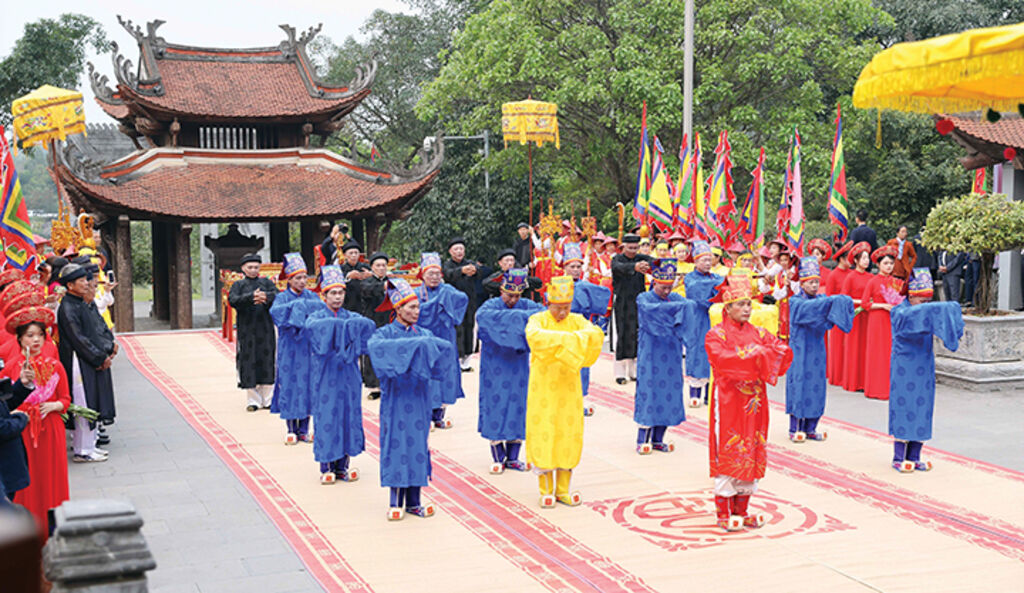
| Performing traditional ritual ceremonies at the Temple of Lac Long Quan - the Nation’s Ancestor__Photo: Ta Toan/VNA |
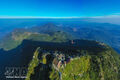
Hung Kings Temple is the common name for a historical complex of temples and pagodas dedicated to the Hung Kings and the royal family, located on Nghia Linh mountain, now in Hy Cuong commune, Phu Tho province.
The Hung Kings refer to the 18 generations of rulers of the Van Lang State, the first state of the Lac Viet people, considered the ancestors of the Vietnamese, which existed from around the 7th to the 2nd century BCE. Legend has it that they were the descendants of Lac Long Quan and Au Co, who laid the foundation for the establishment of the nation.
In the old times, this land was the capital of the Van Lang State, known as Phong Chau. Surrounded by rivers, layered mountain ranges and fertile land, it offered favourable conditions for both livelihood and defence.
For thousands of years, Hung Kings Temple has been a sacred symbol closely tied to the spiritual life of the Vietnamese people. The Hung Kings’ Commemoration Day, held annually on the 10th day of the third lunar month, has become ingrained in the mind of every Vietnamese, as reflected in the folk verse: “Whoever goes back and forth, remember the ancestors’ commemoration of the tenth of the third lunar month”.
In 2009, the site was recognised as a special national relic for its outstanding historical and cultural values under Prime Minister Decision 1272/QD-TTg.
Main architectures of the Hung Kings Temple
According to the historical documents, the Hung Kings Temple complex began to be constructed during the reign of Emperor Dinh Tien Hoang (968-979). Later, around the 15th century under the Later Le Dynasty, the entire complex was completed in a form largely similar to what exists today.
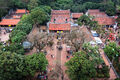
The Hung Kings Temple complex covers a total area of 845 hectares, comprising four main temples, namely Ha (Lower) temple, Trung (Middle) temple, Thuong (Upper) temple, and Gieng (Well) temple, along with a pagoda and a mausoleum, as well as other numerous architectural structures. They are distributed from the foot to the top of the mountain, harmoniously integrated with the majestic natural landscape. Over time, many sites within the complex have been restored and expanded, yet they still retain their ancient and solemn character.
Ha temple
The temple is dedicated to the 18 generations of the Hung Kings, with three ancestral tablets placed in the sanctuary.
It is closely linked to the legendary origin of the Vietnamese people. According to legend, Mother Au Co gave birth to a sac of one hundred eggs, from which one hundred children were born. The Vietnamese term “dong bao” (compatriots) originates from this story, where “dong” means “same” and “bao” means “sac.” Behind the temple remains the “dragon eye well”, believed to be the place where Au Co incubated the eggs.
Ha temple was constructed between the 17th and 18th centuries on an earlier foundation. Its architecture follows the shape of the Chinese character “Nhi” (二), consisting of two buildings, the front hall and the sanctuary, each with three compartments. The design is relatively simple, with minimal decorative details.
At the foot of the temple stands a hexagonal stele house with six roofs. Inside is a stone stele inscribed with President Ho Chi Minh’s famous words during his visit to the Hung Kings Temple in 1945: “The Hung Kings built the nation, we must work together to protect it”.
Adjacent to Ha temple is Thien Quang pagoda that follows the Mahayana Buddhism. In the front are two four-tiered cylindrical stupas, worshipping venerable monks who practiced and passed away there. There is a bell tower within the pagoda, with the bell believed to have been cast during the Later Le dynasty.
Trung temple
Also known as Hung Kings’ ancestral temple, the temple is believed to be where the Hung Kings enjoyed the sceneries and discussed state affairs with their officials.
The temple is also associated with the legend of the sixth Hung King selecting his successor. Instead of passing the throne to his eldest son, he organised a contest. Prince Lang Lieu, the youngest son, created two traditional rice cakes: banh chung, square-shaped to symbolise the Earth, and banh day, round to represent the Sky. Impressed by their meaning and simplicity, the King chose Prince Lang Lieu as his successor, and he later became the seventh Hung King.
The temple was constructed according to the shape of the Chinese character “Nhat” (一), consisting of three compartments. It has three front doors facing south. The structure measures approximately 7.2 metres in length and 3.7 metres in width, with a front roof height of 1.8 metres.
Thuong temple
This is the highest structure in the Hung Kings Temple complex, located at the top of the mountain. It is also known as “Kinh Thien Linh Dien” (Palace for worshipping Heaven) or “Cuu Trung Thien Dien” (Palace among nine layers of clouds).
It is said that there was the place where the Hung Kings performed rituals to Heaven, Earth and the Rice God, praying for favourable weather, abundant harvests, and national prosperity. The temple follows the architectural layout of the Chinese character “Vuong” (王) and features simple decoration. It consists of four levels, including the bell house and drum house, the main ceremonial hall, the front offering hall, and the sanctuary.
To the east of the temple lies the Hung King Mausoleum, situated in a position described as “backed by mountains and facing water,” oriented towards the southeast. It is believed to be the tomb of the sixth Hung King.
Gieng temple
The temple worships Princesses Tien Dung and Ngoc Hoa, daughters of the 18th Hung King, who made great contributions in teaching people wet rice cultivation and water management.
The temple was built in the 18th century with the architectural layout of Chinese character “Cong” (工). It faces southeast and consists of three main structures, including the front hall, the sanctuary and a connecting corridor, as well as two other auxiliary buildings.
Within the historical complex of Hung Kings Temple, several other notable sites are present, including the temple of Mother Au Co, which houses statues of Mother Au Co alongside civil and military mandarins, and the temple of Lac Long Quan, which features a bronze statue of Lac Long Quan set on a stone-carved pedestal with an incense burner in front.
The site is also home to the Hung Kings Museum, which features thematic exhibitions on the Hung Kings era. The artifacts displayed in the museum provide valuable insights into the formation, establishment and development of the Van Lang State during the time of the Hung Kings.
Hung Kings Temple festival
The Hung Kings Temple festival is recognised as one of the national ancestral commemoration days of Vietnam. Since 2007, the Hung Kings’ Commemoration Day has been an official public holiday.
In years marking semi-decennial or decennial milestones, the festival is organised on a national scale. For other years, it is hosted by Phu Tho province.
The main activities of the Hung Kings Temple festival consist of two parts: the ceremonial part and the festive part.
The ceremonial part includes the palanquin procession and the incense offering ceremony at Thuong temple. These two rituals are conducted simultaneously on the main festival day, the 10th day of the third lunar month.
The festive part features many interesting and unique folk games and cultural activities that aim to preserve and honor the long-standing traditional values of the nation such as Xoan singing - a traditional folk singing style of Phu Tho, wrestling, tug of war, boat racing, etc.
The festival is one of the largest national festivals in Vietnam. Notably, in 2012, the worship of the Hung Kings has been recognised by UNESCO as an intangible cultural heritage of humanity.- (VLLF)