 |
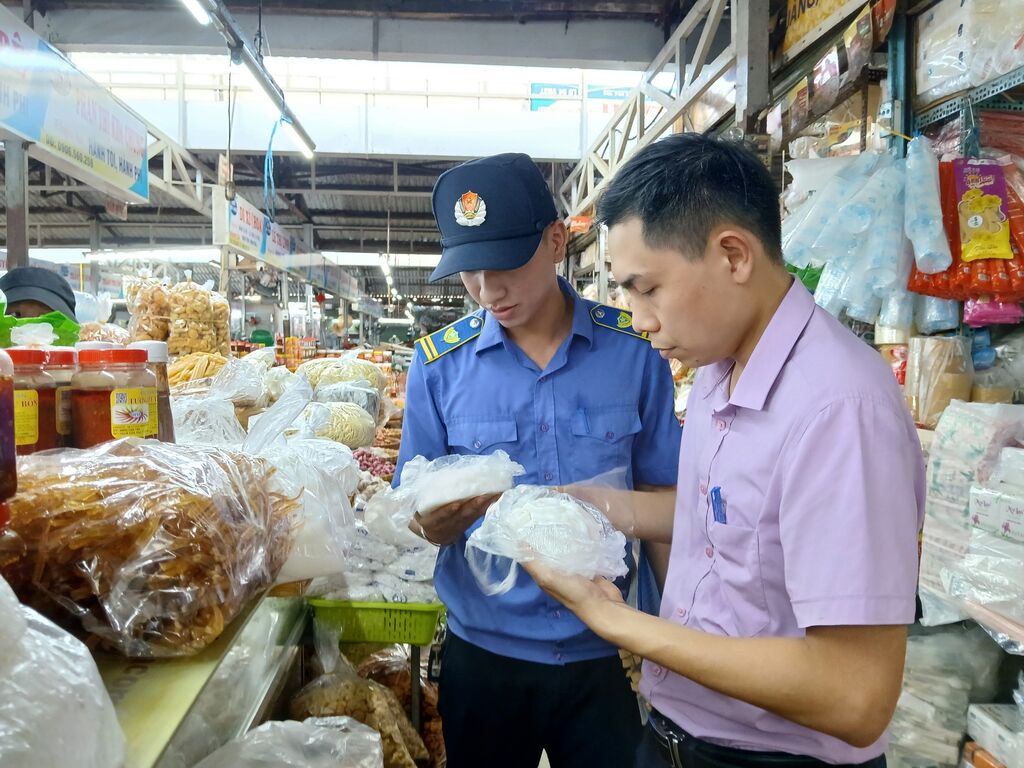
| The food safety team of the Con Market Surveillance Board in Da Nang city inspects rice vermicelli, noodles and steamed rice rolls for sale at the market__Photo: My Ha/VNA |
The Ministry of Health (MOH) is working to revise the 2010 Law on Food Safety towards comprehensive control of the entire food supply chain, from input materials, production and processing to distribution and final delivery to consumers.
For the first time, the principle of “value chain-based management” is brought into law. Instead of each ministry overseeing a specific product group or a separate stage as currently provided, the proposed revision would introduce a seamless control model in the entire food production and trading process.
According to the MOH, this approach would enable management agencies to monitor food products through their entire life cycle and early detect risks, rather than mainly taking action after food safety violations or food poisoning incidents occur.
With the aim of controlling counterfeit goods, smuggled products and food products sold in cyberspace, the MOH proposes a mandatory traceability requirement for such goods and products on the market. Traceability information would have to be displayed on product packages in the form of barcodes, QR codes, DataMatrix codes or other electronic formats, enabling both consumers and regulators to verify product origins.
Under the draft, consumers would be entitled to request traceability information if they suspect that a product is not up to food safety standards. Businesses, in turn, would have to identify the batch concerned, report the quantity in circulation and prepare a recall plan if risks are detected.
Regarding post-market inspection, the MOH proposes a risk analysis-based management approach. Accordingly, management authorities would carry out investigations and testing to identify potentially harmful biological and chemical agents, assess the likelihood of risks, and devise control measures at each stage of the supply chain.
Compared with the current mechanism, which mainly relies on inspections and sanctions after violations have occurred, the new approach places greater emphasis on early risk prevention and prioritises inspections of high-risk product groups and producers instead of broad-based inspections.
For imported food products, the draft requires importers to register product declarations or declare applicable standards before importation, and to obtain confirmation of compliance for each import batch, except cases exempt from inspection.
The draft also proposes establishing a national food safety database and warning system to collect data for monitoring, issuance of early alerts on food safety risks, and performance of traceability of food origin upon the occurrence of food poisoning incidents.
In the e-commerce sector, the draft requires businesses selling food via digital platforms to disclose product declaration forms and food safety eligibility certificates. They would also have to follow rules on the confidentiality of buyer information.
Unified food safety management from central to local levels
In a move to ensure effective food safety governance, the MOH has proposed a draft scheme to restructure the state management apparatus in charge of food safety, aiming to streamline the organisational model across all administrative levels.
At the central level, the Vietnam Food Administration would remain under the MOH, assuming functions and duties, and taking over personnel and facilities for food safety management in the stage following the primary production phase of the food supply chain from related units under the Ministry of Industry and Trade and the Ministry of Agriculture and Environment.
At the provincial level, Food Safety Departments would be established on the basis of existing units in the health sector currently serving as focal points for food safety management. They would take over food safety-related functions, tasks, personnel and facilities from relevant units under provincial-level Departments of Industry and Trade and Departments of Agriculture and Environment.
Meanwhile, at the commune level, Food Safety Teams would be formed to operate as public non-business units under commune-level People’s Committees. With their own seals, accounts and specialised vehicles, these teams would serve as frontline enforcement bodies responsible for inspection, supervision, and handling of food safety violations.- (VLLF)