 |
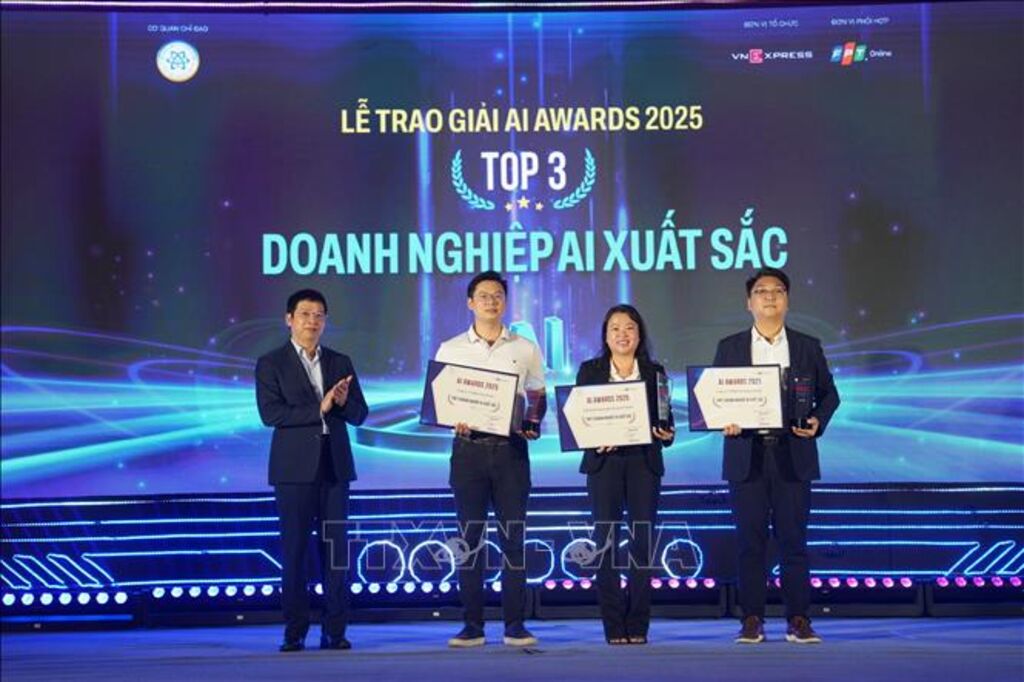
| Top 3 outstanding AI enterprises honored__Photo: Thu Phuong/VNA |
By 2030, Vietnam plans to create six strategic technological products - large language models (LLMs) and Vietnamese virtual assistants, edge artificial intelligence (AI) cameras, autonomous mobile robots, 5G mobile network infrastructure, blockchain layers for traceability and crypto-assets and unmanned aerial vehicles.
Core objectives & technological mastery
Under the program for the development of strategic technology products prioritized for rapid deployment approved by the Prime Minister under Decision 2815/QD-TTg, the nation will research, develop and master core and strategic technologies to create strategic technological products with high localization rates and added value which are capable of replacing imports and for export.
Support will be provided for the formation of several strategic industrial sectors that have global competitiveness, making significant contributions to the national economic growth and assurance of national defense and security and national technological autonomy.
Specifically, the program focuses on mastering the end-to-end lifecycle of these products from engineering and manufacturing to testing and integration. The country will also prioritize R&D for core technologies and high-value-added modules to enhance its position in the global value chains. It will develop products as import substitutes, aiming to occupy at least 30 percent of the domestic market while expanding their export markets.
The program will also provide support to at least 30 enterprises and 10 research institutes/universities to participate in the research and development of globally competitive core technologies and strategic technological products; the development of 100 aligned enterprises that provide equipment and services for the development of strategic technological products; and the formation of at least three strategic industrial sectors.
Key evaluation criteria
To meet the established evaluation criteria, the nation plans to achieve a domestic value-added rate of at least 60 percent of selling prices and 40 percent of total production costs. At the same time, the country aims to master at least 80 percent of the core technologies within its strategic technological products.
The country will publish all research project outcomes in scientific journals accredited by the State Council for Professorship with at least 60 percent of these research projects obtaining formal acceptance for intellectual property protection.
At least 80 percent of research outcomes will be directly integrated into production and business operations or successfully commercialized and at least 10 percent of research projects involving dual-use technologies and products will demonstrate practical applications in both civil and national defense and security sectors.
Key tasks and solutions
To realize the aforementioned objectives, the program set forth six key groups of tasks and solutions, including improving mechanisms and policies; supporting research, development and capacity building; promoting innovation and market development; developing human resources; strengthening international cooperation, and enhancing awareness and program management efficiency.
Regarding human resources development, the program will organize the selection and appointment of chief engineers and chief architects to lead the strategic technological product development tasks.
The nation will implement a regulatory sandbox to attract outstanding foreign scientists and overseas Vietnamese experts to work at higher education institutions, thereby accelerating the research, development, application and transfer of strategic technologies.
In terms of international cooperation in science, technology and innovation, projects in the fields will be implemented within both bilateral and multilateral frameworks. The nation will facilitate the exchange of experts and researchers with international organizations, inviting foreign specialists and overseas Vietnamese experts to provide consultancy, lead research subjects and engage in high-level teaching tasks under the program.
Expenses for the implementation of the program come from the state budget, specifically 15 percent of state budget expenditures for science and strategic technology research. Additionally, the program will mobilize resources from enterprises, the private sector and other lawful funding sources.- (VLLF)