 |
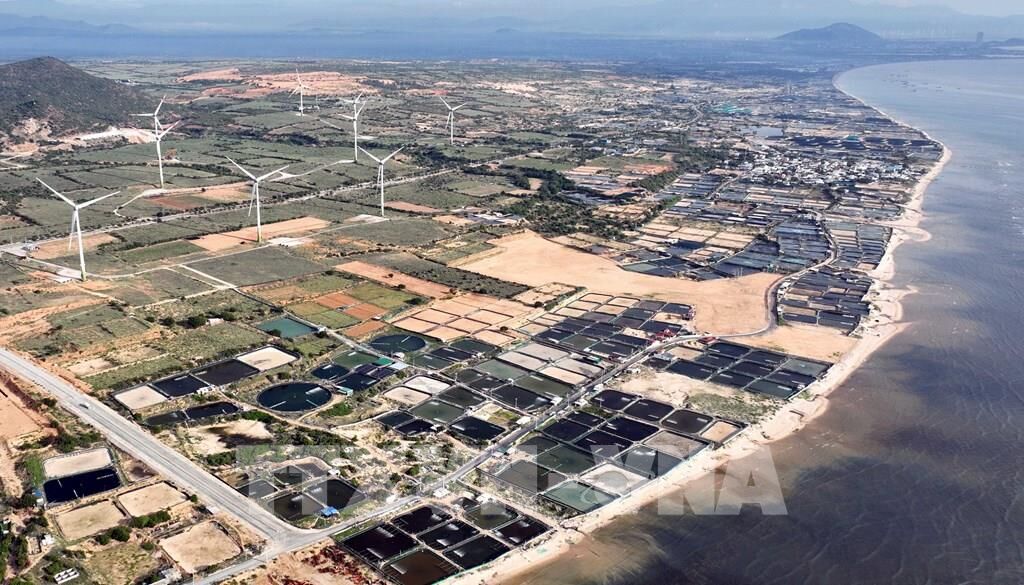
| Area for the construction of Ninh Thuan 1 nuclear power plant in Phuoc Dinh commune, Khanh Hoa province__Photo: Tuan Anh/VNA |
The Government has introduced principles for designing nuclear power plants and research nuclear reactors in its newly-issued decree that will take effect on January 1, 2026.
Decree 316/2025/ND-CP dated December 10, 2025, detailing a number of articles of, and measures to implement, the 2025 Law on Atomic Energy concerning nuclear power plants and research nuclear reactors, consists of 74 articles, and sets out safety and security requirements for nuclear power plants and research nuclear reactors, investment policy for investment projects on construction of nuclear power plants, sites for construction of nuclear power plants, designing and construction of nuclear power plants, trial operation of nuclear power units, operation of nuclear power plants, and decommissioning of nuclear power plants.
The Decree provides regulations on radiation safety, nuclear safety and nuclear security throughout the entire lifecycle of nuclear power plants and research nuclear reactors. It applies to domestic and foreign organizations and individuals, overseas Vietnamese and international organizations involved in activities related to nuclear power plants and research nuclear reactors in Vietnam’s territory.
Regarding general requirements for designing of nuclear power plants and research nuclear reactors, the Decree requires the designing to facilitate the performance of fundamental safety functions, including the control of nuclear chain reactions, heat removal from the reactor’s active zone and spent nuclear fuel storage areas, and the prevention of radioactive releases.
The designing of nuclear power plants must be based on deterministic safety analysis and probabilistic safety analysis in order to prevent incidents and mitigate consequences. For research nuclear reactors, the designing must be based on deterministic safety analysis and probabilistic safety analysis (if applicable) using a graded approach, and ensure the control of radioactive releases into the environment, and keep the volume of radioactive waste generated directly from the operation of nuclear power plants or research nuclear reactors within the prescribed limits.
The designing must also anticipate the decommissioning with plans on dismantlement, treatment of radioactive waste, and environmental rehabilitation, thereby minimizing the volume of radioactive waste generated during the dismantlement process and facilitating nuclear safeguards.
With respect to principles for assurance of radiation safety and nuclear safety, the designing must adhere to the following key principles: (i) the defense-in-depth principle, (ii) integrated passive and active safety features; (iii) principles of independence, redundancy and diversity, ensuring self-protection capabilities, post-incident recoverability and the limitation of common-cause failures; (iv) accessibility and facilitation for calibration, testing, maintenance, repair, replacement and inspection to monitor functional capabilities and maintain the integrity of critical safety items; and (v) anticipation of potential internal and external hazards to nuclear power plants or research nuclear reactors, including hazards directly or indirectly caused by humans.- (VLLF)